Subscriptions Central AfricaEast AfricaHorn of AfricaIndian OceanNorth AfricaSouthern AfricaWest AfricaAfrica / World Agriculture - NutritionCulture - ArtsEconomy - DevelopmentEnvironment - NatureGay - LesbianGender - WomenHealthHuman rightsLabourMediaPoliticsScience - EducationSocietyTechnologyTravel - Leisure From Behind By Country By Topic Chronological Press Releases Partner Media Contact Us


See also:
» 26.10.2009 - Report outlines ways to help developing nations transition to ‘green’ economy
» 20.10.2009 - DRC and Morocco elected to new forest financing programme
» 19.10.2009 - Africa's climate change negotiators meet in Ethiopia
» 19.10.2009 - African countries conclude gender and climate change training
» 15.10.2009 - Kibaki appeals for unity ahead of global summit
» 13.10.2009 - Conservation expert calls for protection of Africa's forest gardeners
» 30.09.2009 - Climate change could induce more food dependency on Africa, FAO paper
» 22.09.2009 - Ban calls for global collective action on climate change

Africa | World
Environment - Nature | Science - Education

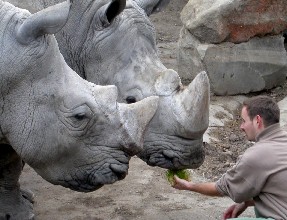
First-ever rhino artificially inseminated

Lulu (behind) and Easyboy being fed at Berlin Zoo

Lulu (behind) and Easyboy being fed at Berlin Zoo

© afrol News / Victor Molnar
afrol News, 5 October
- For the first time, a successful pregancy after artificial insemination of a rhinoceros cow has been achieved in a Berlin zoo. The assumed virgin, 24-year-old Lulu, is five months pregnant and gives new hope for the possible rescue of the northern black rhino, a sub-species of which only 32 animals remain alive.

Lulu herself is a southern black rhino that was brought up in captivity. Her sub-species is no longer threatened with extinction after decades of protection and breeding efforts by authorities in Southern African nations. During the last decade, these efforts brought the southern black rhino population up from around hundred animals to a current level of 11,000 rhinos, prompting the resumption of a limited rhino hunt in Southern Africa this week.

Nevertheless, researcher Robert Hermes from the Berlin-based Leibniz Institute for Zoo and Wildlife Research (IZW) says the successful artificial insemination of Lulu marks a great advance in the rhino's survival chances. Contrary to other rhino species, the northern and southern black rhinos barely reproduce in captivity, complicating breeding efforts.

Lulu of the Berlin Zoo shared the same fate. The rhino cow had never been bulled even if she has been living together with the future father of her calf, 25-year-old Easyboy. "We assume that they have grown up as sister and brother even if they are not related," said Dr Hermes. The German researchers found that Lulu's hymen still was intact.

This mating abstinence has severe consequences for the female rhinos. If they are never bulled, the uterus degenerate, cysts start appearing and the menopause starts years before it normally should. Lulu was sent to a gynaecologist who concluded that the cow had started on this negative spiral, but still gave her another three to four years to be able to get pregnant.

According to Mr Hermes, the biological clock however has expired for many of the threatened northern black rhinos in captivity. 22 animals still live in the wild in northern Congo Kinshasa at the Sudanese border. Ten live in captivity and four of these six females have entered the menopause. "There is nothing more to do with those," says Mr Hermes. "These cows have been lost for the reproduction of the species."

The encouraging results with Lulu in the Berlin Zoo however give some hope for the two remaining fertile cows in captivity. The German scientists have eyed Najin - a fertile northern black rhino cow in the Czech zoo
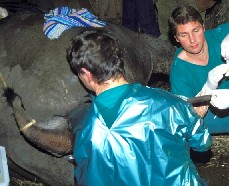
Insemination atempt of a rhino cow in Berlin

Insemination atempt of a rhino cow in Berlin

© afrol News / IZW
of Dvur Kralové - for their next artificial insemination project.

Najin four years ago even managed to give birth to a rhino calf under natural circumstances. Since that, however, the Czech rhino is not getting pregnant and she is threatened with the same fate as her sisters in captivity if not a successful artificial insemination takes place within short time.

According to the German researchers, the survival of the northern black rhino sub-species is still possible if large efforts are made. "Also the southern black once were close to extinction," says Mr Hermes. With support from the International Rhino Foundation and the organisation SOS Rhino, the research team now hopes to embark on a new breeding programme for the northern sub-species.

While Lulu so far seems to be a success story, the artificial insemination of a rhino cow however turned out a complicated affair. Standard fertilising equipments that are used for big animals proved useless as the female genital is extremely deep; up to one and a half meter. In addition, the rhinos' cervix is "very firm and strongly folded," complicating the injection of rhino semen into the cow.

- In addition, rhinos are very dangerous, the German researchers noted. All investigations into the cows' fertility, such as ultrasound scanning, had to be executed in total narcosis. A special anaesthesia protocol had to be developed by a researcher team at the Austrian Salzburg Zoo and drugs about 5000 times stronger than those used on humans were injected to the rhino.

Lulu nevertheless has survived the special treatment and is now in the fifth month of her pregnancy. She is currently taken care of by veterinaries at the zoo in Budapest, Hungary. "We are confident that she will give birth to a healthy calf in August next year," commented Dr Hermes.

This is already the 20th attempt of artificial insemination of 11 southern black rhino cows living in captivity worldwide. All have failed before Lulu's seemingly successful pregnancy. "Three times before, we achieved pregnancy, but they only lasted a couple of weeks," says Dr Hermes. With Lulu, this is the second attempt.


    E-mail this to a friend     Printable version

Related pages and feature
Current afrol News Top Stories
Africa
World
Environment - Nature
Science - Education
Conservation
Natural sciences
Science
Wildlife
» China to cement new role in Africa
» Zimbabwe crisis solved, for now
» Equatorial Guinea polls begin, with little hope of change
» "Uganda AIDS prevention threatened"
» São Tomé to establish state oil company
» It's confirmed: New ocean to split Ethiopia
» South African mortality crisis overcome
» "Send Central African leaders to ICC"
» Dengue epidemic paralyses Cape Verde
» Algeria "not affected by global crisis"


top of page about afrol News | news | countries | archive | services | feed back | español 

© afrol News. Reproducing or buying afrol News' articles.

   You can contact us at mail@afrol.com