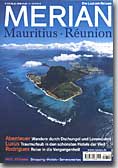
afrol News, 10 November - The twin Indian Ocean islands Mauritius and Réunion have achieved an extraordinary tourism marketing success in Germany, Europe's biggest market. Pictured the "Gardens of Eden", the two islands are currently featured in every newsstand, promising a giant "rediscovery" of these two destinations.
As Europeans get tired of their Mediterranean heavens, plagued with mass tourism, more exotic destinations, which however need a well developed infrastructure, are getting trendy. The Caribbean and South East Asia have already profited from this trend. Currently, Indian Ocean luxury pearls such as the Seychelles, Maldives, Mauritius and Réunion are following.
The German journal 'Merian' is known as an accurate reader of the tourism market, which is necessary when producing a hybrid between a travel journal and a travel guide, always dedicated to one single destination. Most journals featuring African countries so far thus only have covered the well-known and ever-popular North African destinations, such as Egypt.
Its latest issue, however, is solely dedicated to the island state Mauritius and the neighbour Île de la Réunion, a French Département, two destinations with luxury sanctuaries that mostly known to wealthy Frenchmen. The delicately illustrated 'Merian' journal will go a long way in presenting the two islands to a "new" market of more than 100 million German speakers in Germany, Austria and Switzerland.
Mauritian journalist Jean-Claude Antoine, normally writing for the local journal 'Week End', is given free hands to describe the advantages of his home island and why he is so proud to be Mauritian. Wherever he goes abroad, people great him: "You are from Mauritius! From Paradise!" Mr Antoine tells the German readership.
The Mauritian journalist - who sometimes seems to be on the pay roll of his country's tourism authorities - presents a stylised version of Mauritius' multi-ethnic history, concluding with the exemplary co-existence of races and cultures in this isolated society. Multi-ethnicity, he explains, is an immense resource to both Mauritians and tourists as it has resulted in a rich cultural life.
Only a few decades ago, nobody had ever heard about Mauritius, Mr Antoine further tells from his visits abroad. He always had to bring a map, pointing at this small dot in the Indian Ocean, east of Madagascar, and explain that this dot indeed represented an island state, independent since 1968.
Three decades later, the Mauritian tourism authorities can be proud of their marketing efforts, Mauritius being vaguely known as a paradise on earth in most tourism markets. A tourism boom has already set in on the island, its smooth, tropical beaches being slowly filled with upper-class resorts. Until now, however, German speakers have made up a small minority of arrivals.
Neighbouring Réunion doesn't get a worse treatment in the latest issue of 'Merian'. Among others, Belgian journalist Ignace de Witte - resident of the island since 1989 - doesn't get tired of the word "paradise" when describing the French département. Also here - non-regarding the troublesome historic mass use of slave labour and persisting enormous social differences - a culturally rich, multi-ethnic culture had grown into a resource and an example of integration.
All were a part of the new and exiting Reunionese culture, Mr de Witte explains, although their names may sound racist to a foreigner; the Creoles (mostly white and mostly rich), the Cafres (black slave descendents, mostly poor), the Malbars (of Indian descent) and the Zarabs (Muslims). The writer however insists on harmony.
The key to understand this island was however "La Réunion, c'est la France," which already General de Gaulle had exclaimed. The French département chose to remain a dependency and receives heavy subsidies from Paris, something explaining the high standards of living, the high prices and the extraordinary high presence of nationals from the French mainland.
The Mauritius and Réunion journal, which probably holds the record the 'Merian' series in its use of the word "paradise", goes on with a long list of articles, interesting features, startling photos and practical travel tips for the German readership. Though the number of German tourists to the two islands is still relatively modest, the 'Merian' editors count on increased traffic, in particular after this publication.
However, the editors were maybe not totally sure of this, and lowered the risk by, for the first time ever, combining two destinations in one edition. 'Merian' editor Andreas Hallaschka explains this by saying his editors could not decide on which island was the most beautiful. "Each of them had been worth one single journal, but they are particularly wonderful when combined."
For the two Indian Ocean "paradises", a possible increased arrival of German tourists could not have come at a better time. The Mauritian economy, with its 700,000 annual arrivals, is especially dependent on the tourism industry. Réunion, where only 4 percent of GDP is related to the sector, expects much of its future economic growth from an increased number of European tourists.
Last year saw a remarkable recovery of tourism on Indian Ocean destinations, estimated at around 5 percent both in Mauritius and Réunion. This year, however, the US invasion of Iraq and increased global terrorism activity seems to cause retraction in regional tourism. The Seychelles are already complaining over a drop of 7 percent in arrivals; numbers for Mauritius and Réunion could be comparable, if not German speakers give the sector a needed revival.
afrol News - It is called "financial inclusion", and it is a key government policy in Rwanda. The goal is that, by 2020, 90 percent of the population is to have and actively use bank accounts. And in only four years, financial inclusion has doubled in Rwanda.
afrol News - The UN's humanitarian agencies now warn about a devastating famine in Sudan and especially in South Sudan, where the situation is said to be "imploding". Relief officials are appealing to donors to urgently fund life-saving activities in the two countries.
afrol News - Fear is spreading all over West Africa after the health ministry in Guinea confirmed the first Ebola outbreak in this part of Africa. According to official numbers, at least 86 are infected and 59 are dead as a result of this very contagious disease.
afrol News - It is already a crime being homosexual in Ethiopia, but parliament is now making sure the anti-gay laws will be applied in practical life. No pardoning of gays will be allowed in future, but activist fear this only is a signal of further repression being prepared.
afrol News / Africa Renewal - Ethiopia's ambitious plan to build a US$ 4.2 billion dam in the Benishangul-Gumuz region, 40 km from its border with Sudan, is expected to provide 6,000 megawatts of electricity, enough for its population plus some excess it can sell to neighbouring countries.










 front page
| news
| countries
| archive
| currencies
| news alerts login
| about afrol News
| contact
| advertise
| español
front page
| news
| countries
| archive
| currencies
| news alerts login
| about afrol News
| contact
| advertise
| español