afrol News, 20 October - After months of hue and cry from local communities and conservationists, the Kenyan government has lifted a ban imposed five years ago prohibiting harvesting of mangroves. The well-meant ban had only hurt coastal community livelihoods.
The 1997 ban, exacerbated by a national ban on exploitation of all forests, "almost crippled the socio-cultural and economic activities of Kenya's coastal communities, who rely on mangrove wood for construction of houses and their fishing boats," reported the conservation organisation WWF today.
Coastal communities heavily rely on mangrove forests and wanted the ban reversed to enable them repair their dilapidated houses and boats so that they can get on with the business of their lives. Environmentalists, on the other hand, observed that Kenya's mangrove forests were healthy where a controlled extraction was done.
Latest reports had also indicated that merchants out to capitalise on the desperate situation had been spotted offloading illegally harvested mangrove poles under the cover of darkness on some of Kenya's beaches.
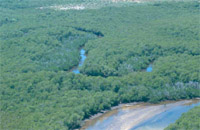
Mangrove trees tolerate the high salinity levels of the ocean and twice daily flooding by the tide. Their wood is heavy and highly resistant to pests like termites. Their roots and branches break up wave action, providing sheltered waters for spawning fish and a wide variety of other sea creatures and birds.
While forest and marine scientists concur it is important to safeguard mangrove resources from threats, they want this to be informed by comprehensive information on the status of mangrove resources, according to WWF.
- The general reason given for the ban was over-exploitation, but there wasn't enough scientific information on Kenya's stocking densities and growth rates of mangroves, or the levels of exploitation, says Mr Jared Bosire, a mangrove expert with the Mombassa-based Kenya Marine and Fisheries Research Institute.
In 1998, WWF funded a survey in Kiunga, in the extreme north of Kenya, to take stock and map the mangrove resources. The survey revealed that most areas had viable mangrove forests that could support controlled extraction, while others were badly damaged requiring restoration.
Lamu district, where Kiunga is found, has 70 percent of Kenya’s mangrove forests, and eight of the nine of mangrove species of east Africa. It was also here that illegal logging had been observed most frequently during the ban.
- While restrictions on mangrove use are necessary in severely degraded areas to give them time to regenerate, local communities whose subsistence hinges on mangrove resources should not be put at risk, says Dr Amani Ngusaru, Coordinator of WWF's eastern Africa marine programme. "What we are really encouraging is sustainable use as the best management practice."
afrol News - It is called "financial inclusion", and it is a key government policy in Rwanda. The goal is that, by 2020, 90 percent of the population is to have and actively use bank accounts. And in only four years, financial inclusion has doubled in Rwanda.
afrol News - The UN's humanitarian agencies now warn about a devastating famine in Sudan and especially in South Sudan, where the situation is said to be "imploding". Relief officials are appealing to donors to urgently fund life-saving activities in the two countries.
afrol News - Fear is spreading all over West Africa after the health ministry in Guinea confirmed the first Ebola outbreak in this part of Africa. According to official numbers, at least 86 are infected and 59 are dead as a result of this very contagious disease.
afrol News - It is already a crime being homosexual in Ethiopia, but parliament is now making sure the anti-gay laws will be applied in practical life. No pardoning of gays will be allowed in future, but activist fear this only is a signal of further repression being prepared.
afrol News / Africa Renewal - Ethiopia's ambitious plan to build a US$ 4.2 billion dam in the Benishangul-Gumuz region, 40 km from its border with Sudan, is expected to provide 6,000 megawatts of electricity, enough for its population plus some excess it can sell to neighbouring countries.










 front page
| news
| countries
| archive
| currencies
| news alerts login
| about afrol News
| contact
| advertise
| español
front page
| news
| countries
| archive
| currencies
| news alerts login
| about afrol News
| contact
| advertise
| español