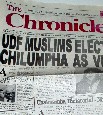
Misanet / The Chronicle, 5 January - 'The Chronicle', the No 1 Investigative Newspaper in Malawi, a title awarded to it by the National Media Institute of Southern Africa (NAMISA), has never had an easy ride from its inception in 1993. It has never had a smooth ride.
Although there are constitutional guarantees of freedom of the press, the environment has not been very conducive for the paper to operate in. Freedom of the media has always been under threat by various sectors in the community who see it as being too probing.
The Malawian constitution in section 34 speaks about the freedom of the press, but this has proved to be only on paper and not in action following various reports of journalists being harassed and physically attacked leaving them with various degrees of injuries.
For 'The Chronicle' to survive in such an environment it had to face and overcome numerous pressures, especially from the government as the paper has always been perceived as an "opposition paper" because it has been uncovering secret deals done by party functionaries from Malawi's ruling United Democratic Front (UDF) and reporting this information to the public because they are matters of national interest.
Among the difficulties faced by 'The Chronicle' are the fact that the paper has been denied the opportunity of attending and effectively covering presidential functions. For example, press conferences and related functions where the president will be in attendance are never covered by 'The Chronicle' because every time it tries to attend there are threats issued to reporters. This has always been difficult for 'The Chronicle' to understand in a democracy.
In some circumstances where a journalist has been courageous enough to attend those functions, albeit incognito - once identified as representing 'The Chronicle' there is always a change of temperature and the journalist would not be allowed to interview or pose a question to the president in the presence of fellow journalist from state owned media houses who take charge of the whole function.
Just recently, the author of the story was invited to attend a press conference of Malawi's first Vice President Justin Malewezi who was returning from Zimbabwe where he attended a funeral.
The press conference was held at the VIP lounge of Lilongwe International Airport. It happened that there was journalist representing several media organisations and according to "their" protocol in such circumstances, the 'Malawi Broadcasting Corporation' (MBC), 'Television Malawi' (TVM) or 'Malawi News Agency' (MANA) are the ones who are supposed to pose the first questions.
'The Chronicle' reporter had the microphone and tried to get clarification following a briefing which the Vice President presented to the press on the relationship between Malawi and Zimbabwe and the funeral of the Zimbabwe's Vice President. The one who could be described as the person in-charge of the press conference approached the reporter and asked her if she wants to pose the first question. The response was 'YES', but the person told the reporter to give him the mic in the presence of the veep and gave it to the 'MANA' reporter.
As if this was not enough, after the 'MANA' reporter asked the question the mic went to another reporter and when it was time for 'The Chronicle' to pose a question, the person in-charge of the mic told the delegates at the conference and the Vice President that the press conference had come to an end. 'The Chronicle' was again denied a chance to ask some very pertinent questions.
These are but some of the problems faced by 'The Chronicle' journalists when carrying out their constitutionally mandated duties for the nation. Often, to add insult to injury, reporters would be harassed at functions by the UDF's youth organisation, the Young Democrats, in the presence of government officials, especially police officers on duty who will not intervene.
One fortunate matter that proceeds our reputation is that we will always protect the identity of our sources and we refuse to name the people who leak information to us. This means that we are always warned of an imminent attack by well-wishers and told of the plots that are being hatched for us. Often we know in advance what is being plotted and believe that this is why some of us are still working on.
'Chronicle' journalists and the Editor in Chief, Robert Jamieson are on record to have been physically attacked by ruthless young democrats in the presence of the police. The Sub-Editor Pushpa Jamieson was also physically attacked at a presidential function and her camera confiscated when she was trying to take pictures of a riot outside the stadium.
In February 2002, 'Chronicle' reporter Mallick Mnela was abducted by the Young Democrats. Other journalists namely, Joseph Ganthu and Kambani Banda were assaulted when the paper published a story about in-fighting in the UDF.
Early this year, senior journalist Christopher Jimu was summoned to Lingadzi police station where a senior Minister, Mary Kaphwereza Banda, had reported that the reporter was harassing her and she needed protection. This happened when the reporter was trying to get more information from the Minister on a story. The police listened to the case and found that the Minister's claims were unsubstantiated and only made to harass and intimidate the media.
The most recent debilitating and crippling event that happened to 'The Chronicle' was when government officials invaded the papers newsroom and confiscated all the working computers leaving the paper completely devoid of production equipment. The computers were taken a day after other officials impounded an Isuzu KB utility vehicle that belongs personally to the Sub Editor, Pushpa Jamieson.
Numerous well-wishers came alongside the paper with assistance. The paper once again refused to shut down and still continues to be on the streets despite having inadequate resources.
'The Chronicle' has, on several occasions received lawsuits from politicians demanding huge sums of money in damages, claiming that they have been libelled. It is expected that these lawsuits will come fast and furious as part of the campaign to silence the paper and kill a critical voice.
After surviving for 10 difficult years and as the election period fast approaches, it is expected that the paper will probably experience different kinds of pressure in a move to stop it from telling the nation what is actually transpiring.
By Wezie Nyirongo, 'The Chronicle' (Lilongwe, Malawi)
afrol News - It is called "financial inclusion", and it is a key government policy in Rwanda. The goal is that, by 2020, 90 percent of the population is to have and actively use bank accounts. And in only four years, financial inclusion has doubled in Rwanda.
afrol News - The UN's humanitarian agencies now warn about a devastating famine in Sudan and especially in South Sudan, where the situation is said to be "imploding". Relief officials are appealing to donors to urgently fund life-saving activities in the two countries.
afrol News - Fear is spreading all over West Africa after the health ministry in Guinea confirmed the first Ebola outbreak in this part of Africa. According to official numbers, at least 86 are infected and 59 are dead as a result of this very contagious disease.
afrol News - It is already a crime being homosexual in Ethiopia, but parliament is now making sure the anti-gay laws will be applied in practical life. No pardoning of gays will be allowed in future, but activist fear this only is a signal of further repression being prepared.
afrol News / Africa Renewal - Ethiopia's ambitious plan to build a US$ 4.2 billion dam in the Benishangul-Gumuz region, 40 km from its border with Sudan, is expected to provide 6,000 megawatts of electricity, enough for its population plus some excess it can sell to neighbouring countries.










 front page
| news
| countries
| archive
| currencies
| news alerts login
| about afrol News
| contact
| advertise
| español
front page
| news
| countries
| archive
| currencies
| news alerts login
| about afrol News
| contact
| advertise
| español