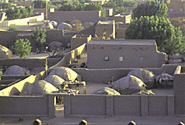
afrol News, 5 July - The late 15th century pyramidal Tomb of Askia has been declared a new World Heritage site. The 17-meter high monument was raised in Gao by Askia Mohamed, the founder of the powerful Songhay Empire, which dominated the Sahel and the trans-Saharan trade for centuries. Now, Gao hopes more tourists will discover the eastern Malian city.
UNESCO Director-General Koïchiro Matsuura this week welcomed a number of new World Heritage sites at a congress in the Chinese city of Suzhou. One of the most profiled new sites was the fourth-ever Malian monument, the Tomb of Askia, located in Gao, the ancient capital of the Songhay Empire at the Niger River.
The UN agency found no difficulties accepting the Malian application to include Askia's tumb in the prestigious World Heritage list. The "dramatic 17-meter pyramidal structure" (UNESCO) actually fulfilled three conditions to be included, when only one had been necessary.
Songhay's founding Emperor, the mythological hero Askia, ordered the building of the monument in 1495 in his capital Gao. It bears testimony to the power and riches of the Empire that flourished in the 15th and 16th centuries through its control of the trans-Saharan trade, notably in salt and gold.
The Songhay Empire was the last of the three large empires centred on the Niger River and controlling the trans-Saharan trade, succeeding Ghana (8th-12th century) and Mali (12th-15 century). With the Songhay Empire, Islam was confirmed as the official religion in the Sahel and Emperor Askia and his heirs made Gao an influential location of Islamic learning.
According to the UNESCO specialists, Askia's tomb is also "a fine example of the monumental mud-building traditions of the West African Sahel." The building, where Emperor Askia's remains supposedly are placed, stands out as the largest pre-colonial architectural monument in the entire region.
The complex, including the pyramidal tomb, two flat roofed mosque buildings, the mosque cemetery, and the open air assembly ground, was built when Gao became the capital of the Songhay Empire and after Askia Mohamed had returned from Mecca and made Islam the official religion of the Empire.
According to UNESCO, "the Tomb of Askia reflects the way local building traditions in response to Islamic needs absorbed influences from North Africa to create a unique architectural style across the West African Sahel." This, the UN agency holds, makes the ancient building representative for the regional architectural history.
Further, the Tomb of Askia was considered "an important vestige of the Empire of Songhay, which once dominated the Sahel lands of West Africa and controlled the lucrative trans- Saharan trade," according to UNESCO. This was a second criterion for the tomb to be named a World Heritage site.
Finally, the UN's cultural agency found the tomb to reflect "the distinctive architectural tradition of the West African Sahel and in particular exemplifies the way buildings evolve over centuries through regular, traditional, maintenance practices."
Askia himself made the influence of the Songhay Empire to reach the modern states of Niger, Nigeria and Burkina Faso. Long after the Songhay Empire fell victim to a Sahara-crossing military campaign by Morocco in 1591, the architectural style of Gao gained influence in the entire Sahel, from modern Mauritania to present-day Chad.
Gao remains one of the most profiled tourist destinations in modern Mali due to the architectural rests of the Songhay empire and the city's later importance in the trans-Saharan trade. The city, beautifully placed at the Niger River, however currently suffers from its remoteness to Mali's modern capital, Bamako, and poor infrastructure.
Mali, one of the culturally richest countries in the Sahel, already counted on three World Heritage sites before the addition of the Tomb of Askia. These include the entire town of Timbuktu - also a major trans-Saharan trade centre that lived its heydays during the Mali Empire. The two other sites are the old towns of Djenné - also on the Niger River - and the cliff landscape of the land of the Dogons in southern Mali.
Tourism to Mali's many cultural and natural attractions has increased during the last years as its rich history has become more known and the country experiences political stability. Local authorities of course hope that the naming of Askia's tomb as a World Heritage site will increase tourism to Gao.
afrol News - It is called "financial inclusion", and it is a key government policy in Rwanda. The goal is that, by 2020, 90 percent of the population is to have and actively use bank accounts. And in only four years, financial inclusion has doubled in Rwanda.
afrol News - The UN's humanitarian agencies now warn about a devastating famine in Sudan and especially in South Sudan, where the situation is said to be "imploding". Relief officials are appealing to donors to urgently fund life-saving activities in the two countries.
afrol News - Fear is spreading all over West Africa after the health ministry in Guinea confirmed the first Ebola outbreak in this part of Africa. According to official numbers, at least 86 are infected and 59 are dead as a result of this very contagious disease.
afrol News - It is already a crime being homosexual in Ethiopia, but parliament is now making sure the anti-gay laws will be applied in practical life. No pardoning of gays will be allowed in future, but activist fear this only is a signal of further repression being prepared.
afrol News / Africa Renewal - Ethiopia's ambitious plan to build a US$ 4.2 billion dam in the Benishangul-Gumuz region, 40 km from its border with Sudan, is expected to provide 6,000 megawatts of electricity, enough for its population plus some excess it can sell to neighbouring countries.










 front page
| news
| countries
| archive
| currencies
| news alerts login
| about afrol News
| contact
| advertise
| español
front page
| news
| countries
| archive
| currencies
| news alerts login
| about afrol News
| contact
| advertise
| español