afrol News, 5 July - Morocco's Portuguese city of Mazagan, now within the city of El Jadida, has survived five hundred years as a bicultural settlement. The well-preserved melting pot is now internationally recognised as "an outstanding example of the interchange of influences between European and Moroccan cultures," promising a boost for future tourism.
The UN's cultural agency, UNESCO, this week added Mazagan to its official and prestigious list of World Heritage sites. Mazagan thus becomes the ninth Moroccan location included on UNESCO's list and makes Morocco one of the countries with most World Heritage sites.
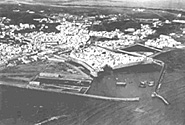
The Portuguese fortification of Mazagan, which now is part of the city of El Jadida, lies only 90 kilometres south-west of Casablanca, in a region of the Moroccan coastline that still is largely unknown to the large number of European tourists travelling to Morocco. The UNESCO listing however rapidly may change this, given Moroccan authorities' well planned strategy for the tourism sector.
Magazan was built as a fortified colony on the Atlantic coast in the early 16th century as Portugal was continuing its reconquista from Portugal into Morocco. The Portuguese City of Mazagan further is one of the earliest settlements of the Portuguese explorers in West Africa on the route to India and marked the beginning of Portugal's overseas empire.
The Portuguese colonists built a fortification, which, with its bastions and ramparts, is an early example of Renaissance military design. The surviving Portuguese buildings include the cistern and the Church of the Assumption, built in the Manueline style of late Gothic architecture.
In 1769, the reviving Sharifian dynasty of Morocco finally managed to recapture Mazagan from the declining Portuguese kingdom. While the new Moroccan lords made use of the Portuguese fortifications and buildings, they also contributed strongly to the further architectonic development of Mazagan.
Although the majority of the Portuguese settlers emigrated to Brazil, where they established Novo Mazagan after the Moroccan takeover, a significant European and Jewish population has remained in the city. In particular the "un-Moorish appearance" of the city has attracted European colonialists and visitors during the last two centuries.
According to UNESCO, Mazagan due to its rich history has become "an outstanding example of the interchange of influences between European and Moroccan cultures, well reflected in architecture, technology, and town planning." This was a major reason for adding the Portuguese city of Mazagan to the list of World Heritage sites.
Further, the "outstanding and early example of the realisation of the Renaissance ideals integrated with Portuguese construction technology" had called the UNESCO's attention. For the foreign visitor, the shallow lanes, Portuguese Renaissance architecture, modern Moroccan flavours and a beautiful beach equally call for attention in modern El Jadida.
El Jadida was discovered for its tourism potentials already by the French colonial officials, who made a major administrative centre out of the old city. Nowadays, the city is mostly famed by the bourgeoisie of nearby Casablanca, enjoying the special ambiente, clean beaches and crowded bars of El Jadida.
For Moroccan tourism authorities, the UNESCO recognition of Mazagan's uniqueness comes as a heaven-sent gift to develop the city for international tourism. Morocco's other eight World Heritage sites - including Fez, Marrakech, Meknes and Essaouira - have certainly profited from this recognition.
afrol News - It is called "financial inclusion", and it is a key government policy in Rwanda. The goal is that, by 2020, 90 percent of the population is to have and actively use bank accounts. And in only four years, financial inclusion has doubled in Rwanda.
afrol News - The UN's humanitarian agencies now warn about a devastating famine in Sudan and especially in South Sudan, where the situation is said to be "imploding". Relief officials are appealing to donors to urgently fund life-saving activities in the two countries.
afrol News - Fear is spreading all over West Africa after the health ministry in Guinea confirmed the first Ebola outbreak in this part of Africa. According to official numbers, at least 86 are infected and 59 are dead as a result of this very contagious disease.
afrol News - It is already a crime being homosexual in Ethiopia, but parliament is now making sure the anti-gay laws will be applied in practical life. No pardoning of gays will be allowed in future, but activist fear this only is a signal of further repression being prepared.
afrol News / Africa Renewal - Ethiopia's ambitious plan to build a US$ 4.2 billion dam in the Benishangul-Gumuz region, 40 km from its border with Sudan, is expected to provide 6,000 megawatts of electricity, enough for its population plus some excess it can sell to neighbouring countries.










 front page
| news
| countries
| archive
| currencies
| news alerts login
| about afrol News
| contact
| advertise
| español
front page
| news
| countries
| archive
| currencies
| news alerts login
| about afrol News
| contact
| advertise
| español