afrol News, 6 July - Togo has finally succeeded in having its first site ever, the Koutammakou cultural landscape, introduced in the World Heritage list. It didn't lack on Koutammakou's "remarkable" qualities, but rather on a management plan for the cultural landscape that could be accepted by UNESCO.
The Togolese Direction of Museums, Sites and Monuments has for years sought to admit the Koutammakou landscape in UNESCO's official and prestigious list of World Heritage sites. Together with regional cultural management partners, the Direction since 1999 has elaborated of a management plan for the Koutammakou and sought to update its failed nominations to the UNESCO list.
This year, Togolese cultural authorities finally have a reason to celebrate as UNESCO Director-General Koïchiro Matsuura announced the Koutammakou's acceptance into the list at an UNESCO meeting in Suzhou (China). Togo thus gets its first-ever World Heritage site listed.
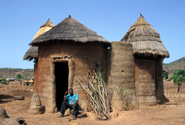
The Koutammakou - or the Land of the Batammariba - is a cultural landscape in north-eastern Togo, which extends into neighbouring Benin. The landscape is home to the Batammariba people, whose remarkable mud tower-houses have come to be seen as a symbol of Togo.
In this landscape, nature is strongly associated with the rituals and beliefs of society. According to UNESCO, this 50,000-hectar cultural landscape is especially "remarkable due to the architecture of its Takienta tower-houses, which are a reflection of social structure," which are known to blend uniquely with the natural environment.
Many of the buildings are two stories high and those with granaries feature an almost spherical form above a cylindrical base. Some of the Takienta buildings have flat roofs, while others have conical thatched roofs. They are always grouped in villages, which also include ceremonial spaces, springs, rocks and sites reserved for initiation ceremonies.
In addition to the Takienta mud-tower houses, the Koutammakou landscape is also remarked by its farmland and forest. UNESCO had put great value into the "associations between people and landscape" in the hilly landscape at the Togo-Benin border.
According to the UN's cultural agency "the Koutammakou is an outstanding example of a system of traditional settlement that is still living and dynamic, and subject to traditional and sustainable systems and practices, and which reflects the singular culture of the Batammariba, particularly the Takienta tower houses."
Further, UESCO had found the Koutammakou to be an "eloquent testimony to the strength of spiritual association between people and landscape, as manifested in the harmony between the Batammariba and their natural surroundings."
The good news for the Batammariba is that, in addition to the probable attraction of new tourists to their landscape, Togolese authorities also have had to elaborate a cultural management plan for the region. Approximately 400 persons have been involved in the elaboration of the management plan for the site, which included several stakeholders meetings.
The management plan is built upon a decentralised scheme, meaning that the Batammariba will have their saying in how their cultural landscape is to be managed. They will also been given opportunities to yield revenues from the expected growth in tourism to their homelands.
With the exemplary management plan approved by Togolese authorities, UNESCO this time had absolutely no objections to inscribe the remarkable Koutammakou in its list. UNESCO Director-General Matsuura in fact hailed candidate for having made the "difficult and arduous task" for UNEACO "to consider their inscriptions."
afrol News - It is called "financial inclusion", and it is a key government policy in Rwanda. The goal is that, by 2020, 90 percent of the population is to have and actively use bank accounts. And in only four years, financial inclusion has doubled in Rwanda.
afrol News - The UN's humanitarian agencies now warn about a devastating famine in Sudan and especially in South Sudan, where the situation is said to be "imploding". Relief officials are appealing to donors to urgently fund life-saving activities in the two countries.
afrol News - Fear is spreading all over West Africa after the health ministry in Guinea confirmed the first Ebola outbreak in this part of Africa. According to official numbers, at least 86 are infected and 59 are dead as a result of this very contagious disease.
afrol News - It is already a crime being homosexual in Ethiopia, but parliament is now making sure the anti-gay laws will be applied in practical life. No pardoning of gays will be allowed in future, but activist fear this only is a signal of further repression being prepared.
afrol News / Africa Renewal - Ethiopia's ambitious plan to build a US$ 4.2 billion dam in the Benishangul-Gumuz region, 40 km from its border with Sudan, is expected to provide 6,000 megawatts of electricity, enough for its population plus some excess it can sell to neighbouring countries.










 front page
| news
| countries
| archive
| currencies
| news alerts login
| about afrol News
| contact
| advertise
| español
front page
| news
| countries
| archive
| currencies
| news alerts login
| about afrol News
| contact
| advertise
| español