World | Chad Science - Education | Environment - Nature
French-Chadian funded scientists reveal origin of hippos
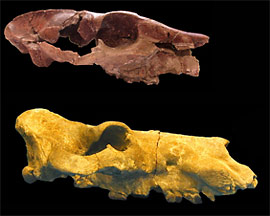
Skulls of a 9 million-year-old anthracothere from Pakistan and a contemporaneous fossil hippopotamus exhibit many similarities, including the eye socket.
afrol News, 10 February - A group of scientists supported by the Mission Paléoanthropologique Franco-Tchadienne has found the missing link between the whale and its not-so-obvious nearest relative, the hippopotamus. The researchers from Chad, France and the US thus found the solution to an old scientific mystery.
A group of four-footed mammals that flourished worldwide for 40 million years and then died out in the ice ages is the missing link between the whale and its not-so-obvious nearest relative, the hippopotamus, the researchers conclude.
The quest for the origin of whales was led by a group of researchers from France, the US and Chad. The team was headed by Michel Brunet of the French Université de Poitiers, Jean-Renaud Boisserie of the US University of California, Berkeley and Fabrice Lihoreau of the Université de N'Djaména in Chad.
The investigations into the mystery began in Chad. Mr Brunet and Mr Boisserie became a hippo specialists while digging for early human ancestors in the deserts of Chad. Most hominid fossils earlier than about 2 million years ago are found in association with hippo fossils, implying that they lived in the same biotopes and that hippos later became a source of food for humans.
Hippos first developed in Africa 16 million years ago and exploded in number around 8 million years ago, spreading all over the world, Mr Boisserie explains. But the question of the origin of hippos has so far bee a disputed matter. Consequently, scientists disagree on the hippos' closest relatives. Many scientists hold that the hippo is most closely related to the pig.
- The problem with hippos is, if you look at the general shape of the animal, it could be related to horses, as the ancient Greeks thought, or pigs, as modern scientists thought, while molecular phylogeny shows a close relationship with whales, said Mr Boisserie. "But cetaceans – whales, porpoises and dolphins – don't look anything like hippos. There is a 40-million-year gap between fossils of early cetaceans and early hippos."
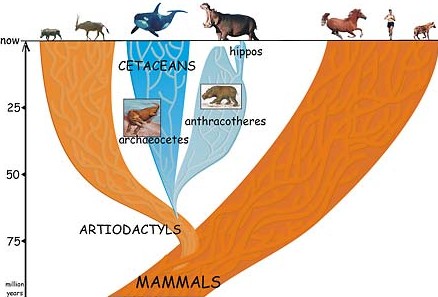
The team of scientists however have filled this time gap by proposing that whales and hippos had a common water-loving ancestor 50 to 60 million years ago that evolved and split into two groups: the early cetaceans, which eventually spurned land altogether and became totally aquatic; and a large and diverse group of four-legged beasts called anthracotheres.
The pig-like anthracotheres - which blossomed over a 40-million-year period into at least 37 distinct genera on all continents except Oceania and South America - died out less than 2 and a half million years ago. It left only one descendent: the hippopotamus.
This proposal places whales squarely within the large group of cloven-hoofed mammals – the group that includes cows, pigs, sheep, antelopes, camels, giraffes and most of the large land animals. Rather than separating whales from the rest of the mammals, the new study supports a 1997 proposal to place the legless whales and dolphins together with the cloven-hoofed mammals in a group named Cetartiodactyla.
- Our study shows that these groups are not as unrelated as thought by morphologis
The family tree of modern whales and their first cousin, the hippopotamus, showing how the now-extinct anthracotheres are the link between their distant ancestors.
ts, Mr Boisserie said, referring to scientists who classify organisms based on their physical characteristics or morphology. "Cetaceans are artiodactyls, but very derived artiodactyls."
The origin of hippos has been debated vociferously for nearly 200 years, ever since the animals were rediscovered by pioneering French palaeontologist Georges Cuvier. Their conclusion that hippos are closely related to pigs and peccaries was based primarily on their interpretation of the ridges on the molars of these species, Mr Boisserie said. "In this particular case, you can't really rely on the dentition, however," he added.
As scientists found more fossils of early hippos and anthracotheres, a competing hypothesis roiled the waters: that hippos are descendents of the anthracotheres.
All this was thrown into disarray in 1985 when UC Berkeley's Vincent Sarich, a pioneer of the field of molecular evolution, analysed blood proteins and saw a close relationship between hippos and whales. A subsequent DNA analysis had only solidified this relationship.
Though most biologists now agree that whales and hippos are first cousins, they continue to clash over how whales and hippos are related. A major roadblock to linking whales with hippos was the lack of any fossils that appeared intermediate between the two.
In fact, it was a bit embarrassing for palaeontologists because the claimed link between the two would mean that one of the major radiations of mammals – the one that led to cetaceans, which represent the most successful re-adaptation to life in water – had an origin deeply nested within the artiodactyls, and that morphologists had failed to recognise it.
This new analysis finally brings the fossil evidence into accord with the molecular data, showing that whales and hippos indeed are one another's closest relatives. New whale fossils discovered in Pakistan in 2001, some of which have limb characteristics similar to artiodactyls, drew a more certain link between whales and artiodactyls.
Mr Boisserie and his colleagues conducted a phylogenetic analysis of new and previous hippo, whale and anthracothere fossils and were able to argue persuasively that anthracotheres are the missing link between hippos and cetaceans.
- While the common ancestor of cetaceans and anthracotheres probably wasn't fully aquatic, it likely lived around water, he said. "And while many anthracotheres appear to have been adapted to life in water, all of the youngest fossils of anthracotheres, hippos and cetaceans are aquatic or semi-aquatic," Mr Boisserie added.
The study into the origin of the hippos was supported in part by the Mission Paléoanthropologique Franco-Tchadienne, which is co-directed by Mr Brunet, and the French government. The study was conducted in the universities of N'djamena, Poltiers and Berkeley.
afrol News - It is called "financial inclusion", and it is a key government policy in Rwanda. The goal is that, by 2020, 90 percent of the population is to have and actively use bank accounts. And in only four years, financial inclusion has doubled in Rwanda.
afrol News - The UN's humanitarian agencies now warn about a devastating famine in Sudan and especially in South Sudan, where the situation is said to be "imploding". Relief officials are appealing to donors to urgently fund life-saving activities in the two countries.
afrol News - Fear is spreading all over West Africa after the health ministry in Guinea confirmed the first Ebola outbreak in this part of Africa. According to official numbers, at least 86 are infected and 59 are dead as a result of this very contagious disease.
afrol News - It is already a crime being homosexual in Ethiopia, but parliament is now making sure the anti-gay laws will be applied in practical life. No pardoning of gays will be allowed in future, but activist fear this only is a signal of further repression being prepared.
afrol News / Africa Renewal - Ethiopia's ambitious plan to build a US$ 4.2 billion dam in the Benishangul-Gumuz region, 40 km from its border with Sudan, is expected to provide 6,000 megawatts of electricity, enough for its population plus some excess it can sell to neighbouring countries.










 front page
| news
| countries
| archive
| currencies
| news alerts login
| about afrol News
| contact
| advertise
| español
front page
| news
| countries
| archive
| currencies
| news alerts login
| about afrol News
| contact
| advertise
| español