afrol News, 14 March - Hope has "rekindled for cooperation, economic progress" in Comoros, according to an analysis by the International Monetary Fund (IMF). Comoros is seeking to emerge from nearly a decade of political strife and has recently signed new agreements with the IMF that could turn the tide.
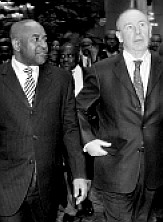
Comoros President Azali Assoumani recently met with Managing Director Rodrigo de Rato in Washington DC, to discuss the country's commitment to a 12-month IMF staff-monitored economic programme for the country and to thank the IMF for its support. Staff-monitored programs are designed for countries that want to establish a track record of improved macroeconomic performance and reform.
These IMF programmes frequently serve - if they are successful - as a stepping-stone for more ambitious reform efforts and supportive financing under the IMF's Poverty Reduction and Growth Facility, according to reports in the Fund's internal publication 'IMF Survey'. The Fund now places great hopes in the economic revival of Comoros, the publication revealed.
Comoros is seeking to emerge from nearly a decade of political strife. The country, which consists of three islands that had no common political history before French rule, has seen its post-1975 period of independence marked by political instability, coups, and secessionist efforts.
Until recently, tensions between the governments of the three islands - Grande Comore, Anjouan and Moheli - and the union government had stymied economic development. With the signing of a transition arrangement in December 2003 and parliamentary elections in March–April 2004, however, there is renewed hope that a lasting political arrangement and sustained economic progress are achievable.
According to the IMF, the cornerstones of "the reasonably ambitious Comoros programme" are macroeconomic stabilisation - centred around implementation of a consolidated budget for the union and island governments - and fast-track progress on a number of structural reforms, notably privatisation of the Comoros Hydrocarbon Company and Comore Telecom by the end of 2005.
- Progress will hinge on continued inter-island cooperation, 'IMF Survey notes. Further, it depended on "a growing realisation that coherent economic policies and normalised relations with donors and creditors offer the only way to rekindle growth and obtain debt reduction under the enhanced Initiative for Heavily Indebted Poor Countries."
The last IMF report on the economic situation in Comoros, released earlier this month, emphasised that the "remaining mistrust" among island governments was still hampering economic growth. Potential donors and investors were still on distance due to a high risk of coups and internal strife. With renewed trust from the IMF and France - the former colonial power - the tide was however turning.
Economic performance in 2004 had however been rather poor, the IMF report noted. This was mainly due to deteriorating terms of trade, with a collapse in vanilla prices and a high oil prices. International vanilla prices fell from an average of US$ 251 per kilogram in 2003 to about US$ 50 per kilogram at present. High oil prices affected transport costs from the remote archipelago.
Also the IMF report however was optimistic on further developments. In its economic outlook for 2005, the IMF forecast GDP growth at 3 percent, which is slightly above the population growth rate in Comoros. With "credible home-grown" economic reforms, Comoros could soon look forward to higher growth rates and debt reduction from its main creditors.
afrol News - It is called "financial inclusion", and it is a key government policy in Rwanda. The goal is that, by 2020, 90 percent of the population is to have and actively use bank accounts. And in only four years, financial inclusion has doubled in Rwanda.
afrol News - The UN's humanitarian agencies now warn about a devastating famine in Sudan and especially in South Sudan, where the situation is said to be "imploding". Relief officials are appealing to donors to urgently fund life-saving activities in the two countries.
afrol News - Fear is spreading all over West Africa after the health ministry in Guinea confirmed the first Ebola outbreak in this part of Africa. According to official numbers, at least 86 are infected and 59 are dead as a result of this very contagious disease.
afrol News - It is already a crime being homosexual in Ethiopia, but parliament is now making sure the anti-gay laws will be applied in practical life. No pardoning of gays will be allowed in future, but activist fear this only is a signal of further repression being prepared.
afrol News / Africa Renewal - Ethiopia's ambitious plan to build a US$ 4.2 billion dam in the Benishangul-Gumuz region, 40 km from its border with Sudan, is expected to provide 6,000 megawatts of electricity, enough for its population plus some excess it can sell to neighbouring countries.










 front page
| news
| countries
| archive
| currencies
| news alerts login
| about afrol News
| contact
| advertise
| español
front page
| news
| countries
| archive
| currencies
| news alerts login
| about afrol News
| contact
| advertise
| español