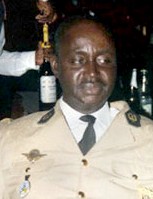
Central African leader François Bozizé: «I can be proud.»
afrol News, 23 March - François Bozizé, who seized power in the Central African Republic after various coup attempts in March 2003, is set to win the controversial presidential elections in the impoverished country as most votes now have been counted. Opposition representatives hold that the 15 March general polls were rigged.
Preliminary results announced by the electoral commission of the Central African Republic (Cémi) indicate that the incumbent ruler, General Bozizé, has won the first poll round strait away, not necessitating a second poll round. Mr Bozizé was reported to have gained just over 55 percent of the votes. His two major challengers, former Prime Minister Martin Ziguélé and former President André Kolingba, both had won less than 13 percent of the votes.
Final results are expected on Thursday or Friday, Cémi officials said yesterday. If the preliminary results are officially confirmed by the commission, the General has gained a popular mandate and his two-year unconstitutional rule comes to a formal end. The presidential and legislative polls organised on 15 March were set to finalise the impoverished country's transition period.
General Bozizé came to power in Bangui on 13 March 2003. The former army chief of staff - who had been fired by the unpopular by democratically elected President Angé-Felix Patassé - had staged various coup attempts before he succeeded ousting Mr Patassé. Mr Bozizé had led a rebel movement to Bangui, after devastating northern parts of the country and attacking government troops and UN peacekeepers.
Upon taking power, the coup plotter was condemned by the international community, including the African Union (AU). He however soon gained acceptance from leaders of the Central African region, of which none had a democratic record. Promising a transition towards democracy, he also was accepted by the UN, although his announcement to stand candidate at the elections came as a disappointment.
According to Jean Willybiro-Sako, the chairman of the Central African election commission (Cémi), last week's poll exercise had been a close to total success. Voters' turnout had been high and voting went orderly around the country. Only at a few polling stations, voting had started late, but was subsequently extended.
The opposition however holds that General Bozizé and his followers had used intimidation and rigging to win the poll. Supporters of Mr Bozizé and of his main challenger, ex-President André Kolingba, were clashing in the run-up to the elections. Opposition sources hold that the General's followers were handing out arms to intimidate Mr Kolingba's followers. Further, around 10 percent of the votes had been scrapped by the commission.
Mr Willybiro-Sako told the press in Bangui that Cémi was still continuing counting the approximately 1.5 million votes. He admitted there had been "some strange cases" at several polling stations, including more votes than registered voters. Cémi officials were however doing their best to correct possible errors and were also seeking to have a second look at the many votes scrapped. There was no reason for the population to shout "fraud" due to any extraordinary event, Mr Willybiro-Sako emphasised.
In Bangui, an opposition appeal to mobilise "against the second self-proclamation of Bozizé" is currently circulating. The appeal holds that a 53 percent vote win for the General had been planned long before the 15 March poll and implies that the chief of the UN mission in the Central African Republic, Lamine Cissé, had agreed to the vote rigging.
International observers to the poll however claim that no grave incidents had occurred during the run-up or the poll. They characterised the elections are generally democratic. Also General Bozizé stated that now, "a true democracy is being established," and added that he took great pride in his role in that process.
afrol News - It is called "financial inclusion", and it is a key government policy in Rwanda. The goal is that, by 2020, 90 percent of the population is to have and actively use bank accounts. And in only four years, financial inclusion has doubled in Rwanda.
afrol News - The UN's humanitarian agencies now warn about a devastating famine in Sudan and especially in South Sudan, where the situation is said to be "imploding". Relief officials are appealing to donors to urgently fund life-saving activities in the two countries.
afrol News - Fear is spreading all over West Africa after the health ministry in Guinea confirmed the first Ebola outbreak in this part of Africa. According to official numbers, at least 86 are infected and 59 are dead as a result of this very contagious disease.
afrol News - It is already a crime being homosexual in Ethiopia, but parliament is now making sure the anti-gay laws will be applied in practical life. No pardoning of gays will be allowed in future, but activist fear this only is a signal of further repression being prepared.
afrol News / Africa Renewal - Ethiopia's ambitious plan to build a US$ 4.2 billion dam in the Benishangul-Gumuz region, 40 km from its border with Sudan, is expected to provide 6,000 megawatts of electricity, enough for its population plus some excess it can sell to neighbouring countries.










 front page
| news
| countries
| archive
| currencies
| news alerts login
| about afrol News
| contact
| advertise
| español
front page
| news
| countries
| archive
| currencies
| news alerts login
| about afrol News
| contact
| advertise
| español