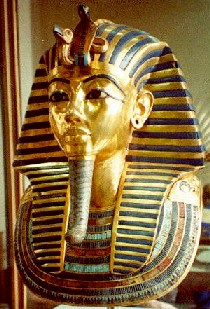
afrol News, 6 April - Ancient Egypt's King Tut ankh Amun was a red wine drinker, a new study by Spanish chemical scientists reveals. Until know, scientists had disagreed whether the fossil wines unearthed in the pharaoh's tomb were from red or white grapes. The study proves that red wine was dominant in "King Tut's" era, some 3300 years ago.
It is well known that wine production was widespread in the ancient kingdoms of Egypt. The earliest scientific evidence of grapes is from 60-million-year-old fossil vines, while the first written record of winemaking comes from a much more recent source, the Bible.
Scientists have detected wine in a jar from as far back as 5400 BC, found at the site of Hajji Firuz Tepe in the northern Zagros Mountains of present-day Iran. But the earliest knowledge about wine cultivation comes from ancient Egypt, where the winemaking process was represented on tomb walls dating to 2600 BC.
- Wine in ancient Egypt was a drink of great importance, consumed by the upper classes and the kings, says Maria Rosa Guasch-Jané, a master in Egyptology at the University of Barcelona in Spain. She and Rosa Lamuela-Raventós, a professor of nutrition and food science, have analysed samples of ancient Egyptian jars from Tut ankh Amun's tomb, now belonging to the Egyptian Museum in Cairo and the British Museum in London.
One of the samples coming from the tomb of King Tut ankh Amun - discovered in 1922 by Howard Carter in Western Thebes, Egypt - had the following inscription: "Year 5. Wine of the House-of- Tut-ankh-Amun Ruler-of-the-Southern-On, l.p.h.[in] the Western River. By the chief vintner Khaa."
According to Ms Guasch-Jané, wine jars were placed in tombs as funerary meals. "The New Kingdom wine jars were labelled with product, year, source and even the name of the vine grower, but they did not mention the colour of the wines they contained," she explains. Scientists and oenophiles have long debated the type of grape that ancient Egyptians used in their wines.
The Spanish scientists thus developed the first technique that can determine the colour of wine used in ancient jars. The technique focuses on analysing malvidin-glucoside, which is the major component that gives the red colour to young red wines. No other juice used in the ancient Near East and Mediterranean region contains it.
As wine ages, malvidin reacts with other compounds forming more complex structures. The researchers directed their efforts toward developing a tool for breaking down these structures to determine the colour of the fossil wine. This method has never before been used to identify tartaric acid or syringic acid, nor has it been used on any archaeological sample, according to the scientists.
The scientific report of the new technique appeared in the latest edition of 'Analytical Chemistry', a US-based scientific publication. Ms Lamuela-Raventós and Ms Guasch-Jané say they plan to use the new technique in more extensive studies of wine residues from other archaeological samples. The Spanish Wine Culture Foundation and Codorniu Group had funded their research.
afrol News - It is called "financial inclusion", and it is a key government policy in Rwanda. The goal is that, by 2020, 90 percent of the population is to have and actively use bank accounts. And in only four years, financial inclusion has doubled in Rwanda.
afrol News - The UN's humanitarian agencies now warn about a devastating famine in Sudan and especially in South Sudan, where the situation is said to be "imploding". Relief officials are appealing to donors to urgently fund life-saving activities in the two countries.
afrol News - Fear is spreading all over West Africa after the health ministry in Guinea confirmed the first Ebola outbreak in this part of Africa. According to official numbers, at least 86 are infected and 59 are dead as a result of this very contagious disease.
afrol News - It is already a crime being homosexual in Ethiopia, but parliament is now making sure the anti-gay laws will be applied in practical life. No pardoning of gays will be allowed in future, but activist fear this only is a signal of further repression being prepared.
afrol News / Africa Renewal - Ethiopia's ambitious plan to build a US$ 4.2 billion dam in the Benishangul-Gumuz region, 40 km from its border with Sudan, is expected to provide 6,000 megawatts of electricity, enough for its population plus some excess it can sell to neighbouring countries.










 front page
| news
| countries
| archive
| currencies
| news alerts login
| about afrol News
| contact
| advertise
| español
front page
| news
| countries
| archive
| currencies
| news alerts login
| about afrol News
| contact
| advertise
| español