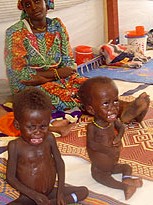
afrol News, 12 July - More than 1 million people in Niger are now in need of emergency food aid, representing one tenth of the poor Sahelian country's total population. Children are most vulnerable. Conditions in Niger are "particularly critical this year" following a poor rainy season and devastation to crops and grazing land caused by the worst locust invasion in 15 years, according to humanitarian agencies.
The UN's World Food Programme (WFP) today announced plans to almost triple the number of people being fed through its Niger emergency operation to over a million, as the annual "hunger season" takes a firm and distressing grip on one of the world's poorest countries.
- Most immediately at risk are young children, WFP says in a statement released today. Feeding centres run by the Paris-based organisation Médecins sans Frontičres (MSF) are reporting admission rates nearly three times those during the same period last year. Recent nutritional surveys had pointed to severe acute malnutrition rates of between 2.4 and 2.9 percent amongst children under five years old. In the worst hit areas rates for severe acute malnutrition were as high as six percent.
Niger is entirely located in the Sahelian and Saharan part of West Africa, thus suffering from periodic droughts. While harvests in many parts of the country at first seemed positive last year, a severe locust invasion stripped farmers out of their entire crop. Since that, rains have been erratic, hindering a quick recovery. An estimated 80 percent of the population is rural, mostly depending directly on land resources.
The looming food crisis in Niger was discovered by surprised MSF workers early this year, noting a sudden rush of undernourished children to their rural health centres. A limited food aid programme was introduced shortly thereafter and several humanitarian organisations have arrived in Niger to start up specialised nutritional programmes.
The depth of the food crisis is however only being understood now, as the presence of humanitarian workers in Niger has increased. "Children are dying and adults are going hungry," said WFP Niger Country Director, Gian Carlo Cirri, who has been appealing for a rapid response to Niger's worsening crisis. "We have said this before and we are saying it again - Niger needs help today, not tomorrow," Mr Cirri added.
WFP's initial response had been "severely hampered" by late funding and difficulties buying food within the region, the UN agency said. Supplies now however were being sourced at ports in West Africa and on other international markets. WFP plans to target free food to mothers accompanying malnourished children to its centres. Other vulnerable households are also to receive free food supplies through targeted general food distributions, already established by the government of Niger.
Following widespread coverage of Niger in the international media, the bulk of WFP's US$ 4.2 million appeal for 465,000 people was received in the last six weeks. However, WFP now requires an additional US$ 12 million to cover the rapidly rising costs of the operation, which now aims to feed nearly 1.2 million people.
Niger however faces structural food problems that will not be resolved by the current operation. Even in a good year, malnutrition rates amongst young Nigerien children are extremely high. Some 82 percent of the population rely on subsistence farming and cattle rearing while only 15 percent of the land is suitable for arable farming. There is little irrigation, leaving most farmers at the mercy of the rains.
Niger is the world's second poorest country after Sierra Leone and despite targeted government efforts to improve the situation, people seem to "live as if cursed by poverty," as Mr Cirri puts it. The WFP representative holds that the international community cannot allow this to continue.
afrol News - It is called "financial inclusion", and it is a key government policy in Rwanda. The goal is that, by 2020, 90 percent of the population is to have and actively use bank accounts. And in only four years, financial inclusion has doubled in Rwanda.
afrol News - The UN's humanitarian agencies now warn about a devastating famine in Sudan and especially in South Sudan, where the situation is said to be "imploding". Relief officials are appealing to donors to urgently fund life-saving activities in the two countries.
afrol News - Fear is spreading all over West Africa after the health ministry in Guinea confirmed the first Ebola outbreak in this part of Africa. According to official numbers, at least 86 are infected and 59 are dead as a result of this very contagious disease.
afrol News - It is already a crime being homosexual in Ethiopia, but parliament is now making sure the anti-gay laws will be applied in practical life. No pardoning of gays will be allowed in future, but activist fear this only is a signal of further repression being prepared.
afrol News / Africa Renewal - Ethiopia's ambitious plan to build a US$ 4.2 billion dam in the Benishangul-Gumuz region, 40 km from its border with Sudan, is expected to provide 6,000 megawatts of electricity, enough for its population plus some excess it can sell to neighbouring countries.










 front page
| news
| countries
| archive
| currencies
| news alerts login
| about afrol News
| contact
| advertise
| español
front page
| news
| countries
| archive
| currencies
| news alerts login
| about afrol News
| contact
| advertise
| español