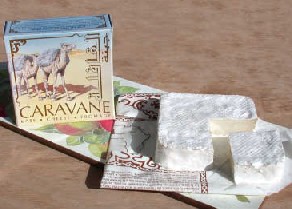
afrol News, 24 March - Mauritanians love camel milk, which any good host should immediately offer his guests. Maybe therefore, the desert country has one of the region's few well-developed dairy sectors. New and exciting products are being developed in Nouakchott, still only for the domestic market. The "Caravane" camel cheese of a French brie style is on the market and promises to become a hit. Chocolate of camel milk is also being developed.
Tiviski, the Nouakchott-based dairy, is one of the very few well-functioning of its kind in West Africa - a sub-continent that is over-populated with milk-producing mammals such as cows, goats, sheep and camels. But dairy produce are mostly produced and consumed locally in West Africa, because industrial production of these perishable products and their distribution demands costly plants and a good infrastructure. In West African city super markets, milk, cheese and yoghurt typically are import products from Europe.
Not so in Mauritania. In the traditionally desert-wandering pastoral society, dairy produce have been among the most important sources of nutrition and signs of hospitality. Mauritanians traditionally offer their guests camel milk. Now, dairy produce are also rediscovered in the Mauritanian modernity as a product with roots and development potentials.
The Tiviski dairy, headed by Nancy Abeiderrahmane, has known to set the trend. Based in Nouakchott, Ms Abeiderrahmane has been able to develop new products from old raw materials to satisfy the small but conscious Mauritanian urban market. Milk from camels, cows and goats are used to present a relatively modern group of products.
Basically, the Nouakchott dairy sells traditional milk products to its urban clientele. Pasteurised whole camel or cow milk is sold in half litre cartons, but also a blend of fresh pasteurized camel milk (65 percent) and cow milk, marketed as "El Medina", has found new followers. Especially tourists and other foreigner, who find the pure camel milk a bit heavy, opt for this milder version.
But the dairy also has gone new ways to attract the national audience. Goats are held by a large part of the population due to their drought resistance and ability to find food where there is none and goat milk therefore is produced widely. At Tiviski, the answer to this access to a cheap recourse was the development of "Chev'lait", which is a slightly sweetened cultured goat milk, sold in a quarter litre pouch. Sales are modest, but the new product has found its audience.
The most innovative thinking has however been dedicated to camel milk, which Ms Abeiderrahmane sees a particular interest in promoting. The Tiviski Manager holds that a sound market for camel milk products is the best way to protect these beasts, which secure an environmentally sound soil use in semi-arid and arid zones such as Mauritania.
The biggest success so far has been the launch of "Caravane", which the manager describes as a "soft French-type cheese made from camel milk." The camel cheese has the aspect of a French brie, but has a distinct taste of camel milk. "Caravane" is the first mass produced Mauritanian cheese on the market and seems to have the potential to become a hit. The distinct cheese has already been termed "Camelbert" by humoristic tongues.
Tiviski definitively has plans to enlarge its assortment, although Ms Abeiderrahmane has not yet decided what will be the next product on the market. The manager however has no fears regarding the possibilities of her raw products. "What about a cosmetics line based on camel milk," she jokefully asks.
The Mauritanian manager is aware that a good assortment of camel milk products does not need to be limited to a market of Mauritanian traditionalists. Indeed, there is a great market of Western consumers seeking exotic products and regional specialities. But, "to date, these products are not available for export," Ms Abeiderrahmane notes. Entering the EU or US market is a complicated process that also would demand hygienic control legislation and institutions established by the Mauritanian government to safeguard European or American standards.
The potential of camel milk on international markets was however demonstrated clearly last week, as Al Ain Dairy of the United Arab Emirates signed a contract with the Austrian chocolate manufacturer Hochleitner Ltd to set up a camel chocolate plant in the Emirates that is to become operational in second quarter of 2006. George Hockleitner was the first to successfully produce and market chocolate based on sheep milk and now has designed a tasteful camel chocolate.
"I have combined camel milk from Al Ain and honey from Yemen and we end up with a healthy, tasty and delicious chocolate" said Mr Hochleitner in a recent press statement. The chocolate is to be offered at Arab luxury hotels and may also be sold in Europe. The camel farm providing El Ain with milk has pledged to increase its production by buying 2000 camels more. For Mauritanian camel herders, a similar future initiative by Tiviski could mean new and exiting markets.
afrol News - It is called "financial inclusion", and it is a key government policy in Rwanda. The goal is that, by 2020, 90 percent of the population is to have and actively use bank accounts. And in only four years, financial inclusion has doubled in Rwanda.
afrol News - The UN's humanitarian agencies now warn about a devastating famine in Sudan and especially in South Sudan, where the situation is said to be "imploding". Relief officials are appealing to donors to urgently fund life-saving activities in the two countries.
afrol News - Fear is spreading all over West Africa after the health ministry in Guinea confirmed the first Ebola outbreak in this part of Africa. According to official numbers, at least 86 are infected and 59 are dead as a result of this very contagious disease.
afrol News - It is already a crime being homosexual in Ethiopia, but parliament is now making sure the anti-gay laws will be applied in practical life. No pardoning of gays will be allowed in future, but activist fear this only is a signal of further repression being prepared.
afrol News / Africa Renewal - Ethiopia's ambitious plan to build a US$ 4.2 billion dam in the Benishangul-Gumuz region, 40 km from its border with Sudan, is expected to provide 6,000 megawatts of electricity, enough for its population plus some excess it can sell to neighbouring countries.










 front page
| news
| countries
| archive
| currencies
| news alerts login
| about afrol News
| contact
| advertise
| español
front page
| news
| countries
| archive
| currencies
| news alerts login
| about afrol News
| contact
| advertise
| español