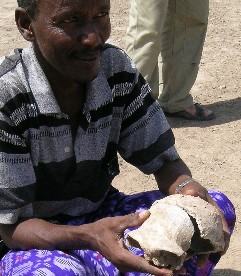
afrol News, 27 March - A research team headed by Ethiopian anthropologist Sileshi Semaw has unearthed a human-like skull estimated to be between 500,000 and 250,000 years old. The cranium, which was found in the Afar region in northern Ethiopia, could prove to be a "missing link" between the earlier Homo erectus and modern humans, Homo sapiens, early analyses show.
The important palaeo-anthropological discovery was announced by the Stone Age Institute, based in the US state Indiana, which employs the Ethiopian anthropologist. Mr Semaw, a 45-year-old Ethiopian national, heads the Gona Palaeo-anthropological Research Project in northern Ethiopia on behalf of the US institute.
The skull was found by Mr Semaw's assistant Asahmed Humet on 16 February this year while the research team was conducting archaeological and geological reconnaissance survey in the Gawis river drainage basin in the Afar regional of Ethiopia. The cranium was found in a small gully at the base of a steep slope of soft sediments from which it had recently eroded.
At the same site, the Ethiopian research team also found additional contemporary stone tools and artefacts. Further, a diversity of fossil animals including two types of pigs, zebras, elephants, multiple types of antelopes, small carnivores including cats, and numerous rodents were found at the same layer of the sediments as the skull, indicating that these animals had been eaten or held by the proto-human at Gawis.
The importance of the discovery is attached to the skull's age and its structure. The skull was found in sediments from the Middle Pleistocene, meaning the proto-human must have lived between 500,000 and 250,000 years. The sediments include some volcanic ash layers, meaning that the scientist expect that a more accurate dating should soon be possible.
The age and shape of the skull indicate that it "appears to be intermediate between the earlier Homo erectus and later Homo sapiens and may be sampling a single lineage," according to the Stone Age Institute. The age indicated it was from an "intriguing and important period in the development of modern humans," representing the last forms of proto-humans before our Homo sapiens species was fully developed.
The discovery is also of a great importance because it included a near-complete skull, while most fossils of proto-humans - hominids - only are found as fragments. "I am thrilled to have a complete cranium discovered from Gona that can provide key information for understanding the variation that existed during the Middle Pleistocene," Mr Semaw commented the discovery.
Scott Simpson, the project palaeontologist added that "a good fossil provides anatomical evidence that allows us to refine our understanding of evolution. A great fossil forces us to re-examine our views of human origins. I believe the Gawis cranium is a great fossil."
The Gawis skull comes from a time of transition to modern humans from African Homo erectus that is poorly known, and it could therefore prove to be a major "missing link" of human evolution. According to the Stone Age Institute, the fossil record from Africa for this period is sparse and most of the specimens are poorly dated. The few fossil skulls that are known from the Middle Pleistocene of Africa present a narrow view of the range of potential anatomical variation during this period.
"The Gawis cranium provides us with the opportunity to look at the face of one of our ancestors," the Institute therefore notes. "Additionally, this fossil links us with the past by showing a face that is recognisably different and more primitive than ours."
Work is in progress by Mr Semaw's team in Gona to determine the age of the skull and associated archaeology, and to understand its evolutionary relationships with others known during the Pleistocene. Mr Semaw concluded by saying that "I am happy that the Gona project succeeded to make a new hominid discovery from this least known time period in human evolution."
"Gona is a wonderful site and Ethiopian palaeo-anthropology has a lot more to offer to the world. We will keep our heads up and continue our work, and I am optimistic that we will be rewarded with more thrilling discoveries for years to come," the Ethiopian scientist promises.
afrol News - It is called "financial inclusion", and it is a key government policy in Rwanda. The goal is that, by 2020, 90 percent of the population is to have and actively use bank accounts. And in only four years, financial inclusion has doubled in Rwanda.
afrol News - The UN's humanitarian agencies now warn about a devastating famine in Sudan and especially in South Sudan, where the situation is said to be "imploding". Relief officials are appealing to donors to urgently fund life-saving activities in the two countries.
afrol News - Fear is spreading all over West Africa after the health ministry in Guinea confirmed the first Ebola outbreak in this part of Africa. According to official numbers, at least 86 are infected and 59 are dead as a result of this very contagious disease.
afrol News - It is already a crime being homosexual in Ethiopia, but parliament is now making sure the anti-gay laws will be applied in practical life. No pardoning of gays will be allowed in future, but activist fear this only is a signal of further repression being prepared.
afrol News / Africa Renewal - Ethiopia's ambitious plan to build a US$ 4.2 billion dam in the Benishangul-Gumuz region, 40 km from its border with Sudan, is expected to provide 6,000 megawatts of electricity, enough for its population plus some excess it can sell to neighbouring countries.










 front page
| news
| countries
| archive
| currencies
| news alerts login
| about afrol News
| contact
| advertise
| español
front page
| news
| countries
| archive
| currencies
| news alerts login
| about afrol News
| contact
| advertise
| español