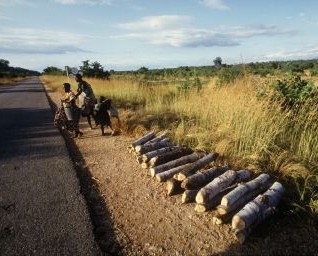
afrol News, 7 June - Findings of a recent forest assessment in Malawi show "increasing deforestation rates and unsustainable exploitation of non-timber forestry products" in the country's protected areas. The report indicates that Malawi's valuable national parks soon could be degraded entirely.
The report by the environmentalist group WWF, which surveyed threats to forests throughout the country's protected areas, concludes that logging and forest conversions for agriculture are key drivers to the disappearance of Malawi's forests and deterioration of the country's national parks. A sample of 20 forest protected areas and all the country's nine national parks and wildlife reserves have been assessed in the study.
The assessment further revealed that Malawi's most biologically significant forests in the country's central region were the most vulnerable. "This was the case for forestry reserves in Mangochi, Mulanje, Dedza and Salima," the study said. And, all national parks had "suffered various degrees of encroachment." The worst affected were found to be Lengwe followed by Kasungu, Nkhotankhota and Nyika.
Malawi's protected forests currently cover 4.7 percent of the country, while national parks and wildlife reserves cover 11.6 percent. In the Malawian government's attempt to further the international tourism industry in the country, protected areas and Lake Malawi resorts have plaid a major role.
But the government has failed to protect is parks well enough. "The plight of Malawi's forests is further exacerbated by a poor management regime on the part of the forest authorities," said Mxolisi Sibanda, a research fellow with WWF's Miombo Ecoregion Programme, who led the assessment.
"Management of forests in Malawi is either very low or non-existent," Mr Sibanda added. "The vulnerability of important forests stems from inadequate law enforcement, consumption demands on forestry products, staffing problems in the government's forestry department and high levels of poverty among the general populace."
Agriculture has also been highlighted as a growing threat to forests, particularly in southern Malawi where droughts and flooding are frequent. The assessment picks out Vwaza Marsh, Nyika and Kasungu as the areas where national parks are under pressure from agricultural expansion.
"A lot needs to be done quickly to protect these forest areas," Mr Sibanda advised. "Funding for implementing management plans, staff training and improved conditions of service are all issues that need urgent attention, Communities also need support to develop a general appreciation for natural resource conservation, especially those communities that live in areas adjacent to the protected areas and are looking for solutions to meet their basic food requirements," the environmentalist said.
The WWF report concludes that the Malawi government, donor agencies and other stakeholders, including organisations like WWF itself, "need to work together in ensuring that protected areas in Malawi are effectively managed for the benefit of the country through tourism, sustainable utilisation and employment creation."
afrol News - It is called "financial inclusion", and it is a key government policy in Rwanda. The goal is that, by 2020, 90 percent of the population is to have and actively use bank accounts. And in only four years, financial inclusion has doubled in Rwanda.
afrol News - The UN's humanitarian agencies now warn about a devastating famine in Sudan and especially in South Sudan, where the situation is said to be "imploding". Relief officials are appealing to donors to urgently fund life-saving activities in the two countries.
afrol News - Fear is spreading all over West Africa after the health ministry in Guinea confirmed the first Ebola outbreak in this part of Africa. According to official numbers, at least 86 are infected and 59 are dead as a result of this very contagious disease.
afrol News - It is already a crime being homosexual in Ethiopia, but parliament is now making sure the anti-gay laws will be applied in practical life. No pardoning of gays will be allowed in future, but activist fear this only is a signal of further repression being prepared.
afrol News / Africa Renewal - Ethiopia's ambitious plan to build a US$ 4.2 billion dam in the Benishangul-Gumuz region, 40 km from its border with Sudan, is expected to provide 6,000 megawatts of electricity, enough for its population plus some excess it can sell to neighbouring countries.










 front page
| news
| countries
| archive
| currencies
| news alerts login
| about afrol News
| contact
| advertise
| español
front page
| news
| countries
| archive
| currencies
| news alerts login
| about afrol News
| contact
| advertise
| español