afrol News, 28 September - The European Union (EU) has granted substantial extra aid to Mali to assure a faster social development of the country and thus halting its large illegal migration outflow. Mali has turned into the largest source of irregular migrant to Spain and Europe, mostly due to rampant poverty and lack of vision for the country's large youthful population. Meanwhile, Guinea-Bissau seems set to be the next to achieve a lucrative EU deal as migrants have started departing from that country.
European governments never really gave importance to developments in the vast, landlocked Sahelian country, with few natural resources, an impoverished population and limited strategic value. Relations were focused on cultural cooperation and small-scaled aid projects. Very few European countries used to have embassies in Bamako. Suddenly, however, poverty and social misery in Mali has risen to a domestic issue for Europeans.
Out of the around 26,000 illegal migrants arriving only in Spain so far this year, at least 2,800 are of Malian origin. More have taken the Sahara route via Algeria to Italy. At least 200,000 Malians now live in Europe, mostly in France, according to official estimates by Bamako authorities.
Spanish diplomats, who have travelled frenetically over most of West Africa during the last year, have been able to secure EU assistance in signing migration control and development aid agreements with the main sources of irregular migrants. Especially Morocco, Mauritania and Senegal - the main countries of departure - have already signed agreements worth hundreds of millions of euros, in addition to receiving logistic aid in controlling borders.
This week has been Mali's turn to sign a development-aid-for-migration-control agreement with the Europeans. The Spaniard Manuel López Blanco, leader of the regional EU delegation based in Dakar, since Monday has been in Bamako, negotiating the last details with the Malian government.
Now, Mr López and Malian Foreign Minister Oumar Hamadoun Dicko have announced the results. The EU has promised to grant Mali euro 426 million (franc CFA 280 billion) over the period of 2008-13 to help the country control migratory flows. The funds mainly are going into government schemes to ease poverty in the country, according to an EU statement.
"Growth, productive investment, private development sector, regional integration, all contribute to job creations as well as migratory flows control," according to the statement. Mr López added that migration control was of vital importance. "We have to understand that the major reasons of this migration, in Mali, are not only economic. We need to understand better how the criminal networks function to be able to fight them better," he said.
Minister Dicko agreed that there needed to be stronger efforts in Mali to fight the mafia networks organising the illegal migrations and appreciated EU funding and logistical aid to investigate into the matter. Spanish and EU operations in neighbouring Senegal have already been highly effective in dismantling these trafficking networks.
Spanish and EU authorities have so far been rather successful in closing the main migration routes into Europe. Economic and diplomatic concessions to Morocco assured Rabat's harsh crack-down on Africans trying to use the country as a base to migrate to Spain. Libya and Tunisia are equally tough on those heading for Italy.
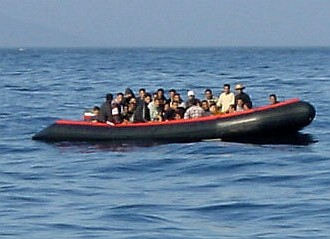
This year, migration routes have focused on the Spanish autonomous Canary Islands, with departures of hazardous boat expeditions from Mauritania, Senegal and Cape Verde. Repatriation agreements, EU patrolling in West African waters and police cooperation - in return for generous development aid packages - have managed to limit the flow out of this countries considerably, although thousands still are reaching the Canary Islands.
Newest reports document that, following the tougher anti-migration efforts in Senegal, the main departure point is now mowing even further south, into Guinea-Bissau. Senegalese trafficking networks are now seen operating from the small town of Verela, just across the border from Senegal. Bissau authorities last week asked Spain for economic assistance to stop this new flow.
For Guinea-Bissau, which has failed to attract highly needed foreign aid for reconstruction after its civil war, the European fear of uncontrolled immigration from West Africa could become a blessing, it seems. Spanish Justice Minister Juan Fernando López Aguilar today announced that Madrid would increase its pressure, but also "diplomatic action and development aid" regarding Guinea-Bissau, in cooperation with the EU. Bissau looks set to be the next country to cash in an EU cooperation deal.
afrol News - It is called "financial inclusion", and it is a key government policy in Rwanda. The goal is that, by 2020, 90 percent of the population is to have and actively use bank accounts. And in only four years, financial inclusion has doubled in Rwanda.
afrol News - The UN's humanitarian agencies now warn about a devastating famine in Sudan and especially in South Sudan, where the situation is said to be "imploding". Relief officials are appealing to donors to urgently fund life-saving activities in the two countries.
afrol News - Fear is spreading all over West Africa after the health ministry in Guinea confirmed the first Ebola outbreak in this part of Africa. According to official numbers, at least 86 are infected and 59 are dead as a result of this very contagious disease.
afrol News - It is already a crime being homosexual in Ethiopia, but parliament is now making sure the anti-gay laws will be applied in practical life. No pardoning of gays will be allowed in future, but activist fear this only is a signal of further repression being prepared.
afrol News / Africa Renewal - Ethiopia's ambitious plan to build a US$ 4.2 billion dam in the Benishangul-Gumuz region, 40 km from its border with Sudan, is expected to provide 6,000 megawatts of electricity, enough for its population plus some excess it can sell to neighbouring countries.










 front page
| news
| countries
| archive
| currencies
| news alerts login
| about afrol News
| contact
| advertise
| español
front page
| news
| countries
| archive
| currencies
| news alerts login
| about afrol News
| contact
| advertise
| español