afrol News, 20 October - Kabwe, the second largest city in Zambia, has found itself on the top-ten of a new list of "the world's worst polluted places" due to very high lead concentrations left over from previous mining operations. Average blood levels of lead among children in some townships are five to ten times the level considered dangerous.
Kabwe is one of six towns situated around the Copperbelt, once Zambia's thriving industrial base. In 1902, rich deposits of lead were discovered here, leading to a century-long mining operation that never bothered too much about environmental standards and public health.
As a result, Kabwe this week landed at fourth place on a list published in a report by the New York-based Blacksmith Institute, which describes the ten most polluted places on earth. Most places, the report says, are not even well known within their own country, with Russia providing three out of the ten sites.
The Zambian town is an especially ugly example of how large-scale pollution in a developing country affects the health of thousands of poor families and in particular children. Neither colonial authorities nor the post-independence government bothered to provide security for Kabwe residents.
For hundred years, Kabwe has spelled wealth for mining companies. Ore veins with lead concentrations as high as 20 percent have been mined deep into the earth and a smelting operation was set up to process the ore. Rich deposits of sulphide ore consisted of silicates, oxides and carbonates of lead, which averaged 34 percent in lead concentration. Mining and smelting operations were running almost continuously up until 1994.
Lead, however, is one of the metals most poisonous for the human organism and the Zambian government never addressed the dangers of lead. In particular the smelting process was unregulated during these 90 years of operations and the smelters released heavy metals in dust particles, which settled on the ground in the surrounding area.
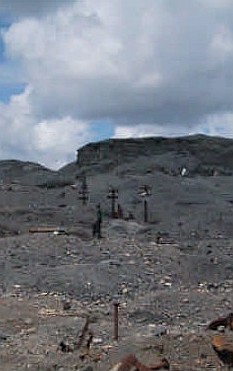
The mine and smelter is no longer operating but has left a city poisoned from debilitating concentrations of lead in the soil and water from slag heaps that were left as reminders to the smelting and mining era. Some of the lead concentrations in soil have been recorded at 2400 mg/kg. In one study, the dispersal in soils of lead, cadmium, copper, and zinc extended to over a 20 km circumference from the smelting and mining processes.
In the US, permissible blood levels of lead are less than 10 micrograms/decilitre (mcg/dl). Symptoms of acute poisoning occur at blood levels of 20 and above, resulting in vomiting, diarrhoea, and leading to muscle spasms and kidney damage. Levels of over ten are considered unhealthy and levels in excess of 120 can often lead to death.
In some neighbourhoods in Kabwe, however, blood concentrations of 200 or more mcg/dl have been recorded in children, and records show average blood levels of children range between 50 and 100 mcg/dl. Children and young men scavenging the mines for scraps of metal are heavily exposed to lead particles, but a lead-polluted waterway also runs from the mine to the centre of town, exposing most residents to the poison.
"After decades of contamination, the clean-up strategy for Kabwe is complex and in its primary stages," the Blacksmith report holds. A local group, the Kabwe Environmental and Rehabilitation Foundation (KERF), however has started educating the community about the risks of lead poisoning.
By now, also the World Bank has stepped in. The Bank approved a US$ 20 million grant to clean up the city and has just completed the scoping study that will lead to initial clean-up activity beginning in 2007.
According to the Blacksmith Institute, around 1 billion of the world's population are affected by pollution, victims typically being children and those suffering from diseases. "Living in a town with serious pollution is like living under a death sentence. If the damage does not come from immediate poisoning, then cancers, lung infections, mental retardation, are likely outcomes," the report states.
afrol News - It is called "financial inclusion", and it is a key government policy in Rwanda. The goal is that, by 2020, 90 percent of the population is to have and actively use bank accounts. And in only four years, financial inclusion has doubled in Rwanda.
afrol News - The UN's humanitarian agencies now warn about a devastating famine in Sudan and especially in South Sudan, where the situation is said to be "imploding". Relief officials are appealing to donors to urgently fund life-saving activities in the two countries.
afrol News - Fear is spreading all over West Africa after the health ministry in Guinea confirmed the first Ebola outbreak in this part of Africa. According to official numbers, at least 86 are infected and 59 are dead as a result of this very contagious disease.
afrol News - It is already a crime being homosexual in Ethiopia, but parliament is now making sure the anti-gay laws will be applied in practical life. No pardoning of gays will be allowed in future, but activist fear this only is a signal of further repression being prepared.
afrol News / Africa Renewal - Ethiopia's ambitious plan to build a US$ 4.2 billion dam in the Benishangul-Gumuz region, 40 km from its border with Sudan, is expected to provide 6,000 megawatts of electricity, enough for its population plus some excess it can sell to neighbouring countries.










 front page
| news
| countries
| archive
| currencies
| news alerts login
| about afrol News
| contact
| advertise
| español
front page
| news
| countries
| archive
| currencies
| news alerts login
| about afrol News
| contact
| advertise
| español