afrol News, 13 December - In an emotional court case driven by hundreds of San tribesmen ("Bushmen") against the government of Botswana, Southern Africa's indigenous people was given the right to return to lands they were expelled from and take up hunting and gathering practices again. The ruling is a major setback for authorities, which had hoped to mine diamonds on San lands.
The Botswana High Court today ruled totally in favour of the Gana and Gwi clans of the indigenous San people, condemning the Gaborone government for having evicted these hunters and gatherers from their ancestral lands in the great Central Kalahari Game Reserve. The forceful eviction in 2002 was ruled to be both "unlawful and unconstitutional", according to the court.
The court also ruled that the San applicants have the right to hunt and gather in the reserve - which had been set up by British colonial authorities for just that reason in the 1950s. San hunters from now on should not have to apply for permits to enter the reserve, the court ruled.
One of the judges, Justice Phumaphi, said the Batswana government's refusal to allow the San to hunt "was tantamount to condemning the residents of the Central Kalahari Game Reserve to death by starvation." Two out of the panel of three judges agreed with the San people in what has been noted as the longest and most expensive court case in Botswana's history.
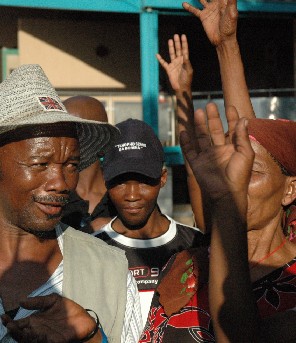
San spokesman Roy Sesana was jubilant after his people finally had scored a full success in this difficult case. Smiling broadly to journalists and followers, Mr Sesana said "Today is the happiest day for us Bushmen. We have been crying for so long, but today we are crying with happiness. Finally we have been set free. The evictions have been very, very painful for my people. I hope that now we can go home to our land."
Only in one point did the Lobatse court somewhat disappoint the San plaintiffs. The judges ruled that the Botswana government could not be made responsible to provide basic services such as water and education to persons living within the vast desert reserve. Before the 2002 eviction, government had provided at least water at some points of the reserve, but this was suddenly cut to force residents leave the area.
Between 1,000 and 2,000 San hunters and gatherers were evicted from the reserve and settled in four camps outside, where authorities promised to bring "development" to the residents. Once leaving the park, however, most felt uncomfortable in the camps, where hunting is not allowed and there are no job opportunities. Alcoholism and social problems were said to be widespread and imprisonment for unauthorised hunting has struck many of the men.
Since the relocation - which many plaintiffs held had not been voluntary - many have tried to make it back to the reserve. These have however been hindered from entering or forcefully been taken back, some even being sent to prison for trying to enter the park.
The San people since then have organised legal resistance to their eviction, to a great part supported from the UK-based group Survival International, while several outside San leaders had expressed doubt whether the Gana and Gwi clans should resist development. The Botswana government reacted strongly to any accusations that it had used force or acted against human rights, even accusing Survival of being a "terrorist" organisation.
After the verdict was pronounced, the many San representatives in Lobatse immediately started celebrating. Even government representatives took to a reconciling tone, saying they would abide the ruling although considering an appeal.
For now, the San communities living in the camps outside the Central Kalahari Game Reserve are entitled to move back into the reserve. Until recently, some 400 San had signed a petition to be allowed moving back, although some of these also demanded government water supply. While some hundreds probably will take the opportunity to move back, it still remains open to see how the majority in the camps will respond to this freedom.
afrol News - It is called "financial inclusion", and it is a key government policy in Rwanda. The goal is that, by 2020, 90 percent of the population is to have and actively use bank accounts. And in only four years, financial inclusion has doubled in Rwanda.
afrol News - The UN's humanitarian agencies now warn about a devastating famine in Sudan and especially in South Sudan, where the situation is said to be "imploding". Relief officials are appealing to donors to urgently fund life-saving activities in the two countries.
afrol News - Fear is spreading all over West Africa after the health ministry in Guinea confirmed the first Ebola outbreak in this part of Africa. According to official numbers, at least 86 are infected and 59 are dead as a result of this very contagious disease.
afrol News - It is already a crime being homosexual in Ethiopia, but parliament is now making sure the anti-gay laws will be applied in practical life. No pardoning of gays will be allowed in future, but activist fear this only is a signal of further repression being prepared.
afrol News / Africa Renewal - Ethiopia's ambitious plan to build a US$ 4.2 billion dam in the Benishangul-Gumuz region, 40 km from its border with Sudan, is expected to provide 6,000 megawatts of electricity, enough for its population plus some excess it can sell to neighbouring countries.










 front page
| news
| countries
| archive
| currencies
| news alerts login
| about afrol News
| contact
| advertise
| español
front page
| news
| countries
| archive
| currencies
| news alerts login
| about afrol News
| contact
| advertise
| español