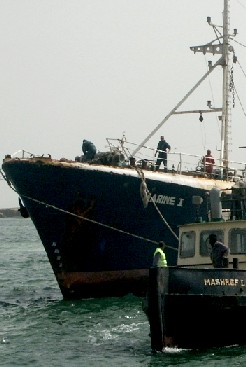
afrol News, 15 February - The 372 would-be migrants that were confined to international waters for more than a week have not been given any answers to what will happen to them next after their unseaworthy vessel, the "Marine 1" docked on Monday in the northern Mauritanian port of Nouadhibou. Although being guarded by Spanish police while on Mauritanian soil, Spain refuses them entry to the Canary Islands.
On Monday, the Asian and African emigrants on board the "Marine 1" finally were given sort of good news when the Mauritanian government gave in to demands the vessel may dock in Nouadhibou. Located in international waters by the Spanish marine on its way to the Canary Islands, all governments in the region had refused to open their waters and ports for the vessel, including Spain, Mauritania, Morocco and Senegal. Therefore, the migrants drifted helpless around for more than one week.
That day, the ship landed shortly before noon and by evening, all 369 migrants were allowed to disembark from the "Marine 1". The sick and vulnerable, many of whom suffered from diarrhoea and exhaustion, were immediately attended to by the Mauritanian Red Crescent and Spanish Red Cross.
The news of the Mauritanian humanitarian action was hailed by human rights and refugee organisations. The International Organisation of Migration (IOM) in a statement said it was "relieved that a solution was found to end the migrants' ordeal at sea." Michael Tschanz, who is heading an IOM team in Nouadhibou, said his organisation would "work with our partners to ensure that those migrants who wish to return home on a voluntary basis can do so as soon as possible."
Already on Tuesday, several countries sent their consular officers to Nouadhibou, seeking to assist their nationals in getting home. Embassy personnel from India, Pakistan and Guinea Conakry attended some of the 372 emigrants - out of which 37 were reported to be West Africans and 335 are South Asians.
By today, however, it seems clear that most would-be migrants still are left in limbo in the Mauritanian desert town. According to the UN refugee agency (UNHCR) in Mauritania, the 37 migrants originating from sub-Saharan Africa have been flown to the Cape Verde islands. Meanwhile, 35 from Afghanistan, Burma and Sri Lanka were sent to the Canary Islands for processing by the Spanish police, as nationals from these countries may have legitimate rights to seek for refugee status.
The remaining 300 passengers on "Marine 1" however still don't know what will happen to them. Ahmedou Ould Haye, the regional delegate for the Red Crescent in Nouadhibou, today told UN media that these migrants "are now sleeping in a warehouse at the port guarded by Spanish police. Spain has refused to allow them to go to the Canary Islands for processing."
Also regarding international law, the situation of these Asian migrants stranded in Mauritania is unclear. As they were in international waters and their docking permission in Mauritania was a result of a humanitarian concession - resulting diplomatic negotiations between regional governments, even UNHCR experts hold that refugee laws do not apply in this situation.
The Asian migrant thus do not have the right to seek asylum neither in Spain nor in Mauritania, despite being on Mauritanian soil and guarded by Spanish police. While not wanting to return to their home countries, it also remains unsure who will have to take responsibility for them or their possible return.
Most of the remaining migrants are believed to be from Pakistan's troubled Kashmir region, meaning Pakistani authorities could be asked to repatriate their nationals - despite their will. The Islamabad government has so far not indicated any interest in intervening.
afrol News - It is called "financial inclusion", and it is a key government policy in Rwanda. The goal is that, by 2020, 90 percent of the population is to have and actively use bank accounts. And in only four years, financial inclusion has doubled in Rwanda.
afrol News - The UN's humanitarian agencies now warn about a devastating famine in Sudan and especially in South Sudan, where the situation is said to be "imploding". Relief officials are appealing to donors to urgently fund life-saving activities in the two countries.
afrol News - Fear is spreading all over West Africa after the health ministry in Guinea confirmed the first Ebola outbreak in this part of Africa. According to official numbers, at least 86 are infected and 59 are dead as a result of this very contagious disease.
afrol News - It is already a crime being homosexual in Ethiopia, but parliament is now making sure the anti-gay laws will be applied in practical life. No pardoning of gays will be allowed in future, but activist fear this only is a signal of further repression being prepared.
afrol News / Africa Renewal - Ethiopia's ambitious plan to build a US$ 4.2 billion dam in the Benishangul-Gumuz region, 40 km from its border with Sudan, is expected to provide 6,000 megawatts of electricity, enough for its population plus some excess it can sell to neighbouring countries.










 front page
| news
| countries
| archive
| currencies
| news alerts login
| about afrol News
| contact
| advertise
| español
front page
| news
| countries
| archive
| currencies
| news alerts login
| about afrol News
| contact
| advertise
| español