Subscriptions Central AfricaEast AfricaHorn of AfricaIndian OceanNorth AfricaSouthern AfricaWest AfricaAfrica / World Agriculture - NutritionCulture - ArtsEconomy - DevelopmentEnvironment - NatureGay - LesbianGender - WomenHealthHuman rightsLabourMediaPoliticsScience - EducationSocietyTechnologyTravel - Leisure From Behind By Country By Topic Chronological Press Releases Partner Media Contact Us


See also:
» 23.04.2008 - SADC set to eradicate poverty
» 22.04.2008 - Forum seeks to protect human trafficked victims
» 15.04.2008 - High-level dialogue links regional integration
» 03.03.2008 - 'Eliminate harmful cultural practices'
» 16.10.2007 - Africa's ARV treatment fails
» 08.08.2007 - Southern Africa: Gender activists urge leaders to bite bullet
» 28.02.2007 - New study counters bid to commercialise ivory
» 23.10.2006 - "Southern Africa soon one market," summit

Southern Africa
Gender - Women | Economy - Development | Society

Risky business of informal cross-border trade

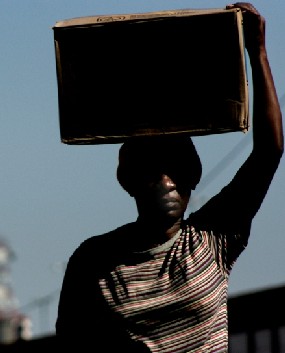
Trading woman in South Africa

Trading woman in South Africa:
«A largely invisible population.»

© Lerato Maduna/GenderLinks/afrol News
afrol News / Gender Links, 22 February
- You see them at every border crossing in Southern Africa, in nearby towns, and every major urban centre. Informal traders who leave home and country determined to earn money by buying, and selling, an assortment of products ranging from food items to electronic appliances - but the business is risky for the mostly women involved.

Although informal cross border traders contribute immensely to the Southern African region - particularly in terms of employment creation, economic upliftment of women, food security, regional economic trade and social integration - they are often invisible: unrecognised at home and harassed in the host country. More than half of informal traders in the world are now women, and yet women traders are especially vulnerable to harassment, abuse, and health risks - including HIV/AIDS.

The lives of these misunderstood informal cross border traders are the subject of "Back and Forth: Informal Cross Border Traders in Southern Africa" - a photo project and exhibit undertaken by the International Organisation for Migration (IOM)'s Partnership on HIV and Mobility in Southern Africa (PHAMSA), in collaboration with the Market Photo Workshop's Photojournalism and Documentary Photography Programme.

Over six-months, advanced photojournalism students, together with selected professional photographers from the region - Botswana, Mozambique, Namibia and Zimbabwe - traced and recorded the work and travels of informal cross-border traders in the region.

The photographs document the lives of informal cross border traders in the region, focusing on their socio-economic conditions, particularly the factors of vulnerability, such as gender inequality, poor living and working conditions, separation from families, exploitation and discrimination, lack of access to health and other services.

To date, no country in the region has a specific permit or visa for these entrepreneurs, and they do not benefit from preferential tariffs. Furthermore, traders, particularly women, face risks of abuse, harassment, exploitation and are exposed to extreme vulnerability, not least of all vulnerability to HIV.

"Older women have traditionally been at the forefront of the informal cross-border trade. Now younger women have also joined the business," notes photographer Tsvangirayi Mukwazhi.

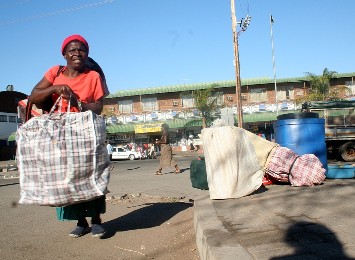
Long waits and exhausting travel are the norms of the traders' lives. Photographer Moshe Sekete captured a woman at the train station in Musina (Limpopo Province, South Africa) who had just placed her luggage on the ground to rest when a voice emanating from the platform announced, "Hurry-up mama, the train is about to leave!" Mr Sekete clicked the camera as the woman gathered her strength, grabbed her belongin
Trading woman at Musina train station

Trading woman at Musina train station:
«Hurry-up mama, the train is about to leave!»

© Moshe Sekete/GenderLinks/afrol News
gs and staggered on.

Traders often spend extended periods away from home in high HIV transmission areas, particularly cross border areas. Here, those who command authority, such as border/customs officials, or those who possess economic resources, such as moneychangers or taxi drivers, may take advantage of the women.

Transport and quality accommodation can also be a challenge for many traders who survive on meagre resources. Thus, transactional sexual relationships may arise between female traders and truck drivers in exchange for free transport or opportunity to sleep in the trucks. Furthermore, some female traders end up sleeping in the open, again, exposing them to various vulnerabilities including sexual assault.

Moreover, in general, informal cross border traders have limited access to healthcare services, including HIV and AIDS interventions. In most countries, foreigners pay a higher fee for public healthcare services, and thus informal cross border traders may be less inclined to seek treatment while travelling.

Few HIV and AIDS interventions are specifically for cross border traders, partially due to difficulties in actually targeting people constantly on the move. Traders are often preoccupied with survival needs, and may not be receptive to HIV and AIDS education and prevention messages.

In addition to the objective of raising awareness among stakeholders on the lives of informal cross border traders, the photography project also aimed to build capacity and increase awareness of the participating photographers on issues related to HIV, AIDS and migration. The photographers first received preparatory sensitisation training by IOM on the issues. They then went out and travelled with informal cross border traders, informally interviewing them, and getting to know what their lives are like.

While many Southern African citizens benefit from these traders, purchasing their many varied goods, few actually think about what life is like to spend so many days so far from home. The project participants therefore now appeal to all citizens, and especially service agencies, to take into account this largely invisible population.


By Reiko Matsuyama
Ms Matsuyama is a Project Officer with the Partnership on HIV and Mobility in Southern Africa (PHAMSA) Programme of the International Organisation for Migration (IOM) Pretoria.


    E-mail this to a friend     Printable version

Related pages and feature
Current afrol News Top Stories
Southern Africa
Gender - Women
Economy - Development
Society
Economic rights
Health
Poverty
Social Services
Trade
» Niger Delta crisis set to end
» Gambia leader validates Mugabe's re-election
» Hope for African banana farmers
» Toybou confirmed Anjouan president
» Congo ex-leader appears in court
» Dispute over ceding of Bakassi continues
» Senior Darfur rebel on trial
» Sudan troops withdraw from Abyei
» 71 Somali insurgents killed in fresh clashes
» Officials deny Mwanawasa death reports


top of page about afrol News | news | countries | archive | services | feed back | español 

© afrol News. Reproducing or buying afrol News' articles.

   You can contact us at mail@afrol.com