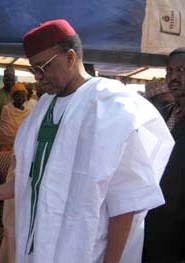
Deposed President Mamadou Tandja of Niger became increasingly isolated during his last year in power, being accused of establishing an unconstitutional government.
afrol News, 19 February - African and world leaders condemned Niger's toppled President Mamadou Tandja for his unconstitutional rule and isolated the country. Now, the world condemns the coup in Niger as the coup-makers say their intention is to restore a constitutional democracy. But is the condemnation sincere? And is there any way out of isolation for Niger?
Any military coup is inacceptable. That is the firm basis of international politics, and it is an especially important ground rule in African politics as defined by the African Union and regional blocks such as West Africa's ECOWAS.
It is therefore no surprise that there is a massive wave of international protests against yesterday's coup in Niger, where a military junta led by squadron leader Salou Djibo toppled President Tandja. African and world leaders are obliged and programmed to condemn the coup.
Chairman Jean Ping of the African Union (AU) today took a natural lead in condemning the Niger coup. More surprisingly, between the lines, the condemnation was rather weak. Mr Ping recognised that "developments in the country" - meaning the undemocratic steps taken by ousted President Tandja - had "led to the seizure of power." The AU leader also emphasised that the Union "systematically" condemns "any unconstitutional change."
Was the AU condemnation thus only an announcement made by obligation, while AU leaders in reality welcomed the coup? Mr Ping's declarations indicate that the AU may be happy to get rid of President Tandja, but nevertheless fears what may now happen in Niger. Mr Ping called for "the speedy return to constitutional order" and announced the AU would be willing to engage Niger's new rulers "to facilitate such a process."
But, despite a possible joy over getting rid of Mr Tandja, the AU indeed is serious when "systematically" condemning coups in Africa. In its efforts to promote good governance and international credibility for Africa, it needs an end to the culture of coups spoiling the continent's image. And the bad news is that coup d'états seem to become more common again - examples being Mauritania, Togo, Gabon, Madagascar and Guinea. New experience shows potential coup-makers that, with some willingness to engage in democratic ground rules, condemnation will be short-lived and their rule can be recognised.
If the Niger coup-makers rapidly engage in talks with the AU and ECOWAS, but also with Nigerien political groups, and give clear signals of promoting democratic structures, isolation will soon be broken. For Niger, this may be a happy outcome. But for Africa - and this is the AU's dilemma - it is a dangerous development that can only inspire potential coup plotters all over the continent.
So the condemnation has been massive from all over Africa. The Economic Community of West African countries (ECOWAS), followed by South African President Jacob Zuma, made it clear that any unconstitutional power change in Africa was totally unacceptable.
But ... Niger was already isolated by ECOWAS before the coup. The regional body had found that President Tandja maintained his grip on power by unconstitutional means, thus suspending Niger's ECOWAS membership. And immediately after the Niger coup, already yesterday evening, Senegal's President Abdoulaye Wade announced he was sending his Foreign Minister to Niger to engage the coup-makers in talks. President Wade headed ECOWAS negotiations to restore the constitutional order in Niger before the coup, and says he has been given green light by ECOWAS to negotiate with the new rulers.
Reactions from outside Africa have followed the AU's soft condemnation line. UN Secretary-Gener
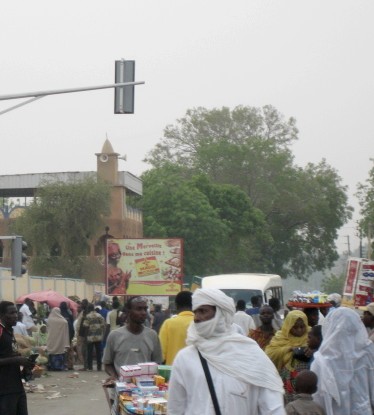
Calm has returned to Niamey. On Friday, normal business activity has resumed, with open shops and banks, and people going to street markets. People demonstrated confidence in the calmness.
al Ban Ki-moon called on all stakeholders in Niger to "swiftly revert to constitutional order in the settlement of the political crisis," thus placing parts of the blame for the coup on President Tandja, who, according to the UN, had made moves allowing him "to hold power indefinitely." No sympathy for Mr Tandja here neither, it seems.
Western countries have entered the same course. Ex-colonial power France today condemned "any seizure of power by non-constitutional means," not the Niger coup plotters specifically, and called on "all parties" to find "a solution to the constitutional crisis."
The exceptional of all these international reactions is the typical lack of a direct criticism of Niger's coupists - only condemnation of coups in general - and the general willingness to place guilt on the old regime of President Tandja. While giving an impression of a world-wide condemnation of Niger's coup, the message is still that the coup was understandable given Mr Tandja's undemocratic behaviour.
So, is there anyway out of isolation and condemnation for Niger? The world's and Africa's preferred option of course would have been that President Tandja could have been persuaded to return to the constitutional order. Especially ECOWAS invested strongly in this solution, but was increasingly frustrated by the toppled President's stubbornness. The preferred option, it became clear, was not realistic. And now, after the coup, it is out of the question.
With Mr Tandja out of the way, the international community will be defining a new preferred option. This means influencing the military junta to live up to their promises of re-establishing "an exemplary democracy". If the junta engages in dialogue; quickly embarks of democratic reforms; outlines credible timetable for elections; and declines on presenting its members as candidates in these elections - then the junta soon will be bearers of hope. While isolation in official terms cannot be lifted until free elections have restored the constitutional order, isolation in practical terms will be lifted if the international community finds reason to believe in the sincerity of the junta.
Will the junta be able to live up to this preferred path of developments? There are reasons for optimism and for pessimism. The main reasons for pessimism lie in the relatively young age and low ranks of the coup-makers, allowing doubts about their political experience. Young inexperienced coup officers too often have developed into fierce dictators in Africa.
But there are good reasons for optimism as well. The vague programme presented by the junta in its first public appearance points in just the desired direction. They say they want "an exemplary democracy" for Niger. This shows that the young officers at least have understood very well what is expected of them. Also, Nigeriens have grown fond and proud of their democratic institutions - threatened to be destroyed by Mr Tandja - and there is a very widespread support of "an exemplary democracy" in Niger. The Nigerien population therefore will pressure for a democratic path.
But it too early to say which way developments in Niger will go. So far, Nigeriens and the international community can only place hope in the sincerity of the military junta's first statements.
afrol News - It is called "financial inclusion", and it is a key government policy in Rwanda. The goal is that, by 2020, 90 percent of the population is to have and actively use bank accounts. And in only four years, financial inclusion has doubled in Rwanda.
afrol News - The UN's humanitarian agencies now warn about a devastating famine in Sudan and especially in South Sudan, where the situation is said to be "imploding". Relief officials are appealing to donors to urgently fund life-saving activities in the two countries.
afrol News - Fear is spreading all over West Africa after the health ministry in Guinea confirmed the first Ebola outbreak in this part of Africa. According to official numbers, at least 86 are infected and 59 are dead as a result of this very contagious disease.
afrol News - It is already a crime being homosexual in Ethiopia, but parliament is now making sure the anti-gay laws will be applied in practical life. No pardoning of gays will be allowed in future, but activist fear this only is a signal of further repression being prepared.
afrol News / Africa Renewal - Ethiopia's ambitious plan to build a US$ 4.2 billion dam in the Benishangul-Gumuz region, 40 km from its border with Sudan, is expected to provide 6,000 megawatts of electricity, enough for its population plus some excess it can sell to neighbouring countries.










 front page
| news
| countries
| archive
| currencies
| news alerts login
| about afrol News
| contact
| advertise
| español
front page
| news
| countries
| archive
| currencies
| news alerts login
| about afrol News
| contact
| advertise
| español