afrol News, 22 March - Several government and pro-government Ethiopian websites are being attacked by viruses, making them unsafe to accede. It remains unclear whether this is anti-government sabotage or a result of poor virus protection in Ethiopia.
An afrol News reporter recently had his computer infected with the malicious spyware "Security Essential 2010" after doing research on a website run by the Ethiopian Ministry of Foreign Affairs. Without any presage, the hostile programme installed itself in the journalist's pc, finally paralysing it and requiring an entirely new installation and much loss of data.
Shortly after, another journalist almost fell into the same trap on an Ethiopian pro-government online media. But advised by colleagues to be especially careful with Ethiopian websites, he managed to escape the spyware attack by swiftly turning off the computer.
Research by afrol News demonstrates that these are not casual single experiences. Indeed, it showed, a larger number of Ethiopian sites on the Internet are currently (March 2010) unsafe.
Normal anti-virus programmes usually do not detect the danger before it is too late. But the Google search engine - itself entering websites worldwide to map their content - has noted the increasing problem.
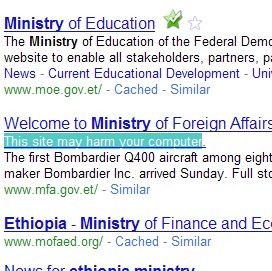
Several key Ethiopian websites are marked "This site may harm your computer" when listed in a Google search. This was not the case until recently.
The websites include the proper online presence of the Ministry of Foreign Affairs of Ethiopia (mfa.gov.et), but also the Ministry of Information (moinfo.gov.et), the National Bank of Ethiopia (nbe.gov.et) and the Ethiopian Embassy in Stockholm, Sweden.
Among the Ethiopian media websites where our reporters have found aggressive spyware were the 'Ethiopian News Journal' (www.ethjournal.com), which however is not marked by Google as a harmful web address. The problem at this Ethiopian media may thus have already been fixed.
Asking several Ethiopian sources about why there are currently so many government sites infected by harmful software, nobody had an answer. Initial speculations went in the direction of sabotage acts from Eritrea or from exiled opposition groups. None of the sources however wanted to state their name.
The theory is not totally unreasonable. One year ago, hackers infected the website of the Ethiopian Embassy in Washington, along with embassies from two other countries, with similar spyware. The Embassy's website was quickly cleaned up and is now risk-free.
But there may be other explanations to these attacks on Ethiopian government websites. Virus and spyware protection programmes are used too seldom on computers in Ethiopia, while outdated software with high security threats is widely in use. In Ethiopian Internet cafés, visitors are at high risk to get a virus infection on their memory sticks. Since 2008, computer viruses have been a serious problem in Ethiopia, even with home-grown infections.
And also computers in public offices are known to be poorly protected. Since one year, though, the Ethiopian Information Network Security Agency launched its own virus protection programme for the national public. The programme has replaced expensive foreign anti-virus programmes on pc-s in many state agencies.
There is another detail indicating that the spread of these viruses comes from within Ethiopia, and not from the outside. Also a few non-Ethiopian websites operated from Ethiopia have been infected. The Google search engine also warns that the website of the Indonesian Embassy in Addis Ababa "may harm your computer."
afrol News - It is called "financial inclusion", and it is a key government policy in Rwanda. The goal is that, by 2020, 90 percent of the population is to have and actively use bank accounts. And in only four years, financial inclusion has doubled in Rwanda.
afrol News - The UN's humanitarian agencies now warn about a devastating famine in Sudan and especially in South Sudan, where the situation is said to be "imploding". Relief officials are appealing to donors to urgently fund life-saving activities in the two countries.
afrol News - Fear is spreading all over West Africa after the health ministry in Guinea confirmed the first Ebola outbreak in this part of Africa. According to official numbers, at least 86 are infected and 59 are dead as a result of this very contagious disease.
afrol News - It is already a crime being homosexual in Ethiopia, but parliament is now making sure the anti-gay laws will be applied in practical life. No pardoning of gays will be allowed in future, but activist fear this only is a signal of further repression being prepared.
afrol News / Africa Renewal - Ethiopia's ambitious plan to build a US$ 4.2 billion dam in the Benishangul-Gumuz region, 40 km from its border with Sudan, is expected to provide 6,000 megawatts of electricity, enough for its population plus some excess it can sell to neighbouring countries.










 front page
| news
| countries
| archive
| currencies
| news alerts login
| about afrol News
| contact
| advertise
| español
front page
| news
| countries
| archive
| currencies
| news alerts login
| about afrol News
| contact
| advertise
| español