See also:
» 25.02.2010 - Paris Club cuts DRC’s debt by half
» 27.01.2010 - UN agency working with 100,000 DRC refugees
» 16.12.2009 - DRC conservation initiative receives international recognition
» 08.12.2009 - Arms and minerals’ smuggling still rife in DRC, report
» 25.11.2009 - UN mission failing to root out rebels in DRC
» 29.10.2009 - UN steps in to help in Angola/DRC refugee saga
» 15.09.2009 - European Council adopts new joint action on DR Congo
» 09.09.2009 - UK unveils funding plan to rebuild the Congo's road network


SQL/DB Error -- [Unknown table engine 'InnoDB']
Congo Kinshasa
Economy - Development | Politics

DRC looking east for development ease

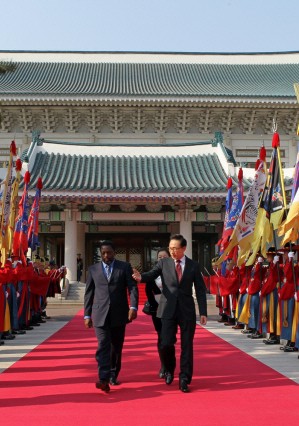
DRC President Joseph Kabila is received by South Korean President Lee Myung-bak

© Korean presidency/afrol News
afrol News, 29 March
- The Democratic Republic of Congo (DRC) is looking to Asia for spontaneous development partnerships, while at the same time struggling to meet deadlines and conditions from Western donors to be considered for debt relief under the HIPC (Highly Indebted Poor Countries) status programme.

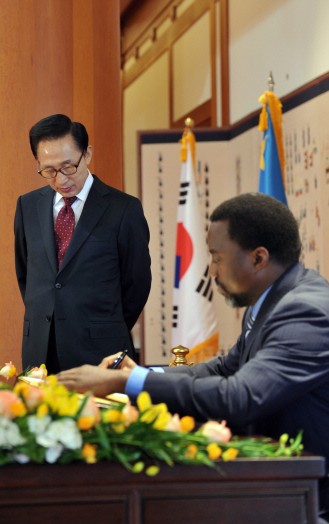
Today, President Joseph Kabila, who is on a three-day official visit to South Korea, has signed a number of agreements that include a deal to modernise industrial infrastructure and develop rural areas through sharing of experiences as well as technical and financial support.

The DRC, with over an US$ 11 billion debt to settle, stays with a hope that it would be slashed by a sizeable amount by June this year, to be able to float above the storms of its development and economic reforms.

Still recovering from years of internal warring, unending destabilisation of rebels' germination and natural disasters, Mr Kabila's administration has had little luck to attract major funding for its economic programmes, despite its mineral wealth.

Last week the International Monetary Fund (IMF) insisted on the meeting of the HIPC conditionalities before the country could be recommended for substantial debt relief.

"The mission, in collaboration with World Bank staff, reviewed the status of the HIPC triggers, whose observance is a condition for reaching the completion point and receiving substantial debt relief from external creditors," said the IMF mission at the end of their visit in Kinshasa.

The mission said while there has been good progress on all fronts, the need for the observance of the seven triggers would require steadfast actions by the Kinshasa government, further adding that this would be facilitated by the monitoring committee which has been created under the authority of the Prime Minister.

"If all goes well on the authorities' part, the IMF and World Bank staffs expect to submit the request for debt relief under the HIPC Initiative and the Multilateral Debt Relief Initiative to their r

DRC President Joseph Kabila and Korean President Lee Myung-bak signing cooperation agreements in Seoul

© Korean presidency/afrol News
espective Boards before end-June. Looking ahead, additional donor budget support would help maintain macroeconomic stability and protect pro-poor spending," stated the IMF mission.

But it may take time before the DRC meets all the demands by the IMF and thus will get access to Western aid and debt relief. Meanwhile, it is easier to turn to Asia for economic aid. Being immensely rich in minerals that are scarce in Asia, the DRC has already attracted investments from China, Japan and other Asian economies, most of which do not set as many conditions as the IMF and the West.

A journey to Korea was therefore timely. While in South Korea, President Kabila would also be looking at possible funding initiatives for his country, through bilateral cooperation in the energy, resources and construction sectors.

It was also revealed that South Korea planned to participate in the DR Congo's projects to build seaports, highways, power plants and other industrial infrastructure as part of the long term discussions.

President Kabila has also reportedly asked his counterpart, President Lee Myung-bak, to help bring to DRC the experiences of South Korea, once one of the poorest nations, but now an economic power in its own right. The Korean model has become a popular school for African developing nations, with the Seoul development agency sending trainers around the continent.

During his stay in South Korea, President Kabila is also scheduled to meet with the business leaders, receive an honorary doctorate from Hanyang University and tour southern industrial cities.

The DRC and South Korea established diplomatic ties in 1963 and this was Mr Kabila's second trip to South Korea, the first being in 2005.


- Create an e-mail alert for Congo Kinshasa news
- Create an e-mail alert for Economy - Development news
- Create an e-mail alert for Politics news


    Printable version

On the Afrol News front page now


UN will not monitor human rights in Western Sahara

afrol News - The US has backed down on its demand that UN peacekeepers in Moroccan-occupied Western Sahara also shall monitor the human rights situation after Moroccan sources threatened to scale down relations with Washington.
Central African Republic
Central African Republic falling apart

afrol News - One month after the rebel movement Séléka took over power in the Central African Republic, unrest is spreading in the country. The new leader lacks control of his forces, which continue looting and abusing civilians.
Kenya
Kenyatta secures tight victory in Kenya

afrol News - The official election results in Kenya have finally been announced, and Uhuru Kenyatta managed to win the first poll round outright with a narrow 50.7 percent. But the main opponent, PM Raila Odinga, is filing a vote rigging complaint to the courts.
Cape Verde
Cape Verde to produce dragon fruit

afrol News - Cape Verde authorities have invested large sums to diversify the arid country's agricultural sector. Now, the dragon fruit, originating in tropical America, is being introduced for the first commercial production in Africa.
Egypt
Even governors in Pharaonic Egypt died in their 20s

afrol News - Researchers have analysed more than 200 mummies from ancient Egypt, finding that even high dignitaries were poorly nourished and had infectious diseases. The typical governor in Pharaonic Egypt died before he was 30 years old.


front page | news | countries | archive | currencies | news alerts login | about afrol News | contact | advertise | español 

©  afrol News. Reproducing or buying afrol News' articles.

   You can contact us at mail@afrol.com