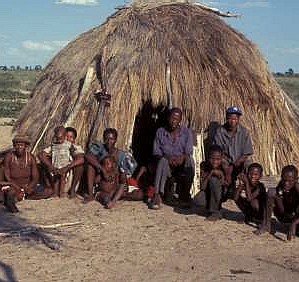
afrol News, 1 June - Indigenous San people ("Bushmen") in the Kalahari desert are taking the Botswana government to court over its refusal to allow them access to water boreholes on their ancestral land.
The case is due to be heard at Botswana's High Court in Lobatse on 9 June, with lawyers representing the San community living in the Central Kalahari Game Reserve asking for a court order to uncap water sources used by the community before 2002.
The government originally evicted the San community from the Central Kalahari Game Reserve in 2002, citing environmental reasons and a wish to centralise San settlements to provide education and other government services. During the forced eviction, Botswana police removed the pump and capped the borehole, the only reliable source of clean water for the San communities in the Reserve.
In 2006, the Botswana's High Court ruled that the government had acted unconstitutionally when it evicted the San and said they had the right to return to the Reserve. Hundreds of San have since gone back home, while others have waited for infrastructure exiting prior to 2002 to be re-established.
Despite repeated attempts to negotiate, the Botswana government still refuses to let the San community use the water borehole. The San community, living in one of the world's driest regions, is forced to make an arduous 450 kilometres round trip to obtain water outside the reserve. Since the borehole was capped one community member has died of dehydration, according to pro-San activists.
According to Jumanda Gakelebone, a spokesman of the San living in the reserve, "the High Court said we have the right to live on the land of our ancestors. Surely that includes the right to drink our water."
Many San community members, Mr Gakelebone said today, "especially the old people and the young are suffering from lack of water. It pains us that the animals and tourists on our land can drink our water to their heart's content yet we go thirsty. We pray that the court will give us back our water."
The San community of the Central Kalahari Game Reserve has received much international support for its fight to resume its traditional way of life in the desert reserve. The reserve was originally established by the British colonial rule to preserve the San's livelihood, but pressure from the tourism industry and mining companies has made the reserve a valuable asset for the Botswana government.
The UN's top official on indigenous rights, Professor James Anaya, has condemned the government for its treatment of the San, stating that it falls short of the "relevant international human rights standards". He found that the San in the reserve "face harsh and dangerous conditions due to a lack of access to water," and urged the Botswana government to reactivate the borehole "as a matter of urgent priority."
The UK-based activist group Survival, supporting the San community, today claims the Botswana government "seems determined not only to flout the order of the Court" that ordered it to allow the San to return in 2006, "but to deny them their human right to water." Survival is appealing for international support for the San's case at the Lobatse court.
afrol News - It is called "financial inclusion", and it is a key government policy in Rwanda. The goal is that, by 2020, 90 percent of the population is to have and actively use bank accounts. And in only four years, financial inclusion has doubled in Rwanda.
afrol News - The UN's humanitarian agencies now warn about a devastating famine in Sudan and especially in South Sudan, where the situation is said to be "imploding". Relief officials are appealing to donors to urgently fund life-saving activities in the two countries.
afrol News - Fear is spreading all over West Africa after the health ministry in Guinea confirmed the first Ebola outbreak in this part of Africa. According to official numbers, at least 86 are infected and 59 are dead as a result of this very contagious disease.
afrol News - It is already a crime being homosexual in Ethiopia, but parliament is now making sure the anti-gay laws will be applied in practical life. No pardoning of gays will be allowed in future, but activist fear this only is a signal of further repression being prepared.
afrol News / Africa Renewal - Ethiopia's ambitious plan to build a US$ 4.2 billion dam in the Benishangul-Gumuz region, 40 km from its border with Sudan, is expected to provide 6,000 megawatts of electricity, enough for its population plus some excess it can sell to neighbouring countries.










 front page
| news
| countries
| archive
| currencies
| news alerts login
| about afrol News
| contact
| advertise
| español
front page
| news
| countries
| archive
| currencies
| news alerts login
| about afrol News
| contact
| advertise
| español