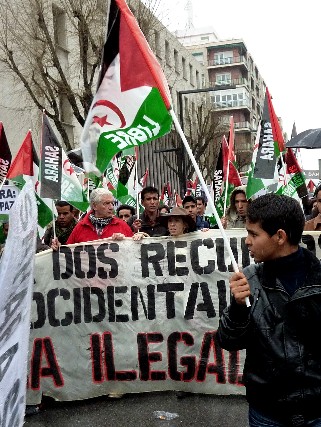
afrol News, 4 June - Last year, the European Parliament stated that EU fisheries in Western Sahara would be illegal if the indigenous Saharawis were not consulted. But now, Morocco refuses EU parliament members to travel to the territory to examine if they are.
The fisheries agreement between the European Union (EU) and Morocco continues to create controversy as it includes licences for EU vessels to fish outside Western Sahara, a territory occupied by Morocco. Trade agreements between Morocco and the US or EFTA had specifically excluded Western Sahara and the UN has termed exploitation of Western Sahara resources illegal unless the Saharawi population benefits directly from it.
Within the EU, the Morocco-EU fisheries deal meets increasing resistance. In December 2009, the European Parliament's fisheries committee issued a request to visit Morocco, with the objective to examine how the EU-Moroccan fisheries partnership agreement (FPA) is implemented and whether the Saharawis benefit from it.
After months went by without any official reply, Morocco has now officially rejected the Fisheries Committee's proposal of visiting the territory, claiming the timing for such a visit "is not opportune". This happens several months after Morocco first had left the impression to the European presidency that a visit by the Europeans would be accepted.
The EU Parliament's own Legal Services had already stated that since the indigenous people in Western Sahara, the Saharawis, are not consulted over the agreement, the EU-Moroccan cooperation must be in violation of international law. Morocco has occupied Western Sahara since 1975, and EU is spending millions of euros annually to pay Morocco to allow mostly Spanish vessels to fish off Western Sahara. The Sahrawis object to European vessels trawling their waters.
"It is a pity the Moroccan authorities do not grant the European Parliament the possibility to establish the facts on the ground", said Isabella Lövin, one of the 9 members of the EU parliament who had signed up to be part of the delegation.
"It seemed an excellent opportunity to demonstrate whether the Saharawi population of Western Sahara benefits from the EU-Moroccan Fisheries Agreement, as the European Commission claims. It is really a pity, and also a bit strange", Ms Lövin stated.
The negative response "does not come as a surprise," according to the pro-Saharawi activist group Fishelsewhere. The controversial EU-Moroccan fisheries agreement has been under increasing fire since the legal opinion delivered by the EP's Legal Services in 2009. The opinion questioned the legality of the agreement since there is no proof that the Saharawi people's wishes and benefits had been taken into account.
Attempting to defend the much criticised agreement it had negotiated in 2006, the European Commission has repeatedly responded that "there is no proof that the Saharawi people do not benefit". Yet, the Commission has still not presented any evidence backing that claim, and has up to now avoided mentioning the matter of the Saharawi peoples' wishes altogether.
The European Commission only defence is a UN legal opinion from 2002. The author of that opinion, Hans Corell, however has stated he is "embarrassed to be European", due to the EU's misuse of his text.
"It has been suggested to me that the legal opinion that I delivered in 2002 had been invoked by the European Commission in support of the Fisheries Partnership Agreement. I do not know if this is true. But if it is, I find it incomprehensible that the Commission could find any such support in the legal opinion," Mr Corell states.
During yesterday's session of the Fisheries Committee, parliament members also asked about the state-of-play on another request they had made to Morocco earlier this year: to deliver a report on the impact of the fisheries agreement on the Saharawi population. The deadline for that report was set during the first quarter of 2010. The Committee said it had still not received any official reply.
It is expected that Morocco's report, when finalised, will claim that the agreement is beneficial to the "local population", which is the way Morocco defines the people who have been moved into the territory from Morocco. A majority of Saharawis now live in refugee camps in Algeria, while Western Sahara's coastal towns now are dominated by Moroccan immigrants.
afrol News - It is called "financial inclusion", and it is a key government policy in Rwanda. The goal is that, by 2020, 90 percent of the population is to have and actively use bank accounts. And in only four years, financial inclusion has doubled in Rwanda.
afrol News - The UN's humanitarian agencies now warn about a devastating famine in Sudan and especially in South Sudan, where the situation is said to be "imploding". Relief officials are appealing to donors to urgently fund life-saving activities in the two countries.
afrol News - Fear is spreading all over West Africa after the health ministry in Guinea confirmed the first Ebola outbreak in this part of Africa. According to official numbers, at least 86 are infected and 59 are dead as a result of this very contagious disease.
afrol News - It is already a crime being homosexual in Ethiopia, but parliament is now making sure the anti-gay laws will be applied in practical life. No pardoning of gays will be allowed in future, but activist fear this only is a signal of further repression being prepared.
afrol News / Africa Renewal - Ethiopia's ambitious plan to build a US$ 4.2 billion dam in the Benishangul-Gumuz region, 40 km from its border with Sudan, is expected to provide 6,000 megawatts of electricity, enough for its population plus some excess it can sell to neighbouring countries.










 front page
| news
| countries
| archive
| currencies
| news alerts login
| about afrol News
| contact
| advertise
| español
front page
| news
| countries
| archive
| currencies
| news alerts login
| about afrol News
| contact
| advertise
| español