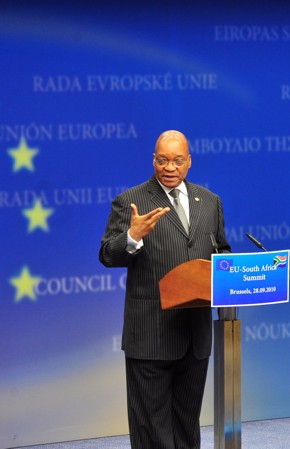
afrol News, 29 September - South African President Jacob Zuma in Brussels today urged the European Union (EU) to lift sanctions against Zimbabwe. Otherwise, Zimbabwe's democratic transition would remain slow.
The South African President, making his first speech to the European Parliament today, did not mention any delicate issues in his address to parliamentarians. Zimbabwe was not on his agenda.
But Louis Michel, an MEP well known to President Zuma, after the speech asked the South African leader to comment on US and EU sanctions against Zimbabwe. Mr Zuma did not need to be asked twice to comment the controversial issue, which has split the EU and the Southern African Development Community (SADC).
"On Zimbabwe, we gave leadership before anybody else did and the current power-sharing deal was facilitated by South Africa", Mr Zuma told MEPs, as he called on the international community to lift sanctions against the SADC country.
"This would give a chance to the efforts we are making there and empower the Southern African Development Community to do more on Zimbabwe," he added. SADC is, among other things, trying to accelerate the process towards free elections in Zimbabwe.
Commenting on EU and US travel bans and asset freezes imposed on some of Zimbabwe's leading figures, including President Robert Mugabe and fellow ZANU-PF party members, Mr Zuma said that "sticking to the sanctions on individuals will give credit to the argument of the ZANU-PF that the functioning of the unity government is not supported to the fullest."
European parliamentarians however urged President Zuma that South Africa should play a more active role in helping to resolve some of Africa's most acute crises, including the slow democratisation in Zimbabwe.
President Zuma's remarks on the Zimbabwe sanctions come one day after the EU signalled it could reconsider its relations with the country. EU president Herman van Rompuy yesterday indicated the union, "in case of positive developments in Zimbabwe," would be ready "to look at fresh measures."
"The EU wants to give Zimbabwe chances of success," Mr van Rompuy said at the EU-South Africa summit yesterday. The EU leader added that the European bloc over the last 18 months had invested around euro 365 million in good governance-related projects in Zimbabwe. Current sanctions did not harm "ordinary citizens" or development at large, he insisted.
Only last year, the EU extended its sanctions against the Zimbabwean leadership by one year and included an embargo on arms and police weaponry. Also the US extended its sanctions. Both referred to systematic human rights abuses by the Mugabe regime.
Meanwhile, a unity government has come to power in Zimbabwe, with Mr Mugabe staying in the presidency and former MDC opposition leader Morgan Tsvangirai heading the MDC-ZANU unity government as Prime Minister.
Also PM Tsvangirai has called for a lifting of the sanctions, although he holds the ZANU party responsible for the US and EU's reluctance to do so.
afrol News - It is called "financial inclusion", and it is a key government policy in Rwanda. The goal is that, by 2020, 90 percent of the population is to have and actively use bank accounts. And in only four years, financial inclusion has doubled in Rwanda.
afrol News - The UN's humanitarian agencies now warn about a devastating famine in Sudan and especially in South Sudan, where the situation is said to be "imploding". Relief officials are appealing to donors to urgently fund life-saving activities in the two countries.
afrol News - Fear is spreading all over West Africa after the health ministry in Guinea confirmed the first Ebola outbreak in this part of Africa. According to official numbers, at least 86 are infected and 59 are dead as a result of this very contagious disease.
afrol News - It is already a crime being homosexual in Ethiopia, but parliament is now making sure the anti-gay laws will be applied in practical life. No pardoning of gays will be allowed in future, but activist fear this only is a signal of further repression being prepared.
afrol News / Africa Renewal - Ethiopia's ambitious plan to build a US$ 4.2 billion dam in the Benishangul-Gumuz region, 40 km from its border with Sudan, is expected to provide 6,000 megawatts of electricity, enough for its population plus some excess it can sell to neighbouring countries.










 front page
| news
| countries
| archive
| currencies
| news alerts login
| about afrol News
| contact
| advertise
| español
front page
| news
| countries
| archive
| currencies
| news alerts login
| about afrol News
| contact
| advertise
| español