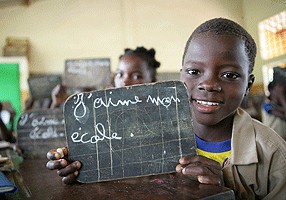
afrol News, 29 September - Beninese authorities report they are on track to ensure primary education for all by 2015, provided current efforts can be maintained. Already last year, school enrolment reached 109 percent(!).
This are the findings of a special report reviewing Benin's progress toward the achievement of the Millennium Development Goals (MDGs), prepared by the government of Benin with the help of the UN. The MDGs are to be reached by 2015 and include universal primary education.
According to the report, primary education gross enrolment ratio increased to 109.1 percent in 2009 from approximately 68 percent in 1980.
This sharp increase, beyond 100 percent, is attributed to a surge of children outside the primary school age, six to 11 years old, entering the first year of the primary education cycle.
This positive trend is attributable to key policies adopted by the government, with support from partners such as UNDP, the most important being the decision to increase the education budget to 24 percent of GDP, and the introduction of free primary school education in 2006.
The government also adopted several policies to include the community in the development process. It created the "Clubs of Mothers" to visit parents in their homes and educate them on the value of education. Additionally, tit conducted surveys on girls enrolment; deliveries of school supplies and provided assistance to children in distress.
"Benin is also witnessing favourable trends with regard to lowering the infant mortality rate and enhancing access to drinking water," according to the UN's development agency UNDP.
"However, major challenges remain," the UN agency adds. "For instance, 51.6 percent of the population lives below the threshold of one dollar per day; and for more than a decade now, this indicator has remained substantially unchanged."
Beninese authorities have used the last years of strong economic to increase its social spending. However, the financial crisis hit Benin last year, and GDP growth fell to only 2.7 percent. This is close to Benin's high population growth rate, meaning GDP per capita stood still in 2009.
Also for 2010, only modest economic growth is expected, according to projections by the International Monetary Fund (IMF). But the Fund foresees very strong growth in the 2011-15 period, and the Beninese government has pledged to spend most of its coming surpluses on social development, including education.
afrol News - It is called "financial inclusion", and it is a key government policy in Rwanda. The goal is that, by 2020, 90 percent of the population is to have and actively use bank accounts. And in only four years, financial inclusion has doubled in Rwanda.
afrol News - The UN's humanitarian agencies now warn about a devastating famine in Sudan and especially in South Sudan, where the situation is said to be "imploding". Relief officials are appealing to donors to urgently fund life-saving activities in the two countries.
afrol News - Fear is spreading all over West Africa after the health ministry in Guinea confirmed the first Ebola outbreak in this part of Africa. According to official numbers, at least 86 are infected and 59 are dead as a result of this very contagious disease.
afrol News - It is already a crime being homosexual in Ethiopia, but parliament is now making sure the anti-gay laws will be applied in practical life. No pardoning of gays will be allowed in future, but activist fear this only is a signal of further repression being prepared.
afrol News / Africa Renewal - Ethiopia's ambitious plan to build a US$ 4.2 billion dam in the Benishangul-Gumuz region, 40 km from its border with Sudan, is expected to provide 6,000 megawatts of electricity, enough for its population plus some excess it can sell to neighbouring countries.










 front page
| news
| countries
| archive
| currencies
| news alerts login
| about afrol News
| contact
| advertise
| español
front page
| news
| countries
| archive
| currencies
| news alerts login
| about afrol News
| contact
| advertise
| español