afrol News, 29 September - The economy of Guinea-Bissau just does not want to take off. For years to come, per capita GDP growth is projected to be minimal, a new analysis shows.
The International Monetary Fund (IMF) during the last two weeks has had a mission in Bissau to review the economic performance of the impoverished and chronically unstable West African nation. The conclusions were more optimistic than before, but still chilling.
IMF mission leader Paulo Drummond noted that the renewed political instability in Guinea-Bissau in the first half of 2010 again had led to economic setbacks. In particular, donor budget support had again fallen back, limiting growth potentials.
However, on the positive side, "higher prices for cashews, the predominant export, and stable remittances helped sustain incomes and alleviated fiscal and balance of payments pressures. Construction activity has been buoyant despite a delay in the government investment programme," Mr Drummond said.
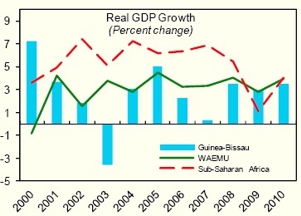
Therefore, and despite the setbacks, Guinea-Bissau at least could count on a 3.5 percent growth in real GDP during 2010, the IMF analysts estimated. Corrected with population growth - estimated at 2.2 percent annually - GPD per capita however only was set to grow at a modest 0.5 percent, according to the IMF.
Unfortunately, the Fund is not much more optimistic for the years to come. For 2011 and 2012, the IMF analysts foresee GDP growth rates of 4.3 and 4.5 percent. This translates to GDP per capita growth rates of 1.3 and 1.5 percent - far too low to address Guinea-Bissau's pervasive poverty problem.
And even these slightly optimistic growth prognoses are uncertain, the Fund holds. "Continued political stability and improved security continue to be critical to economic prospects," Mr Drummond emphasised.
Some relief however was in sight, according to the IMF analyst.
If Bissau authorities were able to keep on their current paste in the economic reform programme, the country could be eligible for massive debt cancellation already by the end of this year. So far, creditors have been hesitant on reducing Guinea-Bissau's debt burden, also in reference to the country's political instability.
afrol News - It is called "financial inclusion", and it is a key government policy in Rwanda. The goal is that, by 2020, 90 percent of the population is to have and actively use bank accounts. And in only four years, financial inclusion has doubled in Rwanda.
afrol News - The UN's humanitarian agencies now warn about a devastating famine in Sudan and especially in South Sudan, where the situation is said to be "imploding". Relief officials are appealing to donors to urgently fund life-saving activities in the two countries.
afrol News - Fear is spreading all over West Africa after the health ministry in Guinea confirmed the first Ebola outbreak in this part of Africa. According to official numbers, at least 86 are infected and 59 are dead as a result of this very contagious disease.
afrol News - It is already a crime being homosexual in Ethiopia, but parliament is now making sure the anti-gay laws will be applied in practical life. No pardoning of gays will be allowed in future, but activist fear this only is a signal of further repression being prepared.
afrol News / Africa Renewal - Ethiopia's ambitious plan to build a US$ 4.2 billion dam in the Benishangul-Gumuz region, 40 km from its border with Sudan, is expected to provide 6,000 megawatts of electricity, enough for its population plus some excess it can sell to neighbouring countries.










 front page
| news
| countries
| archive
| currencies
| news alerts login
| about afrol News
| contact
| advertise
| español
front page
| news
| countries
| archive
| currencies
| news alerts login
| about afrol News
| contact
| advertise
| español