See also:
» 24.03.2010 - Abidjan-Lagos highway overhaul financed
» 23.02.2010 - Nigeria appeals for power back-up
» 08.02.2010 - Nigeria approves hydro power plant
» 16.09.2009 - Govt steps up security as MEND extends ceasefire
» 14.08.2009 - State policy should not leave populations homeless, UN expert
» 12.08.2009 - Govts can stop the carnage on African roads, author
» 27.07.2009 - IT infrastructure outsourcing boosted in Nigeria
» 27.04.2009 - Nigeria approves $150 million maintenance hanger


Nigeria
Economy - Development | Human rights

Nigeria's oil capital "evicts 200,000"

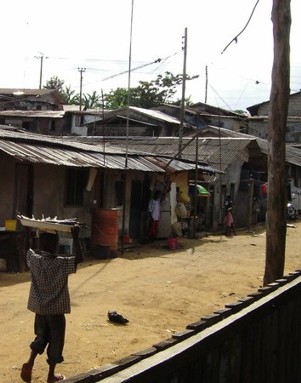
The Abonnema Wharf waterfront, Port Harcourt, is next in line to be demolished

© Amnesty/afrol News
afrol News, 28 October
- "Over 200,000 people are at risk of losing their homes" in Nigeria's oil capital Port Harcourt, a new report documents. Shanty towns are demolished without compensation to modernise the city's waterfront.

Amnesty International today released a 44-page report, documenting the large-scale demolition of poor residents' homes in Port Harcourt. Without prior notice and without compensation, poor city dwellers are evicted from their homes in a long-term drive to develop the rich city.

The Rivers State government claims the demolition of the waterfronts is necessary to implement the Greater Port Harcourt Master Plan, an urban renewal project launched in 2009, but still not available to the public. The development of the waterfront promenade is a central feature of the Master Plan, which encompasses the whole city.

On taking office in October 2007, the governor of Rivers State announced the plan to rebuild Port Harcourt. He also announced the suspension of demolitions in the waterfronts, a policy of the previous administration, stating: "We believe that the concerns of the residents of these waterfronts should be carefully considered before a final decision is reached on this matter."

However, in July 2008, the governor said during a radio broadcast that all waterfronts would be demolished as part of a programme of "urban renewal."

Meanwhile, the South African construction, engineering and consultancy firm Arcus GIBB was contracted to develop a "master plan" for Port Harcourt, updating an earlier plan formulated in 1975 but never implemented. The plan is intended to guide the development of the city for the next 50 years.

In February 2009, the first demolitions of buildings and other structures took place along Abonnema Wharf road, including the local office of the National Union of T

An excavator demolishes houses in Njemanze community in Port Harcourt

© Amnesty/afrol News
enants Nigeria (NUTN). The NUTN Secretary General Amnesty that, when their offices were demolished, "all the property belonging to NUTN in its office including cash, documents and furniture and fittings were carried away by the state government, which claimed that it had acquired the building and everything in it."

In August 2009, Njemanze, a waterfront settlement, was demolished as part of the urban renewal plan. It is estimated that over 13,000 people were forcibly evicted without adequate notice. "They lost their homes and, in many cases, their possessions and livelihoods. One year on, many still have nowhere to live," according to the Amnesty report.

The human rights group questions the legality of the whole process and its total lack of transparency. "No public consultations were carried out before or during the development of the Port Harcourt master plan," according to Amnesty.

A Nigerian developer told the human rights group that "the Greater Port Harcourt Master Plan is a standard town planning manual. Although it runs to four volumes, there are few specifics. No in-depth socioeconomic study was done. Ideally it should have taken a couple of years. There should have been a household survey, a social survey."

The vacated lands are taken over by the Rivers State government, without any compensation, which again leases out the land to prospectors. In one of the few documented state-prospector agreements, government agrees to ensure "peaceful evacuation and relocation of present occupants." It also states that the Rivers State government will ensure neat surroundings within

Residents march on 5 October 2009 in protest at the demolition of waterfront homes in Port Harcourt

© Amnesty/afrol News
a 2 kilometre radius of the site.

A Nigerian developer told the human rights activists that prospectors and state authorities engage in profit sharing agreements once the land has been developed. "The government provides land and the private developer provides money. The government's part of the deal is to ensure the land is unoccupied and unencumbered. Once the government has done that, [the project] gets developed and [the government and the company] share the profits," he told Amnesty.

"Ordinarily, public private partnership is not a problem, it happens all over the world, but the duty of care is missing here," the developer added.

According to Amnesty, the Master Plan includes vast parts of Port Harcourt's residential areas, especially the city's many informal settlements. If the Master Plan is concluded, at least 200,000 citizens will be evicted. Since 2009, massive protest action has somewhat slowed down the progress.

"These planned demolitions are likely to plunge hundreds of thousands of Nigeria's most vulnerable citizens further into poverty," said Amnesty's Tawanda Hondora. "The government should halt the waterfront evictions until they ensure they comply with international human rights standards," she urged.

Amnesty also stated concern about "the excessive use of force," including the unlawful use of firearms, displayed by security forces while undertaking forced evictions. In October 2009 at least 12 people were shot and seriously injured, and one killed, on Bundu waterfront when armed security forces opened fire on a crowd protesting planned demolitions there.


- Create an e-mail alert for Nigeria news
- Create an e-mail alert for Economy - Development news
- Create an e-mail alert for Human rights news


    Printable version

On the Afrol News front page now


UN will not monitor human rights in Western Sahara

afrol News - The US has backed down on its demand that UN peacekeepers in Moroccan-occupied Western Sahara also shall monitor the human rights situation after Moroccan sources threatened to scale down relations with Washington.
Central African Republic
Central African Republic falling apart

afrol News - One month after the rebel movement Séléka took over power in the Central African Republic, unrest is spreading in the country. The new leader lacks control of his forces, which continue looting and abusing civilians.
Kenya
Kenyatta secures tight victory in Kenya

afrol News - The official election results in Kenya have finally been announced, and Uhuru Kenyatta managed to win the first poll round outright with a narrow 50.7 percent. But the main opponent, PM Raila Odinga, is filing a vote rigging complaint to the courts.
Cape Verde
Cape Verde to produce dragon fruit

afrol News - Cape Verde authorities have invested large sums to diversify the arid country's agricultural sector. Now, the dragon fruit, originating in tropical America, is being introduced for the first commercial production in Africa.
Egypt
Even governors in Pharaonic Egypt died in their 20s

afrol News - Researchers have analysed more than 200 mummies from ancient Egypt, finding that even high dignitaries were poorly nourished and had infectious diseases. The typical governor in Pharaonic Egypt died before he was 30 years old.


front page | news | countries | archive | currencies | news alerts login | about afrol News | contact | advertise | español 

©  afrol News. Reproducing or buying afrol News' articles.

   You can contact us at mail@afrol.com