See also:
» 20.04.2010 - Uganda to tap oil rigging experience from Iran
» 25.03.2010 - SA’s business eyeing oil in Uganda
» 04.03.2010 - Red Cross appeals for aid
» 26.01.2010 - US mission to address E/Africa human rights before AU Summit
» 21.01.2010 - 50,000 fruit farmers in Uganda and Kenya empowered to supply Coca-Cola
» 10.11.2009 - Uganda partners with media to fight HIV/AIDS
» 16.10.2009 - Arrest Al Bashir - ICC
» 08.10.2009 - Joint EAC-US military field training exercise in Uganda


Uganda
Economy - Development | Society

Uganda churches make big business of aid

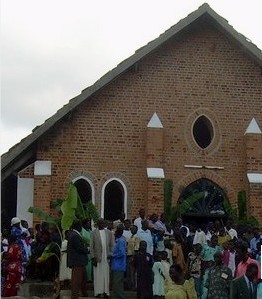
The Church of Uganda, the main church community in the country, forms part of the Anglican Communion

© Church of Uganda/afrol News
afrol News, 29 October
- In Uganda, church communities may get access to major development aid funds. A new study shows that many church leaders abuse these funds and start neglecting religious works.

These are among the conclusions in a PhD thesis about churches and development aid in Uganda by anthropologist Catrine Christiansen, presented this month at the Centre for African Studies in Copenhagen, Denmark.

"I wanted to investigate how the involvement of churches in development aid influenced the same churches as religious institutions," explained Ms Christiansen, meeting journalist Winnie Fćrk from the Danish development magazine 'U-landsnyt'.

"I had previously observed that, when churches got access to foreign aid funds and embarked on development projects, it influenced the relations between priests and church member to such a degree that religiously oriented activities started to function in a lesser degree," she added.

Ms Christiansen observed that "popular clergymen simply became less popular." The anthropologist decided to look into the dynamics, both internal and external, that were seen as driving forces behind both church-related and development tasks.

Interestingly, the results proved different from one church community to another. "I investigated 'the old' churches, meaning the Catholic and the Anglican Church, in addition to so-called 'new churches' such as the Pentecostal, Baptist and Methodist Churches. I found that the typical view among rural Ugandans is that priests in the 'new' churches just change their congrega

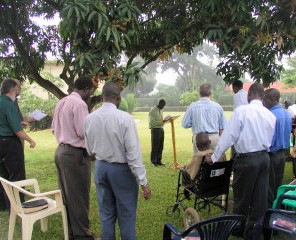
The Uganda Baptist Seminary at a spiritual meeting with US colleagues

© Uganda Baptist Seminary/afrol News
tion from one to another church if they can achieve improved economic terms."

"At the same time, the priests of the 'old' churches increasingly are accused of inappropriately taking money from their churches for their private spending," Ms Christiansen added.

Conclusively, "I found that, in the area I visited, church engagement in development aid was connected with the personal interests of the priests to 'abuse' their churches to get access to external resources."

Ms Christiansen holds that, while the Catholic and Anglican Churches were moving their clergymen from one parish to another, church leaders from the "new churches" instead were able to move their parishioners from one church community to another. Authoritative leaders of these autonomous "new churches" could therefore easily decide to which religious community the parish would belong.

"Many new churches were founded by individuals or families owning a piece of land where the church was built. Therefore, it is often a family member that is appointed church leader and the family that dominates the parochial council. It is therefore the same persons that own and run the church," explains Ms Christiansen.

"Some new churches therefore can appear like 'family companies', while others act more like a 'one-man firm'," adds the researcher. "This creates some entirely new dynamics w

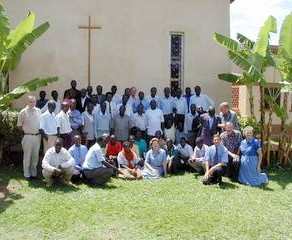
Ugandan Baptists and visitors from the US

© Uganda Baptist Seminary/afrol News
ithin the church domain, which are important to grasp how development aid has led to that churches to a growing degree are seen as 'businesses' that favour the church leader, rather than being seen as religious organisations that work for the good of community."

Asked from where these churches were drawing development aid funds, Ms Christiansen said that all the projects she had studied in Ugandan churches were funded by religious organisations in the United States.

The Danish anthropologist holds that her study includes important lessons for donors considering channelling their funds through churches in Uganda or other developing countries. While many churches were managing development projects well, such donations included large risks.

"Therefore, I want to recommend Northern donors, in particular those seeking to promote the churches' role in society, to become more critical regarding how churches work as religious organisations and how their ways of working can fit into their establishment of new development projects," Ms Christiansen said.

The researcher had gathered her data in the Ugandan field over a large period, from 1998 to 2008. During this period, Ms Christiansen also has worked as a researcher at the renowned Nordic Africa Institute in Uppsala (Sweden), studying how Ugandan rural churches provided aid to needing children.


- Create an e-mail alert for Uganda news
- Create an e-mail alert for Economy - Development news
- Create an e-mail alert for Society news


    Printable version

On the Afrol News front page now


UN will not monitor human rights in Western Sahara

afrol News - The US has backed down on its demand that UN peacekeepers in Moroccan-occupied Western Sahara also shall monitor the human rights situation after Moroccan sources threatened to scale down relations with Washington.
Central African Republic
Central African Republic falling apart

afrol News - One month after the rebel movement Séléka took over power in the Central African Republic, unrest is spreading in the country. The new leader lacks control of his forces, which continue looting and abusing civilians.
Kenya
Kenyatta secures tight victory in Kenya

afrol News - The official election results in Kenya have finally been announced, and Uhuru Kenyatta managed to win the first poll round outright with a narrow 50.7 percent. But the main opponent, PM Raila Odinga, is filing a vote rigging complaint to the courts.
Cape Verde
Cape Verde to produce dragon fruit

afrol News - Cape Verde authorities have invested large sums to diversify the arid country's agricultural sector. Now, the dragon fruit, originating in tropical America, is being introduced for the first commercial production in Africa.
Egypt
Even governors in Pharaonic Egypt died in their 20s

afrol News - Researchers have analysed more than 200 mummies from ancient Egypt, finding that even high dignitaries were poorly nourished and had infectious diseases. The typical governor in Pharaonic Egypt died before he was 30 years old.


front page | news | countries | archive | currencies | news alerts login | about afrol News | contact | advertise | español 

©  afrol News. Reproducing or buying afrol News' articles.

   You can contact us at mail@afrol.com