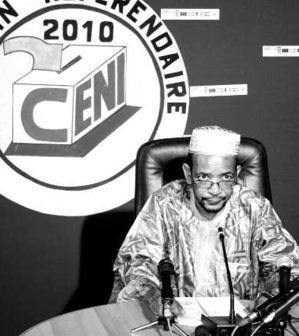
afrol News, 2 November - Preliminary results from Niger's Independent National Electoral Commission (CENI) indicate a broad support for the country's new constitution, which aims a making Niger into "a model democracy".
Nigerien citizens were asked to give their approval to the new constitution on Sunday, with all major political forces and the ruling military junta expressing support for the constitutional change. The new constitution had been drafted by a wide-spanning commission, representing large spectres of Nigerien society.
CENI President Abdourahamane Gousmane already yesterday was able to announce that voter turnout had been relatively high at the referendum. While some urban districts had recorded a 93 percent voter turnout, more remote rural districts however saw a turnout as low as 13 percent, MR Gousmane revealed.
The slightly lower than anticipated voter turnout maybe was related to the too obvious result of the referendum. Few expected the new constitution to be rejected, as the ruling military junta has created enthusiasm for its democratisation project since it toppled increasingly authoritarian ex-President Mamadou Tandja in February.
As Mr Gousmane today could present the first preliminary results of the referendum, there were therefore no great surprises. More than 80 percent of Nigerien voters said "yes" in the referendum and less than 20 percent said "no" to the new constitution.
While the results still are preliminary, they come as great relief to the military junta headed by General Salou Djibo, showing that ex-President Tandja by now has a marginal political standing. Only political parties still supporting Mr Tandja had urged Nigeriens to vote "no".
With the new constitution approved, Niger remains on schedule to implement its democratisation process.
The approval of the constitution by popular vote as such legitimises the current junta's power and transition process. All is therefore ready to return to a constitutional order and to organise presidential and parliamentary elections on 31 January 2011.
The new constitution strengthens the parliament in Niamey at the expense of the President and government. It aims at addressing possibilities for a strong President to abuse power and develop into a dictator by balancing powers better among the legislative and the executive. It also introduces a two-chamber parliament.
The main arguments of the pro-Tandja camp for recommending a "no" vote was that the new constitution would make the impoverished country even more difficult to rule. Weakening the executive too much would be a mistake as Niger needed a strong leadership to lift it out of its chronic crisis.
Niger's junta has been hailed by international cooperation partners, including the African Union (AU), the European Union (EU) and the United States for its progressive policies and determination to reintroduce strong democratic institutions.
afrol News - It is called "financial inclusion", and it is a key government policy in Rwanda. The goal is that, by 2020, 90 percent of the population is to have and actively use bank accounts. And in only four years, financial inclusion has doubled in Rwanda.
afrol News - The UN's humanitarian agencies now warn about a devastating famine in Sudan and especially in South Sudan, where the situation is said to be "imploding". Relief officials are appealing to donors to urgently fund life-saving activities in the two countries.
afrol News - Fear is spreading all over West Africa after the health ministry in Guinea confirmed the first Ebola outbreak in this part of Africa. According to official numbers, at least 86 are infected and 59 are dead as a result of this very contagious disease.
afrol News - It is already a crime being homosexual in Ethiopia, but parliament is now making sure the anti-gay laws will be applied in practical life. No pardoning of gays will be allowed in future, but activist fear this only is a signal of further repression being prepared.
afrol News / Africa Renewal - Ethiopia's ambitious plan to build a US$ 4.2 billion dam in the Benishangul-Gumuz region, 40 km from its border with Sudan, is expected to provide 6,000 megawatts of electricity, enough for its population plus some excess it can sell to neighbouring countries.










 front page
| news
| countries
| archive
| currencies
| news alerts login
| about afrol News
| contact
| advertise
| español
front page
| news
| countries
| archive
| currencies
| news alerts login
| about afrol News
| contact
| advertise
| español