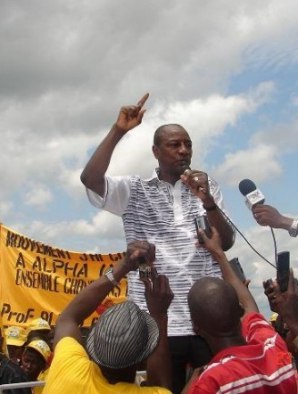
afrol News, 3 December - Guinea's Supreme Court this night confirmed the controversial 15 November provisional election result, rejecting fraud allegations. Alpha Condé therefore will be sworn in as Guinea's next President.
The court found fraud allegations from both candidates widely exaggerated and not supported by the evidence presented. Allegations of "systematic" fraud on a nation-wide level were categorically rejected, in line with conclusions from international election observers.
The ruling was presented under very tense circumstances in the Guinean capital, Conakry. The country's borders have been closed and the court building was under heavy police surveillance.
The court was asked by presidential candidate Cellou Dalein Diallo to review the run-off election results presented last month by Guinea's Independent National Electoral Commission (CENI). Mr Diallo claimed to have documented widespread fraud, costing him his assumed victory in the run-off poll.
The CENI on 15 November surprisingly proclaimed Mr Condé as winner of the 7 November run-off poll. According to the CENI announcement, Mr Condé won the elections with 52.52 percent of the popular vote. Mr Diallo achieved 47.48 percent of the vote.
The results were surprising as Mr Diallo had a large lead in the first round and had also been leading for a long time as partial results from the run-off started ticking in. The first round was held on 27 June, giving Mr Diallo 39.72 percent of the votes, while Mr Condé only achieved 20.67 percent.
The long time span between the first and second poll rounds polarised Guinean voters, provoking several violent clashes between followers of the two main candidates. The ruling military junta, which has overseen the democratic transition, was forced to intervene to secure the run-off.
After the victory of Mr Condé was announced last month, new riots hit Conakry. Emergency laws and curfews have since been the order of the day in Guinea, effectively stopping further blood spill. This week, Guinea's transitional leaders even closed the country's borders to prevent violence and arms smuggling ahead of the anticipated court decision.
It remains to be seen whether today's Supreme Court ruling will put a lasting end to the country's political crisis. Guinean trade unions and civil society groups and the international community in advance called for calm and an acceptance of the ruling. Widespread speculations in Conakry this week about a military coup have not helped calm the situation.
Announcements by Mr Condé that he may appoint a "large union government," including representatives from Mr Diallo's party and from various ethnic groups, may however ease the tensions if Mr Diallo accepts the invitation. The both nevertheless made a joint statement on national radio a few hours before the ruling was expected, calling on their followers to "exercise restraint" after the ruling
Mr Condé is the leader of the Rally of the People of Guinea (RPG) opposition party, which for decades has stood up to Guinea's authoritarian regimes. He is widely believed to have won the stolen 1993 presidential elections.
This year's elections, although troubled, are widely seen as Guinea's first-ever democratic elections since independence in 1958.
The Carter Centre, which had deployed election observer throughout the country, yesterday evening issued a statement hailing the conduct of Guinea’s presidential electoral processes, which it said was "broadly consistent with the country's international and regional obligations for genuine democratic elections."
afrol News - It is called "financial inclusion", and it is a key government policy in Rwanda. The goal is that, by 2020, 90 percent of the population is to have and actively use bank accounts. And in only four years, financial inclusion has doubled in Rwanda.
afrol News - The UN's humanitarian agencies now warn about a devastating famine in Sudan and especially in South Sudan, where the situation is said to be "imploding". Relief officials are appealing to donors to urgently fund life-saving activities in the two countries.
afrol News - Fear is spreading all over West Africa after the health ministry in Guinea confirmed the first Ebola outbreak in this part of Africa. According to official numbers, at least 86 are infected and 59 are dead as a result of this very contagious disease.
afrol News - It is already a crime being homosexual in Ethiopia, but parliament is now making sure the anti-gay laws will be applied in practical life. No pardoning of gays will be allowed in future, but activist fear this only is a signal of further repression being prepared.
afrol News / Africa Renewal - Ethiopia's ambitious plan to build a US$ 4.2 billion dam in the Benishangul-Gumuz region, 40 km from its border with Sudan, is expected to provide 6,000 megawatts of electricity, enough for its population plus some excess it can sell to neighbouring countries.










 front page
| news
| countries
| archive
| currencies
| news alerts login
| about afrol News
| contact
| advertise
| español
front page
| news
| countries
| archive
| currencies
| news alerts login
| about afrol News
| contact
| advertise
| español