See also:
» 19.01.2011 - Mediator sees time run out for Côte d'Ivoire
» 18.01.2011 - Military intervention in Côte d'Ivoire could near
» 01.03.2010 - Regional bloc hails Ivorian progress
» 23.02.2010 - Election hope back for Côte d'Ivoire
» 16.02.2010 - UN stress need to resolve Côte d'Ivoire’s tensions
» 29.01.2010 - Côte d’Ivoire's UN mandate extended to end of May
» 22.01.2010 - Hope in new Ivorian election timetable
» 08.12.2009 - Security Council calls for credible polls


Côte d'Ivoire
Politics

Pressure mounts against Côte d'Ivoire "coup"

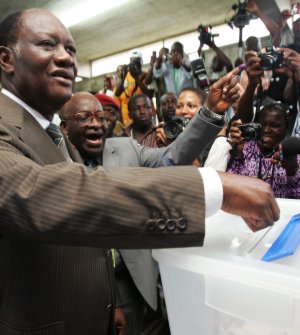
Alassane Dramane Ouattara casts his ballot in Côte d'Ivoire's second round of presidential elections

© Basile Zoma/UN Photo/afrol News
afrol News, 8 December
- West African state leaders have unanimously "recognised Alassane Dramane Ouattara" as the rightful "President-elect of Côte d'Ivoire." Protest against the "coup" of outgoing President Laurent Gbagbo is universal.

In an extraordinary meeting of state leaders of the Economic Community of West African States (ECOWAS) in Abuja, Nigeria, today, outgoing President Gbagbo was ordered to "abide by the results of the second round of presidential elections, which gave the victory to Mr Ouattara, "and to yield power without delay, in the best interest of the Ivorian people."

The Abuja summit was attended by seven West African presidents - from Burkina Faso, Ghana, Liberia, Mali, Nigeria, Senegal and Togo - and ambassadors from other ECOWAS countries. Nigeria President Goodluck Ebele Jonathan headed the meeting.

The ECOWAS summit decided to impose sanctions on Côte d'Ivoire, "including the suspension from all ECOWAS decision-making bodies until further notice." This is the regional body's standard reaction to a coup or other unconstitutional rule in its member countries.

The West African body has so far proven very successful in re-establishing constitutional rule in its member countries after threatening to or implementing sanctions. ECOWAS also has the possibility of heading an armed intervention if its orders are not followed.

US State Department Spokesman Philip Crowley commented that the ECOWAS decision would lead Côte d'Ivoire on a path "that leads to isolation from the global community, and most particularly from the African neighbours" of the country unless Presient Gbagbo does "make the right choice."

Yesterday's powerful ECOWAS message comes in addition to a similar statement from African Union (AU) President Bingu wa Mutharika. The AU leader urged Mr Gbagbo to respect the will of the people expressed at the ballot box" and back down as Côte d'Ivoire could "ill-afford another civil war."

"Mr Ouattara is the winner of the election," said Mr Mutharika, who is also President of Malawi. "The UN and other African bodies endorsed that the election was free and fair and that Ouattara had

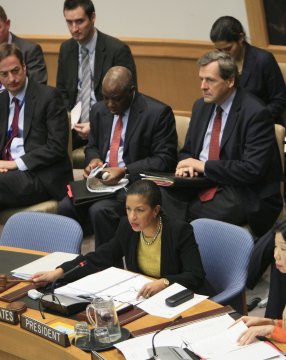
The UN Security Council yesterday discussed the situation in Côte d'Ivoire

© Ryan Brown/UN Photo/afrol News
won," the AU head added in a statement issued today in Lilongwe, Malawi.

Previously, several African governments had already condemned the "coup" by outgoing President Gbagbo. For example, the Botswana presidency already on Sunday issued a statement "congratulating Alassane Ouattara as the winner of the presidential elections of Côte d'Ivoire." The government of Botswana was "deeply concerned about African leaders who reject election results that are not in their favour," the statement added.

But also outside Africa, pressure against defeated President Gbagbo is increasing. US President Barrack Obama today urged President Gbagbo to step down, saying that otherwise, Côte d'Ivoire could not count on US support. He had told this to Mr Gbagbo in a letter to the Ivorian leader.

Also the European Union (EU), Côte d'Ivoire's main cooperation partner, warned Mr Gbagbo of consequences should he not step down. EU "Foreign Minister" Catherine Ashton warned the block could development aid estimated at euro 255 million and impose sanctions against the Ivorian government.

Meanwhile, the UN - which has around 9,000 peacekeepers stationed in Côte d'Ivoire - today gave its full support to Mr Ouattara's election victory. "The Ivorian people have chosen Mr Alassane Ouattara with an irrefutable margin as the winner over Mr. Laurent Gbagbo," the UN Representative in the country, Young-Jin Choi told a news conference in Abidjan.

The UN representative further publicly rebutted Mr Gbagbo's claims of irregularities point by point, noting that even if contested tally sheets were thrown out, it was still "clear that Mr Ouattara had won."

At UN Headquarters in New York it was yesterday reported that the world body was to "step up diplomacy in support of" Mr Ouattara. UN Secretary-General Ban Ki-moon fully supported statements by his representative, Mr Choi, and backed the pro-Ouattara campaign.


- Create an e-mail alert for Côte d'Ivoire news
- Create an e-mail alert for Politics news


    Printable version

On the Afrol News front page now


UN will not monitor human rights in Western Sahara

afrol News - The US has backed down on its demand that UN peacekeepers in Moroccan-occupied Western Sahara also shall monitor the human rights situation after Moroccan sources threatened to scale down relations with Washington.
Central African Republic
Central African Republic falling apart

afrol News - One month after the rebel movement Séléka took over power in the Central African Republic, unrest is spreading in the country. The new leader lacks control of his forces, which continue looting and abusing civilians.
Kenya
Kenyatta secures tight victory in Kenya

afrol News - The official election results in Kenya have finally been announced, and Uhuru Kenyatta managed to win the first poll round outright with a narrow 50.7 percent. But the main opponent, PM Raila Odinga, is filing a vote rigging complaint to the courts.
Cape Verde
Cape Verde to produce dragon fruit

afrol News - Cape Verde authorities have invested large sums to diversify the arid country's agricultural sector. Now, the dragon fruit, originating in tropical America, is being introduced for the first commercial production in Africa.
Egypt
Even governors in Pharaonic Egypt died in their 20s

afrol News - Researchers have analysed more than 200 mummies from ancient Egypt, finding that even high dignitaries were poorly nourished and had infectious diseases. The typical governor in Pharaonic Egypt died before he was 30 years old.


front page | news | countries | archive | currencies | news alerts login | about afrol News | contact | advertise | español 

©  afrol News. Reproducing or buying afrol News' articles.

   You can contact us at mail@afrol.com