See also:
» 10.12.2010 - Djibouti sees Eritrea President as "lunatic"
» 01.12.2010 - Djibouti cleared Blackwater to kill pirates
» 11.11.2009 - Djibouti forcibly repatriates Somali asylum seekers
» 30.01.2009 - Regional cooperation key to uprooting Somali piracy
» 11.07.2008 - Eritrea debunks overstepping in Djibouti
» 01.07.2008 - AU condemns Eritrea military attack on Djibouti
» 27.06.2008 - AU commission investigations on Djibouti-Eritrea clashes
» 17.06.2008 - Eritrea shuns border dialogue


Djibouti
Politics | Economy - Development

Djibouti desperate for energy investors

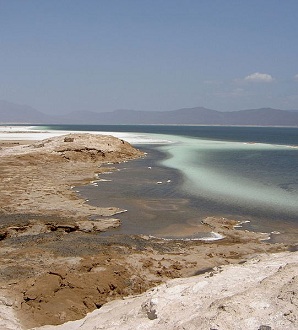
Djibouti's Lac Assal is the saltiest lake in the world, located at Africa's lowest point

© Fishercd/GNU/afrol News
afrol News, 19 January
- With power consumption steadily rising, also through new businesses opening in Djibouti, electricity production remains erratic and causes increased outages. Government desperately seeks investors, new documentation reveals.

In a US Embassy cable from June 2009, recently published through Wikileaks, the Ambassador notes large investment possibilities for US companies in the small African Horn country. Several Djibouti officials, including Minister of Energy Moussa Bouh Odowa, had called for foreign assistance to invest in electricity production.

Djibouti was struggling with "a widening gap between electricity demand from consumers, and a constrained supply of expensive, diesel-generated electricity provided by the national electricity company," it was noted. Government realised it needed improved supplies of lower-cost energy to maintain economic momentum and meet the basic needs of ordinary Djiboutians.

Djibouti's parastatal electricity monopoly Electricity of Djibouti (EDD) in 2009 officially had an installed capacity of 100 megawatts, but the company's "realistic production capacity is much lower - closer to 47 MW," the Ministry of Energy admitted.

The EDD was seen as capable of sustaining a short-term "surge" in production to 60-70 MW, but not for prolonged periods. Summertime demand - when Djibouti's hot season leads to greater air conditioner use - was in 2009 set at 87 MW, leaving a significant gap between production and consumption needs. Furthermore, already for 2010, the Ministry projected that Djibouti's energy needs would reach 125 MW or even higher, as the country was attracting large-scale foreign direct investment projects.

Meanwhile, Djiboutians were experiencing more and more frequent power outages. The worst situation was experienced in May 2009, when Djibouti City experienced multiple, prolonged power cuts of up to 9 hours a day.

During the last y

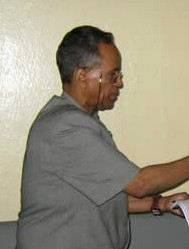
Djibouti Energy Minister Moussa Bouh Odowa

© Hydrocrabon DCPL/afrol News
ears, Djiboutian authorities had tried to attract investors to its considerable renewable energy resources, focusing on geothermal, wind and solar energy projects. But Djibouti lacked both knowledge and capital to develop these resources.

In particular, a planned 50-100 MW Djibouti-Iceland geothermal plant at Lac Assal was frustrating government. Not only did Minister Bouh Odowa distrust the Icelandic investors following the financial crisis, he revealed to the US Ambassador, but the Icelanders were also acting in an undiplomatic way, with "errors of protocol and communication."

The Djiboutian Minister said he was not as confident that Iceland had the full US$ 25-30 million available to fund the Lac Assal project feasibility phase. The Icelanders had agreed to cover 35 percent of the Djibouti project's exploration costs, which would lead to the largest-ever energy project in the country.

Minister Bouh Odowa revealed that he would be very interested in getting further investors than the Icelanders into the project - and other renewable energy projects - to make sure Djibouti could increase its energy production quickly. He would even offer a higher Djiboutian government participation in such investments.

Meanwhile, the Icelanders a few months after the US report managed to produce the awaited feasibility report, including the expensive deep wells drilled in the Lac Assal region. The report had a generally positive evaluation of the geothermal power project.

But little else has been done to increase Djibouti's energy production since the 2009 report. Djibouti still desperately looks for new investors into its large energy production potential.


- Create an e-mail alert for Djibouti news
- Create an e-mail alert for Politics news
- Create an e-mail alert for Economy - Development news


    Printable version

On the Afrol News front page now


UN will not monitor human rights in Western Sahara

afrol News - The US has backed down on its demand that UN peacekeepers in Moroccan-occupied Western Sahara also shall monitor the human rights situation after Moroccan sources threatened to scale down relations with Washington.
Central African Republic
Central African Republic falling apart

afrol News - One month after the rebel movement Séléka took over power in the Central African Republic, unrest is spreading in the country. The new leader lacks control of his forces, which continue looting and abusing civilians.
Kenya
Kenyatta secures tight victory in Kenya

afrol News - The official election results in Kenya have finally been announced, and Uhuru Kenyatta managed to win the first poll round outright with a narrow 50.7 percent. But the main opponent, PM Raila Odinga, is filing a vote rigging complaint to the courts.
Cape Verde
Cape Verde to produce dragon fruit

afrol News - Cape Verde authorities have invested large sums to diversify the arid country's agricultural sector. Now, the dragon fruit, originating in tropical America, is being introduced for the first commercial production in Africa.
Egypt
Even governors in Pharaonic Egypt died in their 20s

afrol News - Researchers have analysed more than 200 mummies from ancient Egypt, finding that even high dignitaries were poorly nourished and had infectious diseases. The typical governor in Pharaonic Egypt died before he was 30 years old.


front page | news | countries | archive | currencies | news alerts login | about afrol News | contact | advertise | español 

©  afrol News. Reproducing or buying afrol News' articles.

   You can contact us at mail@afrol.com