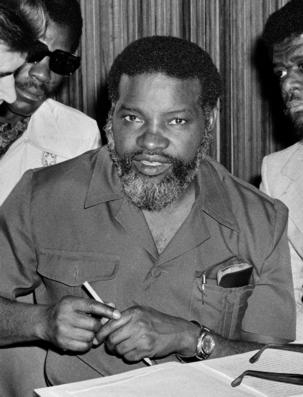
afrol News, 11 February - Former Namibian President Sam Nujoma "has been hospitalised, following a pacemaker procedure or pacemaker implantation," according to "highly placed family and medical sources."
Phil ya Nangoloh from the Namibian human rights group NamRights says he had talked to these family members and medical sources, speaking "on condition of remaining anonymous." Ex-President Nujoma, according to him, was admitted to "the cardiac unit of a key medical institution in the country" on Wednesday, adding it was "a heavily guarded ward."
The operation in course for Mr Nujoma was the implantation of a pacemaker - a small electronic device implanted in the chest of the patient to help control abnormal heart rhythms.
Although the sources have also revealed what appear to be finer particulars about the health institution concerned, "NamRights believes that to disclose the name and nature as well as exact location of the health institution are of little consequence at this stage," Mr Nangoloh says in a statement today.
"There is, nevertheless, substantial circumstantial evidence, strongly suggesting that President Nujoma's extraordinary and or unusual silence as well as sudden disappearance from public view is, by all counts, involuntary," he adds.
As an example, Mr Nujoma recently failed to attend a lavish gala dinner marking the 75th birth day of business magnate, Frans Aupa Indongo. His absence at the recent opening of the Ohorongo cement plant near Otavi is another indicator, mentioned Nujoma watcher and NamRights executive director, Mr Nangoloh.
Since shortly before the December 2010 festive season, 81-year-old former President Nujoma has not been seen, heard and or read in Namibian media. Moreover, prior to that, there have been widespread media speculations that Nujoma was admitted to a health facility in Cape Town, South Africa.
Recently, Namibia's largest Afrikaans daily newspaper, 'Republikein', published two letters to the editor by concerned citizens on the subject of Mr Nujoma's sudden disappearance from public view "without any information from the Namibian authorities."
Mr Nujoma has an important role in Namibia's history and public life, having led the freedom fight against apartheid South Africa as the founding leader of the SWAPO independence movement. As a "father of the nation," he also was Namibia's first President after freedom in 1990, serving until 2005.
"In the likely event that Dr. Nujoma is, indeed, hospitalised, NamRights wishes him a very fast recovery," Mr Nangoloh emphasised.
"However, in order for the public to wish him or pray for his fast recovery, as was done, for example, in the recent case of former South African President, Nelson Mandela," Mr Nangoloh urged Namibia's Health Minister Richard Kamwi to "clear the air around Nujoma's alleged hospitalisation. In any case, the public has the right to know," he added.
afrol News - It is called "financial inclusion", and it is a key government policy in Rwanda. The goal is that, by 2020, 90 percent of the population is to have and actively use bank accounts. And in only four years, financial inclusion has doubled in Rwanda.
afrol News - The UN's humanitarian agencies now warn about a devastating famine in Sudan and especially in South Sudan, where the situation is said to be "imploding". Relief officials are appealing to donors to urgently fund life-saving activities in the two countries.
afrol News - Fear is spreading all over West Africa after the health ministry in Guinea confirmed the first Ebola outbreak in this part of Africa. According to official numbers, at least 86 are infected and 59 are dead as a result of this very contagious disease.
afrol News - It is already a crime being homosexual in Ethiopia, but parliament is now making sure the anti-gay laws will be applied in practical life. No pardoning of gays will be allowed in future, but activist fear this only is a signal of further repression being prepared.
afrol News / Africa Renewal - Ethiopia's ambitious plan to build a US$ 4.2 billion dam in the Benishangul-Gumuz region, 40 km from its border with Sudan, is expected to provide 6,000 megawatts of electricity, enough for its population plus some excess it can sell to neighbouring countries.










 front page
| news
| countries
| archive
| currencies
| news alerts login
| about afrol News
| contact
| advertise
| español
front page
| news
| countries
| archive
| currencies
| news alerts login
| about afrol News
| contact
| advertise
| español