See also:
» 22.09.2010 - US fundamentalists "fight proxy war" in Uganda, Rwanda
» 07.06.2010 - Sudan protests Uganda non-invitation of al-Bashir
» 25.03.2010 - SA’s business eyeing oil in Uganda
» 02.03.2010 - Reject anti-gay bill - activists
» 01.03.2010 - Experts urge Uganda to drop anti-homosexuality bill
» 02.02.2010 - Scores slaughtered by rebels in DRC
» 26.01.2010 - US mission to address E/Africa human rights before AU Summit
» 22.01.2010 - Anti-homosexuality law threat to fighting AIDS


Uganda
Politics | Economy - Development

Huge Uganda election funding questioned

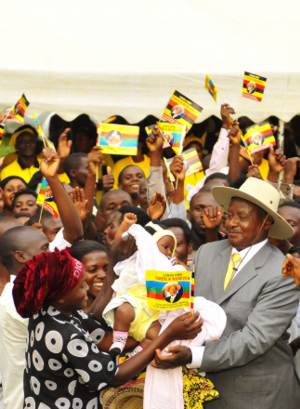
President Museveni's electoral campaign around Uganda were directed like public festivals

© NRM/afrol News
afrol News, 21 February
- Large spending by Uganda's incumbent President Yoweri Museveni to win the 2011 elections is said to have kept away an IMF team that was to assess the country's economic discipline.

A 3 February press statement by the International Monetary Fund (IMF) stated that a team from the Fund would visit Uganda in June 2011 to examine an economy that has experienced skyrocketing prices and hard currency shortage in a dash for Mr Museveni to win elections.

Several government and donor sources suggest President Museveni and his ruling National Resistance Movement (NRM) party may have spent US$ 400 million. The large amount spent on convincing voters is causing unrest.

"The magnitude of resources NRM deployed and huge level of funding challenged the notion of a level playing field," noted Dame Billie Miller, head of Commonwealth election observer team.

The NRM claims to have 8 million members, but is shy to declare its sources of funding to the Ugandan Electoral Commission, much as NRM spokesman, Ofono Opondo says to the contrary.

"Disclosure provision has been flouted by NRM, reasoning that funders need to be anonymous and partly due to lack of culture of transparency," says Dr Sabiti Makara, a political scientist at Uganda's Makerere University.

Nevertheless, it was seen as an eye-opener by many when the IMF noted irregularities in government spending patterns. In January alone, government spent US$ 1.5 billion, which is 30 percent of US$ 5.5 billion annual national budget.

Government to a certain degree confirms this. David Bahati, a pro-NRM legislator, told state run Uganda Broadcasting Corporation how the 2011 elections required him to double the money he

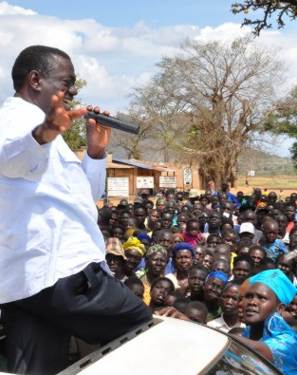
Opposition leader Kizza Besigye campaigning in rural Uganda

© Besigye campaign/afrol News
spent, compared to 2006. "I require shilling 100 million as my election budget," he openly admitted.

Government spending was reported to have skyrocketed after reports that the opposition was receiving great amounts of external funding, allowing it to field more candidates than ever. The opposition fielded nearly 350 MPs of the 405 seats and 80 district heads. In contrast NRM fielded 400 MPs and 112 district heads.

Security sources had reported that Rwanda had wired at least US$ 2 million to the opposition FDC party. NRM spokesman Ofwono Opondo recently told 'Capital Radio', a private radio station in Kampala, how the FDC had received US$ 5 million from its external backers. On 8 February, government charged three members of the minor opposition Democratic Party with terrorism for receiving money from abroad for party activities.

Apparently, the alleged Rwandan funding could have been on a tit for tat basis. Kigali was angered when Uganda allegedly financed President Paul Kagame's opponents during the recent elections there.

The reports of funding from Rwanda came amidst NRM debates on how to rein in on opposition party funding. Ugandan law limits external funding to shilling 400 million. The NRM also wants the state to fund parties, which the opposition dismisses as a paltry sum that could deny them dignity and limit its main sources of funding.

The 2011 election events, with its waste spending, nevertheless have sparked a debate over party and election funding in Uganda.


- Create an e-mail alert for Uganda news
- Create an e-mail alert for Politics news
- Create an e-mail alert for Economy - Development news


    Printable version

On the Afrol News front page now


UN will not monitor human rights in Western Sahara

afrol News - The US has backed down on its demand that UN peacekeepers in Moroccan-occupied Western Sahara also shall monitor the human rights situation after Moroccan sources threatened to scale down relations with Washington.
Central African Republic
Central African Republic falling apart

afrol News - One month after the rebel movement Séléka took over power in the Central African Republic, unrest is spreading in the country. The new leader lacks control of his forces, which continue looting and abusing civilians.
Kenya
Kenyatta secures tight victory in Kenya

afrol News - The official election results in Kenya have finally been announced, and Uhuru Kenyatta managed to win the first poll round outright with a narrow 50.7 percent. But the main opponent, PM Raila Odinga, is filing a vote rigging complaint to the courts.
Cape Verde
Cape Verde to produce dragon fruit

afrol News - Cape Verde authorities have invested large sums to diversify the arid country's agricultural sector. Now, the dragon fruit, originating in tropical America, is being introduced for the first commercial production in Africa.
Egypt
Even governors in Pharaonic Egypt died in their 20s

afrol News - Researchers have analysed more than 200 mummies from ancient Egypt, finding that even high dignitaries were poorly nourished and had infectious diseases. The typical governor in Pharaonic Egypt died before he was 30 years old.


front page | news | countries | archive | currencies | news alerts login | about afrol News | contact | advertise | español 

©  afrol News. Reproducing or buying afrol News' articles.

   You can contact us at mail@afrol.com