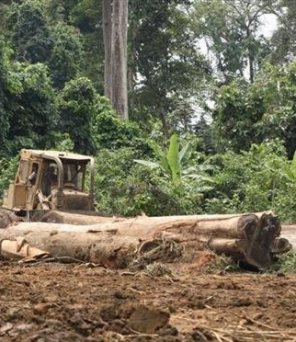
afrol News, 9 March - New decisions by the Congo Kinshasa government, lifting a 9-year moratorium, mean that up to 25 million hectares of rainforest could be sacrificed for industrial exploitation.
Environmental groups say they are "deeply concerned" about the recent announcement by Congolese Environmental Minister José Endundo that government has legalised 15 additional logging titles in the Congo rainforest. In addition, it seems there are also plans to lift the current moratorium on industrial logging expansion.
"In the long run, up to 40 percent of the Congo rainforests could be sacrificed for industrial exploitation," the environmental group Greenpeace warns.
The concern arose after Minister Endundo on 29 January announced changes to the restrictive 2002 logging polices, addressing a situation of warfare and smuggling of natural resources. The Kinshasa government is now reacting to a normalisation of the situation in the vas country.
Back in 2002, facing the chaos of the logging industry sector in Congo Kinshasa (DRC), government decided to enforce a moratorium on new forest titles and concessions. But as the state proved unable to control the situation on the ground, the moratorium was immediately and regularly violated.
In 2005, under the pressure of the World Bank, the government started a "legal review" of 156 forest titles, aiming to "clean up" the sector. At the beginning of 2009, the Kinshasa government revealed the legal review's conclusion: 65 titles were officially converted into long term concessions.
But in January, the Environment Minister announced the official closure of this process and the legalisation of 15 additional titles which had been previously been made illegal. Most importantly though, he spoke about lifting the moratorium.
"In essence this means the allocation of around 15 million hectares – an area 5 times the size of Belgium – to a handful of companies," Greenpeace warns. "This despite the industry being denounced regularly for its scandalous practices, the social conflicts it encourages, and the fragmentation of intact forest it causes, with dire consequences on biodiversity and the climate," the group adds.
Together with the Rainforest Alliance, Global Witness and Bank Information Centre, Greenpeace wrote a letter to the World Bank, demanding the institution should put pressure on Kinshasa authorities. In another letter to the Congolese government, the groups asked for commitment to strengthen the moratorium.
"Given the current socio-economic climate, it would be a scandal to lift the moratorium," Greenpeace holds. "Industrial logging is not a solution to protect the forests. Maintaining the moratorium should be the centre of any national strategy to protect the forests, leading to alternatives for a fair and sustainable development."
afrol News - It is called "financial inclusion", and it is a key government policy in Rwanda. The goal is that, by 2020, 90 percent of the population is to have and actively use bank accounts. And in only four years, financial inclusion has doubled in Rwanda.
afrol News - The UN's humanitarian agencies now warn about a devastating famine in Sudan and especially in South Sudan, where the situation is said to be "imploding". Relief officials are appealing to donors to urgently fund life-saving activities in the two countries.
afrol News - Fear is spreading all over West Africa after the health ministry in Guinea confirmed the first Ebola outbreak in this part of Africa. According to official numbers, at least 86 are infected and 59 are dead as a result of this very contagious disease.
afrol News - It is already a crime being homosexual in Ethiopia, but parliament is now making sure the anti-gay laws will be applied in practical life. No pardoning of gays will be allowed in future, but activist fear this only is a signal of further repression being prepared.
afrol News / Africa Renewal - Ethiopia's ambitious plan to build a US$ 4.2 billion dam in the Benishangul-Gumuz region, 40 km from its border with Sudan, is expected to provide 6,000 megawatts of electricity, enough for its population plus some excess it can sell to neighbouring countries.










 front page
| news
| countries
| archive
| currencies
| news alerts login
| about afrol News
| contact
| advertise
| español
front page
| news
| countries
| archive
| currencies
| news alerts login
| about afrol News
| contact
| advertise
| español