See also:
» 17.02.2011 - Students keep Algeria protests warm
» 15.02.2011 - Call for massive renewed protests in Algeria
» 14.02.2011 - Algeria govt seeks to avoid mass protests
» 12.02.2011 - Saharawis at unease over Algeria, Morocco unrest
» 08.02.2011 - Large student protests in Algeria
» 03.02.2011 - "Algeria soon to lift state of emergency"
» 03.02.2011 - Algeria prepares protests despite govt threats
» 27.01.2011 - Algeria "must reduce oil dependence" to avoid unrest


SQL/DB Error -- [Unknown table engine 'InnoDB']
Algeria
Politics | Human rights

Algeria protests risk losing momentum

Thousands of police held back protestors in central Algiers on 15 February 2011

© Magharebia/afrol News
afrol News, 11 March
- Organisation errors by the protest movement and clever manoeuvres by the government are strongly challenging the pro-democracy protests in Algeria. It is unsure when new protests will be held.

Even before the Tunisian revolution, an Algerian pro-democracy protests movement was forming. In February, a newly formed National Coordination for Change and Democracy (CNCD) took charge of the protest movement, strongly inspired by the successes of protesters in Tunisia and Egypt.

One month later, the CNCD shows strong signs of weakness and fragmentation and is unable to gather large crowds to what was supposed to become weekly, or even daily, mass protests. For this weekend, different CNCD sources announced for mass protests on Saturday and for Sunday. Some sources even said this weekend's protests would be today; Friday.

The confusion arises from the various autonomous committees of the CNCD. Originally, the CNCD was shaped by several civil society groups and opposition parties in the capital, Algiers. But as government and police have managed to prohibit and stop major protests in Algiers, the CNCD committee in the city of Oran now has emerged as the most energetic.

Also, the mix of entities forming the CNCD protest movement proved unhappy. Especially the participation of old, partly unpopular opposition parties has alienated many Algerians. Youthful protesters at several occasions have rallied against the CNCD itself, urging the "old opposition" to keep out of the youth's revolution.

As a result - and because of massive police presence - protests in Algiers never have reached a critical mass. Indeed, Algeria for decades has been used to riots and manifestations from several pressure groups; with the current pro-democracy movement not able to mobilise more people than other typical rallies.

Also the government of unpopular and uncharismatic President Abdelaziz Bouteflika has plaid its cards well, meeting a potential mass protest movement. The potential social explosion causing the Tunisian riots were met

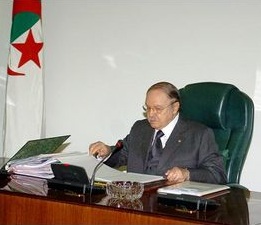
Algeria's President Abdelaziz Bouteflika

© Gouv de Algerie/afrol News
with food price subsidies already in January. Social reforms and employment-creating programmes were quickly announced.

In February, President Bouteflika addressed the principal demand of the new protest movement when he promised a lifting of the emergency laws that had been in place since 1993. Emergency rule was indeed lifted on 24 February.

But President Bouteflika at the same time ordered a continued ban on protests in Algiers, referring to special threats by "terrorist groups" in the capital. Protesters were allowed to organise their marches in any place outside the capital - a move that allowed the regime to continue to meet protesters in Algiers with massive police violence.

The Algerian government finally has managed to discredit the protest movement to a certain degree, with pro-regime media mostly referring to the protests as organised by the opposition parties being part of the CNCD. These parties are seen as sectarian by large groups of Algerians.

Consequently, pro-democracy protests have become smaller during the last few weeks. The largest protest this month was organised in Algiers and Oran on Saturday 5 March, but were all outnumbered by police forces, violently dispersing the crowds of several hundreds and arresting several protest leaders.

The protest movement - originally thought to have great potentials in an Algeria with rampant corruption an unpopular regime - still hopes to mobilise masses this weekend and in the weekends to come. But the movement risks losing its significance as it fails to find the key to ignite the masses.

In a new attempt to regain momentum, a group of Algerian youths yesterday called for a new mass protest on Saturday 19 March. It is themes the "March of the Algerian Youth" and has a clear message to the CNCD and its members: "Political parties are not invited!"


- Create an e-mail alert for Algeria news
- Create an e-mail alert for Politics news
- Create an e-mail alert for Human rights news


    Printable version

On the Afrol News front page now


UN will not monitor human rights in Western Sahara

afrol News - The US has backed down on its demand that UN peacekeepers in Moroccan-occupied Western Sahara also shall monitor the human rights situation after Moroccan sources threatened to scale down relations with Washington.
Central African Republic
Central African Republic falling apart

afrol News - One month after the rebel movement Séléka took over power in the Central African Republic, unrest is spreading in the country. The new leader lacks control of his forces, which continue looting and abusing civilians.
Kenya
Kenyatta secures tight victory in Kenya

afrol News - The official election results in Kenya have finally been announced, and Uhuru Kenyatta managed to win the first poll round outright with a narrow 50.7 percent. But the main opponent, PM Raila Odinga, is filing a vote rigging complaint to the courts.
Cape Verde
Cape Verde to produce dragon fruit

afrol News - Cape Verde authorities have invested large sums to diversify the arid country's agricultural sector. Now, the dragon fruit, originating in tropical America, is being introduced for the first commercial production in Africa.
Egypt
Even governors in Pharaonic Egypt died in their 20s

afrol News - Researchers have analysed more than 200 mummies from ancient Egypt, finding that even high dignitaries were poorly nourished and had infectious diseases. The typical governor in Pharaonic Egypt died before he was 30 years old.


front page | news | countries | archive | currencies | news alerts login | about afrol News | contact | advertise | español 

©  afrol News. Reproducing or buying afrol News' articles.

   You can contact us at mail@afrol.com