afrol News, 19 March - The Ethiopian opposition reports that over 250 of its central members have been arrested during the week. The arrests are seen in connection with a planned mass protest.
According to Ethiopia's main opposition coalition Medrek - composed of eight mostly regionally-based parties - several of its member parties have experienced a wave of arrest this week. At least 250 opposition members remain in detention, they claim.
Most of the detainees were said to be from the Oromo People's Congress (OPC) and the Oromo Federalist Democratic Movement (OFDM), two Medrek coalition partners. The OPC and OFDM are from Ethiopia's central Oromia region, which surrounds the capital, Addis Ababa.
The Medrek leadership reports that at least 217 OFDM members and 40 OPC members have been arrested during the week and that the whereabouts of most of them still were unknown.
At the same time, there are unconfirmed reports that at least 150 key members of the Oromo People's Democratic Organization (OPDO), a member of Ethiopia's ruling coalition, have been arrested on corruption charges during the same time.
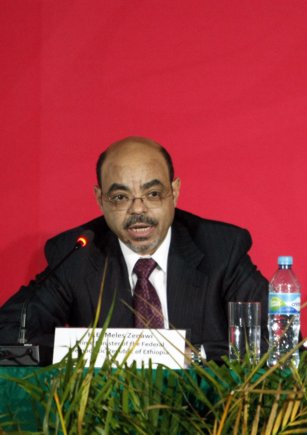
Ethiopian opposition figures put all these arrests in connection with the repeated calls for Egypt-like mass protests and riots. Many of these calls have come from the key Oromia region, with the outlawed Oromo Liberation Front (OLF) repeatedly calling on Ethiopian to unite and overthrow the government of Prime Minister Meles Zenawi.
Oromia is Ethiopia's most central, largest and most populated region. Discontent with the Meles regime in Oromia is reportedly increasing, also in Addis Ababa, as many see his government as a kind of "foreign rule" insofar that Mr Meles' power base is in the northern region of Tigray.
Potentials for a popular rising against the authoritarian Meles regime are therefore seen as greatest in the Oromia region. At the same time, the Ethiopian government is struggling to keep control in other provinces, in particular the vast Somali region, also called Ogaden, in the south-east.
Also socio-economic developments in the urbanised Oromia region seem to prepare the ground for a protest movement. While the Meles government has brought Ethiopia a booming economic development with record GDP growth over years, social differences remain enormous. Currently, food prices are skyrocketing, with some basic items out of supply, causing further frustration.
Indeed, there is a growing movement calling for mass protests in Ethiopia, inspired by the North African revolutions. Two youth groups are calling for nationwide protests on 20 May.
These protests movements are still mostly based in the large Ethiopian Diaspora, using Facebook and other social media to prepare for protests and revolution. While it is expected that Ethiopia-based opposition groups sympathise with the protest call, they have shied away from openly supporting it.
Medrek leaders recently assured they would not take a leading role in any possible mass protests, saying that popular democratic revolutions did not need the leadership of an opposition party, but rather the strong organisation of local youths. This had been the lessons from Egypt.
Experience from Ethiopia's two last elections further had shown how exposed the national opposition was to a government crackdown, as their protest marches were violently suppressed. As Medrek party officials again are being detained, the opposition therefore leaves the revolutionary initiative to the Ethiopian youth.
Meanwhile, the Ethiopian government has noted the increased anti-government activities among Ethiopians in the Diaspora. Foreign Affairs Minister Berhane Gebrekirstos this week therefore announced an outreach programme to the Diaspora, to engage them in discussions about "the ongoing democratisation, development and peace endeavours of the country."
afrol News - It is called "financial inclusion", and it is a key government policy in Rwanda. The goal is that, by 2020, 90 percent of the population is to have and actively use bank accounts. And in only four years, financial inclusion has doubled in Rwanda.
afrol News - The UN's humanitarian agencies now warn about a devastating famine in Sudan and especially in South Sudan, where the situation is said to be "imploding". Relief officials are appealing to donors to urgently fund life-saving activities in the two countries.
afrol News - Fear is spreading all over West Africa after the health ministry in Guinea confirmed the first Ebola outbreak in this part of Africa. According to official numbers, at least 86 are infected and 59 are dead as a result of this very contagious disease.
afrol News - It is already a crime being homosexual in Ethiopia, but parliament is now making sure the anti-gay laws will be applied in practical life. No pardoning of gays will be allowed in future, but activist fear this only is a signal of further repression being prepared.
afrol News / Africa Renewal - Ethiopia's ambitious plan to build a US$ 4.2 billion dam in the Benishangul-Gumuz region, 40 km from its border with Sudan, is expected to provide 6,000 megawatts of electricity, enough for its population plus some excess it can sell to neighbouring countries.










 front page
| news
| countries
| archive
| currencies
| news alerts login
| about afrol News
| contact
| advertise
| español
front page
| news
| countries
| archive
| currencies
| news alerts login
| about afrol News
| contact
| advertise
| español