afrol News, 25 February - "Mauritia" is the name scientists have given the newly discovered micro-continent in the Indian Ocean, which detached about 60 million years ago while Madagascar and India drifted apart. A thick layer of lava so far has kept it secret.
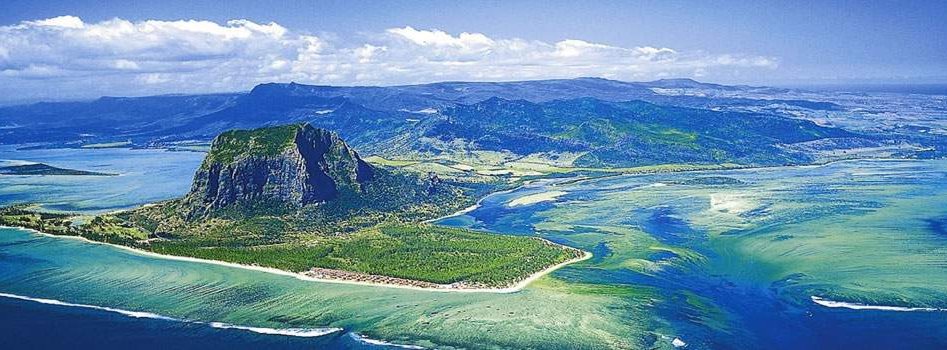
Scientists from the German Research Centre for Geosciences in Potsdam outside Berlin have published remarkable findings they made on the islands of Mauritius and Réunion, showing that the two famous holiday destination islands in the Indian Ocean not were created by volcanism alone. On the contrary, they are located on the rests of a so-called micro-continent the researchers have baptised Mauritia.
Mauritia detached from Madagascar and India as these two parts of the giant continent Gondwana started drifting away from each other some 60 million years ago. But major volcanic activity in the region has covered the continental fragment with huge masses of lava, according to the scientists.
The researchers also conclude that there probably are a larger number of undiscovered micro-continents around in the great oceans. A summary of the study has been published in the latest edition of the prestigious journal 'Nature Geosciences'.
According to the researchers, mostly the break-up of continents is often associated with mantle plumes. These giant bubbles of hot rock rise from the deep mantle and soften the tectonic plates from below, until the plates break apart at the hotspots.
"This is how Eastern Gondwana broke apart about 170 million years ago. At first, one part was separated, which in turn fragmented into Madagascar, India, Australia and Antarctica, which then migrated to their present position," the report says.
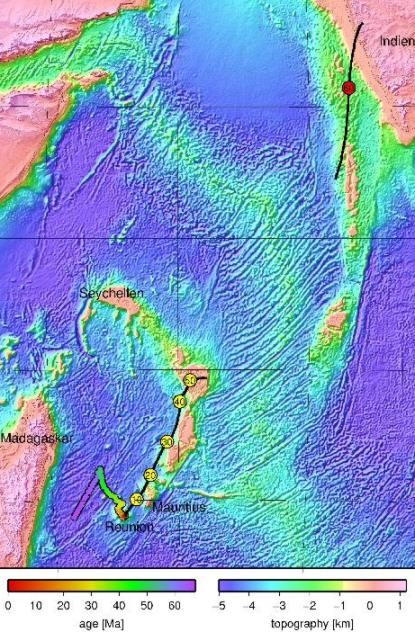
"Plumes currently situated underneath the islands Marion and Reunion appear to have played a role in the emergence of the Indian Ocean. If the zone of the rupture lies at the edge of a land mass - in this case Madagascar and India - fragments of this land mass may be separated off," according to the report. The nearby Seychelles are a well-known example of such a continental fragment.
The researchers first looked into lava sand grains from the beaches of Mauritius. "The sand grains contain semi-precious zircons aged between 660 and 1970 million years, which is explained by the fact that the zircons were carried by the lava as it pushed through subjacent continental crust of this age," the reporters explain. This was to prove that rests of an older micro-continent lays beneath the lava masses on Mauritius.
Researcher Bernhard Steinberger of the research centre in Potsdam and several international colleagues further were able to trace the geohistorical track of the mantel hotspot now located close to Réunion island. "We were able to show that the continent fragments continued to wander almost exactly over the Réunion plume, which explains how they were covered by volcanic rock," Steinberger explains.
Until know, the creation of the African islands southeast in the Indian Ocean, including Réunion and Mauritius, has been explained by the Réunion plume, as a parallel to the creation of the Hawaii islands. But Steinberger and his colleagues conclude the contrary, saying they represent the micro-continent Mauritia.
afrol News - It is called "financial inclusion", and it is a key government policy in Rwanda. The goal is that, by 2020, 90 percent of the population is to have and actively use bank accounts. And in only four years, financial inclusion has doubled in Rwanda.
afrol News - The UN's humanitarian agencies now warn about a devastating famine in Sudan and especially in South Sudan, where the situation is said to be "imploding". Relief officials are appealing to donors to urgently fund life-saving activities in the two countries.
afrol News - Fear is spreading all over West Africa after the health ministry in Guinea confirmed the first Ebola outbreak in this part of Africa. According to official numbers, at least 86 are infected and 59 are dead as a result of this very contagious disease.
afrol News - It is already a crime being homosexual in Ethiopia, but parliament is now making sure the anti-gay laws will be applied in practical life. No pardoning of gays will be allowed in future, but activist fear this only is a signal of further repression being prepared.
afrol News / Africa Renewal - Ethiopia's ambitious plan to build a US$ 4.2 billion dam in the Benishangul-Gumuz region, 40 km from its border with Sudan, is expected to provide 6,000 megawatts of electricity, enough for its population plus some excess it can sell to neighbouring countries.










 front page
| news
| countries
| archive
| currencies
| news alerts login
| about afrol News
| contact
| advertise
| español
front page
| news
| countries
| archive
| currencies
| news alerts login
| about afrol News
| contact
| advertise
| español