Paleontologists discover pterosaur fossils in Niger
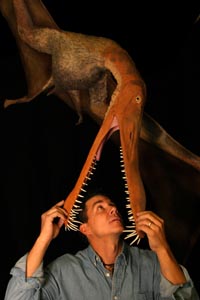
Paleontologist Paul Sereno examines the teeth and jaws of a model of a new species of pterosaur discovered in the southern Sahara. Photo by Mike Hettwer
afrol News, 20 December - A new species of pterosaur with a 5-meter wingspan has been discovered in Niger, in the southern part of the Sahara, by a team led by University of Chicago paleontologist Paul Sereno. "This find puts African pterosaurs on the map," said Mr Sereno. Previous finds of these winged reptiles in Africa had been limited to individual bones or teeth.
The 110-million-year-old fossils include most of one wing and several slender teeth from its over-sized jaws. "To find a wing composed of a string of paper-thin bones in a river deposit next to the sturdy bones of dinosaurs is a remarkable feat of preservation," Mr Sereno said in a statement this week.
The bones and teeth were found in Cretaceous-age rocks in northern Niger that were deposited by ancient rivers. Near the pterosaur site, Mr Sereno's team also found bones of the 10-meter-long, sail-backed fish-eater Suchomimus and the enormous crocodile Sarcosuchus, dubbed "SuperCroc".
- Definitely a fish-eater, remarked Mr Sereno, who will describe and name the new species with David Blackburn, an expedition member from the University of Chicago and now a graduate student at Harvard University.
Like its contemporaries Suchomimus and Sarcosuchus, it dined on the abundant fish in the rivers, as evidenced by its long and slender teeth. As the jaws closed, the teeth interlocked to snare fish, leaving signs of wear on their sides.
- Somehow this huge species was able to fish on the wing, Mr Sereno commented. "We imagine a pterosaur soaring over the water and somehow stalling to snag a fish. It was a tremendous animal."
Based on numerous trackways, paleontologists now believe that pterosaurs were relatively clumsy on land or in shallow water, walking slowly on all fours. The African species preserves sharp hand claws on the front edge of the wing, which probably helped it climb when on land.
The African pterosaur resembles another species, discovered previously in the highlands of Brazil. When the Niger species lived, 110 million years ago, South America and Africa were just beginning to separate. "Pterosaurs wouldn't have had much trouble getting across at that point, so it's not surprising to find a close relative over there," Mr Sereno said.
A life-size skeleton and flesh reconstruction of the new pterosaur, the first for a species from Africa, will go on display in Chicago's Garfield Park Conservatory, as part of the "GIANTS" exhibit, which is to run through September 2004.
The flesh model incorporates the latest information on pterosaurs. "Pterosaurs are close cousins of the dinosaurs but had a very different look and lifestyle. Their bodies were covered by hair-like structures that arose independently from the hair we know today on mammals," Mr Sereno explains.
The flesh model also has translucent wings, as scientists now believe from detailed impressions that the skin forming the wing would have allowed light to pass through.
afrol News - It is called "financial inclusion", and it is a key government policy in Rwanda. The goal is that, by 2020, 90 percent of the population is to have and actively use bank accounts. And in only four years, financial inclusion has doubled in Rwanda.
afrol News - The UN's humanitarian agencies now warn about a devastating famine in Sudan and especially in South Sudan, where the situation is said to be "imploding". Relief officials are appealing to donors to urgently fund life-saving activities in the two countries.
afrol News - Fear is spreading all over West Africa after the health ministry in Guinea confirmed the first Ebola outbreak in this part of Africa. According to official numbers, at least 86 are infected and 59 are dead as a result of this very contagious disease.
afrol News - It is already a crime being homosexual in Ethiopia, but parliament is now making sure the anti-gay laws will be applied in practical life. No pardoning of gays will be allowed in future, but activist fear this only is a signal of further repression being prepared.
afrol News / Africa Renewal - Ethiopia's ambitious plan to build a US$ 4.2 billion dam in the Benishangul-Gumuz region, 40 km from its border with Sudan, is expected to provide 6,000 megawatts of electricity, enough for its population plus some excess it can sell to neighbouring countries.










 front page
| news
| countries
| archive
| currencies
| news alerts login
| about afrol News
| contact
| advertise
| español
front page
| news
| countries
| archive
| currencies
| news alerts login
| about afrol News
| contact
| advertise
| español