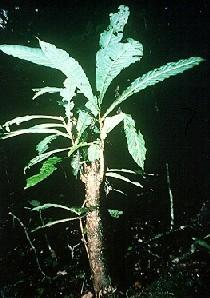
afrol News, 6 April - Bark from West Africa's yohimbe tree, mainly commercially grown in Cameroon and Nigeria, already has a large Northern market as an aphrodisiac. New findings in the US suggest that yohimbe tree bark may revolutionise the treatment of anxiety disorders, but West African growers are not ready for an increased production of the already over-exploited tree.
According to a much published study issued today by the UCLA Neuropsychiatric Institute at the University Of California, yohimbe tree bark may find an enormous new market. The institute maintains the West African bark "holds promise for revolutionising treatment of anxiety disorders."
Writing in the March/April edition of the journal 'Learning and Memory', a UCLA team reported that mice treated with yohimbe bark overcame their fear four times as fast as those treated with vehicle or propanolol, a medication commonly used to treat symptoms of anxiety disorders by blunting the physiological effects of adrenaline.
- We are at the threshold of a new era in our understanding and treatment of anxiety disorders, said Dr Mark Barad, at the UCLA Institute. Treatment with yohimbe bark, according to Mr Barad, revolutionised the way of thinking around overcoming fears and anxieties.
These disorders are an enormous health problem. Only in the US, anxiety disorders affect about 19 million people each year. They include obsessive-compulsive disorder, panic disorder, social phobia, post-traumatic stress disorder, generalised anxiety disorder and specific phobias, according to Mr Barad. These disorders are consuming about one-third of total US mental health costs of US$ 148 billion in 1990.
According to the Californian scientists, yohimbine - the active ingredient in yohimbe bark - treats anxiety disorders in a totally new manner as it in fact causes anxieties by enhancing the effects of the natural release of adrenaline. This anxiety helps learn to overcome the fear faster as part of the treatment.
Yohimbine is currently most commonly used to treat erection dysfunction. In Europe, America and Asia, there is a large market for the West African bark, said to produce a "sexual enhancement." In West Africa, yohimbe has been used as a medical plant for centuries and continues to widely used.
There is even a growing black market of yohimbe bark in the North, mostly trading in false products. The reason behind the growing trade in false yohimbe bark is found in West Africa, where producers cannot meet the international demand. In Cameroon and Nigeria, the main yohimbe tree growers, natural occurrence of "the miracle tree" is almost depleted.
The fast-growing yohimbe tree takes at least ten years to become harvestable and its only desired product is its bark. When producers cut the bark, the yohimbe tree dies. Over-exploitation of this resource has been reported for years. Therefore, the tree is becoming increasingly hard to find and growth on plantations has yet to start in a larger scale.
Cameroon has been the main supplier of yohimbe bark during the 1990s, with some production reported from Nigeria. As export markets have grown, the commercial exploitation of the tree is now also considered in Equatorial Guinea and Gabon, where yohimbe densities are equal to Cameroon.
According to a recent FAO study, the majority of bark is collected by local people who are paid at the roadside for the delivery of bark. The Cameroonian pharmaceutical plant Plantecam is the only producer of yohimbe tablets and the sole supplier of yohimbe to international markets. It has an annual production of an estimated 100 tonnes of yohimbe bark.
FAO has warned about "the destructive harvesting methods employed and the rapidly-growing market for aphrodisiac remedies," suggesting that the unique resource soon may become endangered. The UN agency, in cooperation with the Centre for Research in Agroforestry (ICRAF), has reportedly begun a research programme in Cameroon to investigate the potential of the tree for domestication.
Meanwhile, the growing market for yohimbe bark products is increasingly difficult to satisfy. A "revolutionised" treatment of anxiety disorders based on yohimbe bark would lead to an enormous increase in the demand for the West African tree, with a large potential for West and Central African growers.
afrol News - It is called "financial inclusion", and it is a key government policy in Rwanda. The goal is that, by 2020, 90 percent of the population is to have and actively use bank accounts. And in only four years, financial inclusion has doubled in Rwanda.
afrol News - The UN's humanitarian agencies now warn about a devastating famine in Sudan and especially in South Sudan, where the situation is said to be "imploding". Relief officials are appealing to donors to urgently fund life-saving activities in the two countries.
afrol News - Fear is spreading all over West Africa after the health ministry in Guinea confirmed the first Ebola outbreak in this part of Africa. According to official numbers, at least 86 are infected and 59 are dead as a result of this very contagious disease.
afrol News - It is already a crime being homosexual in Ethiopia, but parliament is now making sure the anti-gay laws will be applied in practical life. No pardoning of gays will be allowed in future, but activist fear this only is a signal of further repression being prepared.
afrol News / Africa Renewal - Ethiopia's ambitious plan to build a US$ 4.2 billion dam in the Benishangul-Gumuz region, 40 km from its border with Sudan, is expected to provide 6,000 megawatts of electricity, enough for its population plus some excess it can sell to neighbouring countries.










 front page
| news
| countries
| archive
| currencies
| news alerts login
| about afrol News
| contact
| advertise
| español
front page
| news
| countries
| archive
| currencies
| news alerts login
| about afrol News
| contact
| advertise
| español