afrol News, 25 January - Ethiopian and US anthropologists have found fossils of hominids, the ancestors of modern man, in northern Ethiopia, which are said to be 4.5 million years old. The fossils may help scientists piece together the mysterious transformation of primitive chimpanzee-like hominids into more human forms.
The fossils were retrieved from the Gona Study Area in northern Ethiopia, only one of two sites to yield fossil remains of Ardipithecus ramidus. The discovery was made by a team of scientists from Ethiopia, the Indiana University Bloomington (USA) and seven other institutions, working at the Ethiopian site.
- A few windows are now opening in Africa to glance into the fossil evidence on the earliest hominids, commented paleoanthropologist Sileshi Semaw, who led the research at Gona.
Mr Semaw, a 44-year-old Ethiopian, is the director of the Gona Paleoanthropological Research Project in Afar, Ethiopia, and earlier has documented the oldest known stone tools in the world, aged 2.6 million years. He further is a research scientist at the US-based Stone Age Institute, which is associated to the Indiana University.
Mr Semaw and his colleagues also reported new evidence that suggests the human ancestors lived in close quarters with a menagerie of antelope, rhinos, monkeys, giraffes and hippos in a northern Ethiopia that was far wetter than it is today. The environmental reconstructions suggested a mosaic of habitats, from woodlands to grasslands.
Research is continuing at Gona to determine which habitats the hominid preferred. "We now have more than 30 fossils from at least nine individuals dated between 4.3 and 4.5 million years old," said Mr Semaw.
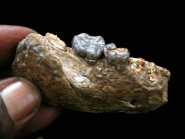
The new discovery at Gona last week was published in the magazine 'Nature'. Here, Mr Semaw and his co-authors describe parts of one upper and two lower jaw bones - with teeth still intact - several loose teeth, part of a toe bone and intact finger bones. The scientists believe the fossils belong to nine individuals of the species Ardipithecus ramidus. They used argon isotope dating of volcanic materials found in the vicinity of the fossils to estimate their age.
In the 11 years since the naming of Ardipithecus ramidus by anthropologist Tim White, only a handful of fossils from the species have been found, and only at two sites - the Middle Awash and Gona, both in Ethiopia. Other fossils of slightly older age are known in Kenya and Chad. Anthropologists working in Ethiopia believe Ardipithecus is the first of the hominid genus - that is, human ancestors who lived just after a split with the lineage that produced modern chimpanzees.
Despite the millions of years that separate us, modern humans have a few things in common with Ardipithecus ramidus. Fossils from Gona and elsewhere suggest that the ancient hominid walked on two feet and had diamond-shaped upper canines, not the "v"-shaped ones chimpanzees use to chomp. Outwardly, however, Ardipithecus ramidus would appear a lot more chimpanzee-like than human.
Gona has turned out to be a productive dig site. In a 'Nature' cover story in 1997, Mr Semaw and colleagues reported the oldest known stone tools used by ancestral humans. The Gona artefacts showed that as early as 2.5 million years ago, hominids were remarkably skilled toolmakers. Last month, Mr Semaw co-authored a paper in 'Geological Society of America Bulletin' summarising Gona's geological properties and the site's cornucopia of hominid fossils spanning several million years.
The authors thank Ethiopia's Authority for Research and Conservation of Cultural Heritage, the National Museum of Ethiopia, and the Ethiopian Ministry of Youth, Sports and Culture for providing permits for the ongoing work at the Gona dig site, and the Afar people "for making the fieldwork a success," according to a press release by the Indiana University.
afrol News - It is called "financial inclusion", and it is a key government policy in Rwanda. The goal is that, by 2020, 90 percent of the population is to have and actively use bank accounts. And in only four years, financial inclusion has doubled in Rwanda.
afrol News - The UN's humanitarian agencies now warn about a devastating famine in Sudan and especially in South Sudan, where the situation is said to be "imploding". Relief officials are appealing to donors to urgently fund life-saving activities in the two countries.
afrol News - Fear is spreading all over West Africa after the health ministry in Guinea confirmed the first Ebola outbreak in this part of Africa. According to official numbers, at least 86 are infected and 59 are dead as a result of this very contagious disease.
afrol News - It is already a crime being homosexual in Ethiopia, but parliament is now making sure the anti-gay laws will be applied in practical life. No pardoning of gays will be allowed in future, but activist fear this only is a signal of further repression being prepared.
afrol News / Africa Renewal - Ethiopia's ambitious plan to build a US$ 4.2 billion dam in the Benishangul-Gumuz region, 40 km from its border with Sudan, is expected to provide 6,000 megawatts of electricity, enough for its population plus some excess it can sell to neighbouring countries.










 front page
| news
| countries
| archive
| currencies
| news alerts login
| about afrol News
| contact
| advertise
| español
front page
| news
| countries
| archive
| currencies
| news alerts login
| about afrol News
| contact
| advertise
| español