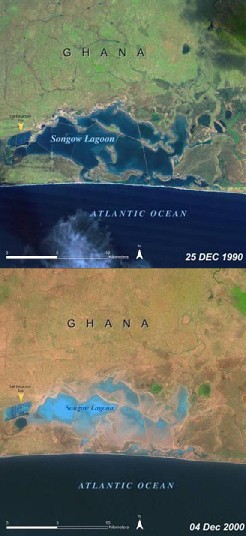
afrol News, 1 November - Two satellite images of Ghana's coastal brackish Songor Lagoon from 1990 and 2000 show dramatic environmental changes. Salt extraction and irrigation has harmed biodiversity and caused the lake to shrink dramatically, a new survey documents.
The UN's environmental agency UNEP yesterday presented a new atlas of African lakes in Nairobi, based on satellite images taken over a decade. Many African lakes and wetlands show dramatic changes during the last ten years, mostly due to the impact of irrigation and other human activities.
Several lakes are in the process of drying up, loosing their biodiversity or being dramatically transformed. One of the most striking examples featured in the atlas is Ghana's coastal Lake Songor Lagoon, which was photographed from space in December 1990 and in December 2000.
The two images show little similarity. The extent of the lagoon has totally changed. From one continuous lake in 1990, the lagoon has now grown into several minor lakes. More dramatically, the colour of the lake has changed, illustrating that its depth and chemical composition has dramatically changed. Biodiversity thus is expected to have totally changed.
Originally, Lake Songor is known to host a very special environment, rich in species. Being a rare large, tropical, brackish coastal lagoon, the lake is home to fish and globally threatened turtles, like the Olive Ridley and green turtle, as well as important bird populations.
In December 1990, it shows as a solid blue mass of water some 74 square kilometers in size. But by December 2000, the water body is a pale shadow of its former self. Also the surrounding lowlands show signs of becoming dryer and less habitable.
Intensive salt production and evaporation at the western end, seen as dark blue and turquoise squares, is thought to be largely to blame, according to a UNEP analysis. "Agricultural extraction of water from feeder rivers like the Sege and Zano may be also taking its toll," the UN agency adds.
The study's authors emphasise that the Sengor Lagoon "emerges as one of the most dramatic visual changes in the Atlas." It only compares to the dramatic decrease and regulation of Lake Djoudj, located 60 kilometres from St Louis in northern Senegal. At Lake Djoudj, however, this dramatic change was caused by the 1986 construction of a dam, influencing the stream of River Senegal.
The UNEP atlas further documents extraordinary changes in the Zambezi river system as a result of the building of the Cabora Basa dam site, beside more familiar images of the near 90 percent shrinkage of Lake Chad. Satellite measurements, detailing the falling water levels of Lake Victoria are also mapped. Africa's largest freshwater lake is now about a meter lower than it was in the early 1990s.
Klaus Toepfer, UNEP's Executive Director, yesterday presented the atlas in Nairobi. He told delegates at a conference that "economically, lakes are of huge importance. In the US, for example, the value of freshwaters for their recreational value alone is estimated at US$ 37 billion a year." The "sustainable management of Africa's lakes" must be an important part of fighting poverty, Mr Toepfer emphasised.
afrol News - It is called "financial inclusion", and it is a key government policy in Rwanda. The goal is that, by 2020, 90 percent of the population is to have and actively use bank accounts. And in only four years, financial inclusion has doubled in Rwanda.
afrol News - The UN's humanitarian agencies now warn about a devastating famine in Sudan and especially in South Sudan, where the situation is said to be "imploding". Relief officials are appealing to donors to urgently fund life-saving activities in the two countries.
afrol News - Fear is spreading all over West Africa after the health ministry in Guinea confirmed the first Ebola outbreak in this part of Africa. According to official numbers, at least 86 are infected and 59 are dead as a result of this very contagious disease.
afrol News - It is already a crime being homosexual in Ethiopia, but parliament is now making sure the anti-gay laws will be applied in practical life. No pardoning of gays will be allowed in future, but activist fear this only is a signal of further repression being prepared.
afrol News / Africa Renewal - Ethiopia's ambitious plan to build a US$ 4.2 billion dam in the Benishangul-Gumuz region, 40 km from its border with Sudan, is expected to provide 6,000 megawatts of electricity, enough for its population plus some excess it can sell to neighbouring countries.










 front page
| news
| countries
| archive
| currencies
| news alerts login
| about afrol News
| contact
| advertise
| español
front page
| news
| countries
| archive
| currencies
| news alerts login
| about afrol News
| contact
| advertise
| español