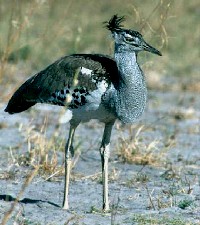
afrol News, 23 November - The Kori Bustard, which used to be common in most of sub-Saharan Africa, is being threatened in one of its last strongholds, Botswana, an investigation reveals. In two Batswana national parks, hunting for local consumption and exports was found to be common.
The Kori Bustard is the world's largest bustard and occurs across sub-Saharan Africa. Although still common in some protected areas, it is currently experiencing rapid population declines across much of its range. Botswana remains a stronghold for the species, but it is threatened by habitat loss due to overgrazing and poaching.
The environmentalist group BirdLife Botswana has now undertaken an investigation of Kori Bustard, Ardeotis kori, poaching and found the practice to be widespread in the country. The bustard is hunted both for local consumption and for export to South Africa and beyond, the study found.
The investigation had focused on 16 settlements bordering the Kgalagadi Transfrontier Park (KTP) and Khutse Game Reserve (KGR) - both strongholds for Kori Bustard in Botswana, Birdlife informed today.
"We found that many Kori Bustards are poached for local consumption, mainly by men over 30," says BirdLife Botswana's Kabelo Senyatso. "Snares are mostly used to kill birds in KGR, whilst guns are favoured in KTP. In some areas only tribal elders are allowed to eat bustard meat."
Consumption of the bustard was found to have long traditions in the areas close to the national parks. "Sometimes a traditional doctor is brought in to 'treat' it before it is eaten, because of a belief that bustard meat can otherwise cause mental illness," Mr Senyatso found.
But the illegal hunting is not only to feed villages along the national parks' borders. "We also found evidence of illegal cross-border trafficking in live bustards. Up to ten at a time are smuggled into South Africa where they are sold as a delicacy to wealthy individuals or exported outside Africa," Mr Senyatso says.
However, on a positive note, the study found no evidence of trade in Kori Bustard body parts within Botswana, unlike other range states. They therefore concluded that there was no illegal market for the threatened bird inside Botswana except in the villages that were poaching.
The global population size of the bustard has not yet been quantified, but ten years ago, it was still believed to be large as the species was described as "frequent" in at least parts of its range. There is however evidence of a population decline which could put the species on the red list of threatened animals within some years.
afrol News - It is called "financial inclusion", and it is a key government policy in Rwanda. The goal is that, by 2020, 90 percent of the population is to have and actively use bank accounts. And in only four years, financial inclusion has doubled in Rwanda.
afrol News - The UN's humanitarian agencies now warn about a devastating famine in Sudan and especially in South Sudan, where the situation is said to be "imploding". Relief officials are appealing to donors to urgently fund life-saving activities in the two countries.
afrol News - Fear is spreading all over West Africa after the health ministry in Guinea confirmed the first Ebola outbreak in this part of Africa. According to official numbers, at least 86 are infected and 59 are dead as a result of this very contagious disease.
afrol News - It is already a crime being homosexual in Ethiopia, but parliament is now making sure the anti-gay laws will be applied in practical life. No pardoning of gays will be allowed in future, but activist fear this only is a signal of further repression being prepared.
afrol News / Africa Renewal - Ethiopia's ambitious plan to build a US$ 4.2 billion dam in the Benishangul-Gumuz region, 40 km from its border with Sudan, is expected to provide 6,000 megawatts of electricity, enough for its population plus some excess it can sell to neighbouring countries.










 front page
| news
| countries
| archive
| currencies
| news alerts login
| about afrol News
| contact
| advertise
| español
front page
| news
| countries
| archive
| currencies
| news alerts login
| about afrol News
| contact
| advertise
| español