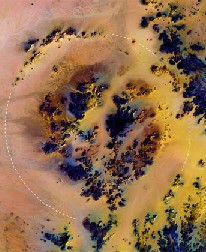
Landsat image of the Kebira Crater in south-western Egypt. The outer rim of the crater is 31 km in diameter. (Courtesy of Boston University Centre for Remote Sensing.)
afrol News, 8 March - Two Egyptian researchers have discovered the remnants of the largest crater of the Sahara desert, which may have been formed by a meteorite impact tens of millions of years ago. The double-ringed crater of a 31 kilometre diameter is located in south-eastern Egypt, close to the Libyan border, and was found on satellite images.
The discovery was made by researchers at the Boston University in the US earlier this month. Dr Farouk El-Baz spotted the enormous crater while studying satellite images of the Western Desert of Egypt with his colleague, Dr Eman Ghoneim, at the university's Centre for Remote Sensing.
The double-ringed crater - which has an outer rim surrounding an inner ring - is approximately 31 kilometres in diameter. Prior to the latest finding, the Sahara's biggest known crater, in Chad, measured just over 12 kilometres. According to Dr El-Baz, the Centre's director, the crater's vast area suggests the location may have been hit by a meteorite that was more than one kilometre is diameter.
Mr El-Baz named his find "Kebira", which means "large" in Arabic and also relates to the crater's physical location on the northern tip of the uninhabited Gilf Kebir desert region in south-western Egypt. The reason why a crater this big had never been found before is something the scientists are speculating.
"Kebira may have escaped recognition because it is so large - equivalent to the total expanse of the Cairo urban region from its airport in the northeast to the Pyramids of Giza in the southwest," said Dr El-Baz, who was born in the Egyptian town Zagazig, but has been a US citizen for over three decades.
"Also, the search for craters typically concentrates on small features, especially those that can be identified on the ground. The advantage of a view from space is that it allows us to see regional patterns and the big picture," the 68-year-old scientist explains.
The researchers also found evidence that Kebira suffered significant water and wind erosion, which may have helped keep its features unrecognisable to others. "The courses of two ancient rivers run through it from the east and west," added Ms Ghoneim, who also is of Egyptian origin and now teaches at both the Egyptian Tanta University and in Boston.
According to the two researchers, the terrain in which the crater resides is composed of 100 million year-old sandstone – the same material that lies under much of the eastern Sahara. The scientists hope that field investigations and samples of the host rock will help in determining the exact age of the crater and its surroundings. The two have yet to make observations at the rather inaccessible site of the crater.
Kebira's shape is reminiscent of the many double-ringed craters on the Moon, which Dr El-Baz remembers from his years of work with the US Apollo space programme. Because of this, he believes the crater may figure prominently in future research in comparative planetology. And, since its shape points to an origin of extraterrestrial impact, it would likely prove to be the event responsible for the extensive field of "Desert Glass" - yellow-green silica glass fragments found on the desert surface between the giant dunes of the Great Sand Sea in south-western Egypt.
Dr El-Baz is research professor and Director of the Centre for Remote Sensing at Boston University. Working as a geologist over the past 30 years, he has conducted studies in all the major deserts of the world. Dr Ghoneim joined the professor's team only three years ago and is now a research associate at the Centre. Both have dedicated much of their research to the geology and geomorphology of Egypt.
afrol News - It is called "financial inclusion", and it is a key government policy in Rwanda. The goal is that, by 2020, 90 percent of the population is to have and actively use bank accounts. And in only four years, financial inclusion has doubled in Rwanda.
afrol News - The UN's humanitarian agencies now warn about a devastating famine in Sudan and especially in South Sudan, where the situation is said to be "imploding". Relief officials are appealing to donors to urgently fund life-saving activities in the two countries.
afrol News - Fear is spreading all over West Africa after the health ministry in Guinea confirmed the first Ebola outbreak in this part of Africa. According to official numbers, at least 86 are infected and 59 are dead as a result of this very contagious disease.
afrol News - It is already a crime being homosexual in Ethiopia, but parliament is now making sure the anti-gay laws will be applied in practical life. No pardoning of gays will be allowed in future, but activist fear this only is a signal of further repression being prepared.
afrol News / Africa Renewal - Ethiopia's ambitious plan to build a US$ 4.2 billion dam in the Benishangul-Gumuz region, 40 km from its border with Sudan, is expected to provide 6,000 megawatts of electricity, enough for its population plus some excess it can sell to neighbouring countries.










 front page
| news
| countries
| archive
| currencies
| news alerts login
| about afrol News
| contact
| advertise
| español
front page
| news
| countries
| archive
| currencies
| news alerts login
| about afrol News
| contact
| advertise
| español