Get news alerts Login Central AfricaEast AfricaHorn of AfricaIndian OceanNorth AfricaSouthern AfricaWest AfricaAfrica / World Agriculture - NutritionCulture - ArtsEconomy - DevelopmentEnvironment - NatureGay - LesbianGender - WomenHealthHuman rightsLabourMediaPoliticsScience - EducationSocietyTechnologyTravel - Leisure From Behind By Country By Topic Chronological Press Releases Partner Media Contact Us


See also:
» 02.07.2010 - Mauritania pays imams to stop fundamentalism
» 23.02.2010 - Mauritania recalls ambassador over release of rebels
» 15.02.2010 - Police chief sentenced to 7 years
» 13.01.2010 - Italy to enhance security cooperation
» 10.11.2009 - Mauritanian grassroots groups receive US funding
» 04.11.2009 - Slavery still persists in Mauritania
» 05.10.2009 - Mauritania gets $12 million to boost food production and lower imports
» 14.11.2007 - Mauritanians await repatriation


Mauritania
Society | Culture - Arts | Science - Education | Health

Mauritania's Prussian past revealed: A desert pharmacy

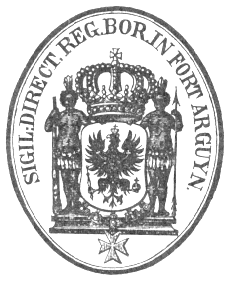
Seal of the Prussian Governor of Arguin, 1711

Seal of the Prussian Governor of Arguin, 1711

© afrol News
afrol News, 12 September
- A lost desert island in Mauritania's far north was the object of desire of a score of European kingdoms wanting to secure trade routes on the continent, saw the unexpected discovery of medical plants and outlived a list of tyrannical governors. These are the ingredients of a new analysis of the Prussian island of Arguin and an aspect poorly studied in African history - the continent as source of medicines rather than diseases.

"The last commercial Brandenburgian [a German state centred on Berlin that turned into Prussia] enclave of certain importance to the history of medicine is found on the desert island of Arguin, arid and rocky, just off the Mauritanian coast. The islet, with a surface of barely around 22 square kilometres, today only is found in very few atlases."

This is how the analysis of Professor Marcus Plehn of the University of Freiburg commences, published in the last edition of the journal 'L'Ouest Saharaien'. His work focuses on a small island that shifted hands between the Portuguese, Dutch, French, British and Prussia between the 15th and 18th century. This small territory interestingly had very little importance regarding raw materials, with the rare exception of medical products. Today, the deserted island however is totally without importance.

Professor Plehn has followed the path of these medicines from the small tracks they have left on historic documents. There he also found evidence of some other economic activities on the island, including the growing of gum arabic, grey amber and the famous bezoars, which originally is an Asian product, lately has been famed by the Harry Potter movies but has been known in Europe as an antidote since the 16th century.

But according to Mr Plehn, these products were not sees as fit for exports to Europe as they existed in plenty, however being very useful for the activities of the local surgeon. "The myrrh and the 'pulvis adstringens' served in the same way. The 'Spiritus carminativus' and the 'pulvis liquiritiae' on the contrary were effective against the very widespread intestinal infections. The 'Terra sigillata', a medical earth, is still used today to treat heartburn and diarrhoeas.

The article in the 'Ouest Saharien' further includes data on the population of these Mauritanian latitudes during the 17th century, cultural anecdotes and indigenous medical practices.

"These were black fishermen of African and Berber origin. When suffering from bruises or even open wounds, they cure themselves through cautery at open fire. When getting sick, which happens frequently, they have to dance until exhaustion. When they cannot dance, a very clo
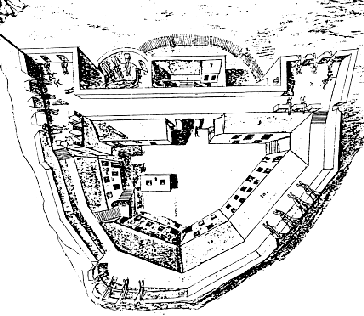
Prussian castle on Arguin Island, 1709

Draft of the Prussian castle on Arguin Island in 1709

© afrol News
se friend has to do while the sick is still alive. After dying, the thumbs are tied to the big toes and the diseased is buried on the side in a grave dug in the sand."

The ritual therapeutic dances, according to Mr Plehn, probably had arrived the Island of Arguin through cultural influences from modern day Senegal and Morocco and served to scare away the jinnis; the bad spirits held responsible for a large number of diseases that appeared suddenly, according to traditional popular Muslim medicine. The rhythmic movements and the music had to disturb and drive away the jinni causing the disease. Also the burial ceremonies corresponded to Muslim rites.

Regrettably, for several diseases neither the European nor African medicines proved effective. This included the insanity suffered by many of the island's Prussian governors, often caused by isolation, depressions, abuse of alcohol, the heat and the negligence of their governments. Several were known to gradually lose the sense of reality, some slipping into extreme greed, others committing intolerable abuses against the native population and his own staff.

"In April 1714, Governor Jan de Both managed to abort a rebellion in his garrison in a bloody manner. He tortured and let the dead bodies be hung up like 'lamb in the butcher's shop'. Other insurgents were taken away to desert islands. De Both transformed Arguin into a pirates' nest, skilfully using the Arabs against his own garrison and refused to obey to the King of Prussia, proclaiming: 'Probably he doesn't even know, this cretin, if I am loyal to him or not'."

Finally, in 1721, Prussia lost interest in its African possessions and the islet fell into the hands of the French, then the Dutch and finally the French again, who gave up the desert castle in 1728. Under local control until Mauritania's colonisation in the 20th century, Arguin Island lost its importance and is today deserted.

According to Mr Plehn, however, the island and its Prussian colonisation (1685-1721) had an impact on the history of medicine. The German professor concludes his article with a list of more than seventy medicaments used throughout human history that can be found on the small desert island.


- Create an e-mail alert for Mauritania news
- Create an e-mail alert for Society news
- Create an e-mail alert for Culture - Arts news
- Create an e-mail alert for Science - Education news
- Create an e-mail alert for Health news

    E-mail this to a friend     Printable version

Related pages and feature
Current afrol News Top Stories
Mauritania
Society
Culture - Arts
Science - Education
Health
History
History
Humanistic sciences
Science
There are currently no news articles published related to this section.


top of page about afrol News | news | countries | archive | services | feed back | español 

© afrol News. Reproducing or buying afrol News' articles.

   You can contact us at mail@afrol.com