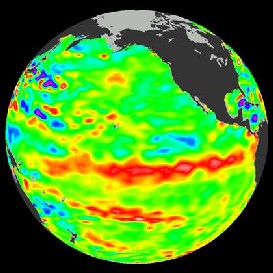
El Niño event returning in the Pacific: The red zones in the Pacific are a sign of El Niño's return. They indicate surface water warmer than the September average. Blue zones are cooler than average.
afrol News, 6 October - Satellite photos of the Pacific reveal the return of a world-wide weather phenomenon, the so-called "El Niño". For Southern Africa, the phenomenon always has spelled severe drought and famine. Scientists expect the Niño to strike already in 2007. The 1991-92 El Niño brought the worst drought in southern Africa during the 20th century.
The US space agency NASA today reported that it has detected a "weak El Niño" returning to the Pacific Ocean, the first since the dramatic climatic season of 1997-98. NASA's Aqua and Jason satellites have measured increasing ocean surface temperatures in belts across the middle and eastern Pacific, which are signs of a major transformation of global weather systems.
Every few years, such unusually warm currents flow off the western coast of South America. Its appearance after Christmas lead sailors in Peru to christen it El Niño, the Christ-child in Spanish. Like a child, it is sometimes unpredictable, and sometimes creates havoc. In El Niño's case, it brings natural disasters such as storms, floods and droughts and famine in far-flung parts of the world.
El Niño events occur irregularly, about every 2-7 years and they last from 12 to 18 months, according to the World Health Organisations (WHO), which is very conscious about its many health risks around the world.
Southern Africa is known to be one of the regions world-wide to be most strongly impacted by an El Niño period, together with parts of South America and South-East Asia. In Southern Africa, it is followed by severe droughts almost every time it occurs. "The 1991-92 El Niño brought the worst drought in southern Africa [the 20th] century, which affected nearly 100 million people," according to WHO.
The 1997-8 El Niño - the last until now - also caused drought in Southern Africa. Its effects were however strongest in Australia - which experienced its worst drought in decades - and in South-East Asia. Throughout the Americas, devastating floods caused great material damage.
While an El Niño event always causes drought in Southern Africa – the correlation is so big that food security agencies use it as a crisis prediction - effects on the rest of the continent depend on the strength of the whether phenomenon. Some strong events can also affect the surface temperature of the Atlantic and the Indian Oceans, which in turn leads to different winds and rainfall patterns in Eastern and Western Africa. Often, El Niño causes excessive rainfall in East Africa. Normally though, especially when the Pacific Niño is weak, these regions are not much affected.
According to NASA oceanographer and climatologist Bill Patzert, the warming of the Pacific observed so far is too little to have "major influence" on current weather patterns, although below normal rainfall has already been registered in Indonesia, Malaysia and the Philippines. "But, if the ocean waters continue to warm and spread eastward, this event would likely strengthen," he added. Climatologists indicate that the event indeed is strengthening.
While the main risk of the event is widespread drought, WHO also warns about other health risks associated with El Niño. Both malaria and rift valley fewer seem to have outbreak circles connected to extraordinary El Niño rains in Africa, the UN agency warns.
afrol News - It is called "financial inclusion", and it is a key government policy in Rwanda. The goal is that, by 2020, 90 percent of the population is to have and actively use bank accounts. And in only four years, financial inclusion has doubled in Rwanda.
afrol News - The UN's humanitarian agencies now warn about a devastating famine in Sudan and especially in South Sudan, where the situation is said to be "imploding". Relief officials are appealing to donors to urgently fund life-saving activities in the two countries.
afrol News - Fear is spreading all over West Africa after the health ministry in Guinea confirmed the first Ebola outbreak in this part of Africa. According to official numbers, at least 86 are infected and 59 are dead as a result of this very contagious disease.
afrol News - It is already a crime being homosexual in Ethiopia, but parliament is now making sure the anti-gay laws will be applied in practical life. No pardoning of gays will be allowed in future, but activist fear this only is a signal of further repression being prepared.
afrol News / Africa Renewal - Ethiopia's ambitious plan to build a US$ 4.2 billion dam in the Benishangul-Gumuz region, 40 km from its border with Sudan, is expected to provide 6,000 megawatts of electricity, enough for its population plus some excess it can sell to neighbouring countries.










 front page
| news
| countries
| archive
| currencies
| news alerts login
| about afrol News
| contact
| advertise
| español
front page
| news
| countries
| archive
| currencies
| news alerts login
| about afrol News
| contact
| advertise
| español