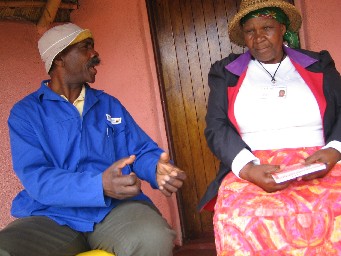
afrol News / Gender Links, 4 April - One imagines people who challenge the State in the High Court to be affluent, urban and well known. Yet finding Tsepo Molefe, the man who made history by challenging Lesotho's legislated 30 percent quota for women in local government takes a two-hour drive out of the capital city Maseru, in among the majestic peaks of Leribe and down country lanes that disappear into potholes too large to navigate before you get to his home in Litjotjela.
It says something about grassroots democracy in Lesotho that the person who helps you find this rural farmer, also a renowned medicine man, is Mateboho Tsepane. She is the very woman who won the council seat for the area after the High Court upheld the law reserving one third of the constituencies in Lesotho for women only in the country's first local government elections in 2005.
Mr Molefe was one of 948 people interviewed for the recent research study "At the coalface: Gender and local government in Southern Africa," published by 'Gender Links', a Southern African non-governmental organisation specialising in gender, governance and the media.
Despite the heated discussions around quotas, case studies in three Southern African countries - Lesotho, Namibia and South Africa - showed that rapid and substantial changes to ensure gender equality only result from a combination of political party commitment, electoral systems and the often-debated quotas.
The Lesotho case is significant because it is one of the few in which a country with a constituency-based electoral system has adopted a legislated quota for increasing women's participation in politics. This involved amending the electoral act to reserve one third of all constituencies for women, to be rotated each election for three elections to give women a head start.
Although precedents exist in local elections in India and Uganda, the approach is controversial because it is open to the criticism - that was also raised in Lesotho - that the rights of men in these constituencies are infringed.
Mr Molefe might not be a man of much formal education, but he is an informed citizen. Speaking in Sesotho, he said that he felt unhappy about the judgement upholding the amendment to the electoral law "because I feel that the court did not uphold my rights. I agreed with the principle [of encouraging women's participation in politics] but not with the approach. It is unfair to deny men the right to stand for elections in any constituency. Women and men should have equal opportunities to stand against each other and they should compete."
Are there disadvantages that women face that mean that the playing field is not level? "Maybe there are disadvantages, but there are other ways of addressing these without infringing on the rights of other candidates," he reasons.
Matau Futho-Letsatsi, Director in the Ministry of Gender pointed to the fact that another 28 percent women won in the two-thirds constituencies open to men and women, bringing the total proportion of women in local government in Lesotho to 58 percent, as a signal that women in Lesotho are ready and willing to stand for political office. Mr Molefe, on the other hand, sees the success of women in the open seats as evidence that women should not get any special favours.
He also pointed to the inconsistency that while the government championed the quota for women at local level, this is not so at the national level. "If they are serious, why do they discriminate between national and local elections?" he asked.
Mr Molefe raises a good point. Countries in Southern Africa that have been willing to legislate quotas for women's representation in politics have been more willing to do so for local than national elections. Lesotho, Namibia and South Africa, the three countries with the highest representation of women in local government, all have legislated quotas of one kind or the other at local but not at national level.
In the national elections that took place in Lesotho in February, the issue of a quota for women did not even arise. Women won 23 percent of the seats; a far cry from the fifty percent now being advocated by SADC Heads of State.
While not directly criticising Ms Tsepane, who is now deputy chair of the Litjotjela Community Council, Mr Molefe expressed disappointment at the performance of the council, in which there are six women and five men. Gender, he says, is a subsidiary issue: "the main problem is favouritism. Matters are not settled according to the law but on the basis of one's relationship to the party."
Members of the community interviewed during the focus groups for this research see things differently. They say that Mr Molefe is a substantial land holder in the area, and wanted to get onto the council so as to influence land distribution policies.
One of the major changes that have come about since the local elections is that the councils, not the chiefs, now have control over who gets what land. In the interview, Mr Molefe expressed "great disappointment that the powers of the local chiefs to reallocate land have been curtailed. This is against our Sotho tradition. It could lead to instability; to bloodshed."
Mr Tsepane believes that Mr Molefe's views towards the council reflect a lingering sour grapes attitude. Pointing to her election by other council members as deputy chair, she says she believes that with or without the quota, "I would have won, because I am hard working and I understand matters of administration. Even without resources we as a council have managed to serve our community."
Ms Tsepane adds that the fact that she was elected to a leadership position in the council as a sign of changing attitudes. "In the old days women and men believed that only men, as heads of household, could be leaders."
According to one male focus group participant, "at first men did not understand. But as they see women performing well in positions of power they will realise that it is okay for women to lead." A woman participant expressed support for the quota "because it is time for women to have the opportunity to take part. We like to have women representatives because they are accessible, unlike men. We interact regularly with them, on water, electricity, business opportunities and many other issues."
All indications are that Litjotjela has forgotten about hitting the headlines in the High Court drama that came close to having the entire elections postponed. "The hostility [to quotas] has died a natural death," reflects Rhetabile Pholo, public relations coordinator of Lesotho's Independent Electoral Commission (IEC). "We don't hear about it any more. It was like a cry in the wilderness that dies away."
From global to regional to country level, the discussion shows that no matter what the electoral system or the local politics, the only way to "fast track" women's entry into politics is through quotas. As witnessed even in the constituency that challenged this system in Lesotho quotas do not lead to the often-predicted backlash
While quotas are not a panacea and could be viewed only as a temporary "jump start" mechanism, based on the evidence and views from the case study countries there is no longer any valid reason for any country in Southern African Development Community (SADC) not to achieve the minimum 30 and desired 50 percent target for women's representation.
By Colleen Lowe Morna Ms Morna is executive director of Gender Links.
afrol News - It is called "financial inclusion", and it is a key government policy in Rwanda. The goal is that, by 2020, 90 percent of the population is to have and actively use bank accounts. And in only four years, financial inclusion has doubled in Rwanda.
afrol News - The UN's humanitarian agencies now warn about a devastating famine in Sudan and especially in South Sudan, where the situation is said to be "imploding". Relief officials are appealing to donors to urgently fund life-saving activities in the two countries.
afrol News - Fear is spreading all over West Africa after the health ministry in Guinea confirmed the first Ebola outbreak in this part of Africa. According to official numbers, at least 86 are infected and 59 are dead as a result of this very contagious disease.
afrol News - It is already a crime being homosexual in Ethiopia, but parliament is now making sure the anti-gay laws will be applied in practical life. No pardoning of gays will be allowed in future, but activist fear this only is a signal of further repression being prepared.
afrol News / Africa Renewal - Ethiopia's ambitious plan to build a US$ 4.2 billion dam in the Benishangul-Gumuz region, 40 km from its border with Sudan, is expected to provide 6,000 megawatts of electricity, enough for its population plus some excess it can sell to neighbouring countries.










 front page
| news
| countries
| archive
| currencies
| news alerts login
| about afrol News
| contact
| advertise
| español
front page
| news
| countries
| archive
| currencies
| news alerts login
| about afrol News
| contact
| advertise
| español