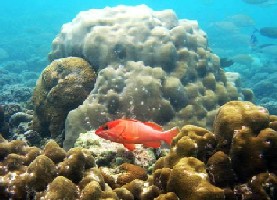
afrol News, 25 October - A previously unknown coral reef on the uninhabited Seychellois island of Curieuse has been discovered. The reef is already protected as it falls within the Curieuse Marine National Park.
Researchers from the British university of Essex this week report that they have discovered a previously unknown coral reef in the Seychelles. Dave Smith and Dave Suggett visited Curieuse Island as part of an ongoing study, with active participation from local Seychellois collaborators.
The island, which is managed by the Seychelles Centre of Marine Research and Technology-Marine Protected Areas (SCMRT-MPA), is home to over 200 giant tortoises, the unique coco de mer palms and rare Seychellois parrots. But until now, it was thought no coral reefs were present.
"Diving revealed an extensive coral reef to the south of the island, at a depth which would not be visible to the occasional snorkeler," according to Dr Smith.
As well as discovering the reef, Dr Smith and Dr Suggett found signs of destruction, and subsequent recovery, caused by the 2004 tsunami.
The high diversity and productivity of the reef was said to support "a large number of mega-fauna including one tiger shark which was so curious during one of the research dives it got a little too close for comfort."
Speaking of their other findings, Dr Smith said: "From the field data we were able to design experiments to test species ability to tolerate climate change events in a makeshift laboratory. These studies demonstrated that there are clear physiological differences between the tolerant and sensitive species, and provided evidence for different mechanisms."
The team was also joined by a writer from National Geographic Japan and their findings have resulted in a plan by authorities to establish a centre of marine field-based research on Curieuse Island.
Curieuse Island is located just off the north coast of Praslin Island, and is open for day visits for tourists. The island, which now is a natural park, was exploited by French sailors in the 18th century for its giant tortoise population and suffered great damage as it was set on fire in 1771. In 1833, Curieuse became a leper colony, which lasted until 1965. Since that, the island has been uninhabited.
afrol News - It is called "financial inclusion", and it is a key government policy in Rwanda. The goal is that, by 2020, 90 percent of the population is to have and actively use bank accounts. And in only four years, financial inclusion has doubled in Rwanda.
afrol News - The UN's humanitarian agencies now warn about a devastating famine in Sudan and especially in South Sudan, where the situation is said to be "imploding". Relief officials are appealing to donors to urgently fund life-saving activities in the two countries.
afrol News - Fear is spreading all over West Africa after the health ministry in Guinea confirmed the first Ebola outbreak in this part of Africa. According to official numbers, at least 86 are infected and 59 are dead as a result of this very contagious disease.
afrol News - It is already a crime being homosexual in Ethiopia, but parliament is now making sure the anti-gay laws will be applied in practical life. No pardoning of gays will be allowed in future, but activist fear this only is a signal of further repression being prepared.
afrol News / Africa Renewal - Ethiopia's ambitious plan to build a US$ 4.2 billion dam in the Benishangul-Gumuz region, 40 km from its border with Sudan, is expected to provide 6,000 megawatts of electricity, enough for its population plus some excess it can sell to neighbouring countries.










 front page
| news
| countries
| archive
| currencies
| news alerts login
| about afrol News
| contact
| advertise
| español
front page
| news
| countries
| archive
| currencies
| news alerts login
| about afrol News
| contact
| advertise
| español